
Key Takeaways
- Europe is entering a narrow but consequential window in which strategic autonomy is no longer optional but structurally necessary.
- The transatlantic relationship can no longer be treated as the fixed foundation of European security.
- Energy security has become inseparable from geopolitical strategy.
- Russia remains the primary military threat to Europe, but the Ukraine war has also accelerated long-delayed defense integration.
- China presents a different but equally strategic challenge: Europe must de-risk without fully decoupling.
- European competitiveness is now a security prerequisite.
- The EU’s institutional machinery remains too slow for the geopolitical environment it now faces.
- Public opinion provides a rare mandate for action. Europeans increasingly support common defense, unity among member states, and joint funding for strategic projects.
- The core choice facing Europe is stark: either consolidate this moment into a more autonomous, resilient, and geopolitical Union, or risk gradual strategic decline in a world increasingly shaped by coercion, fragmentation, and great-power competition.
Introduction
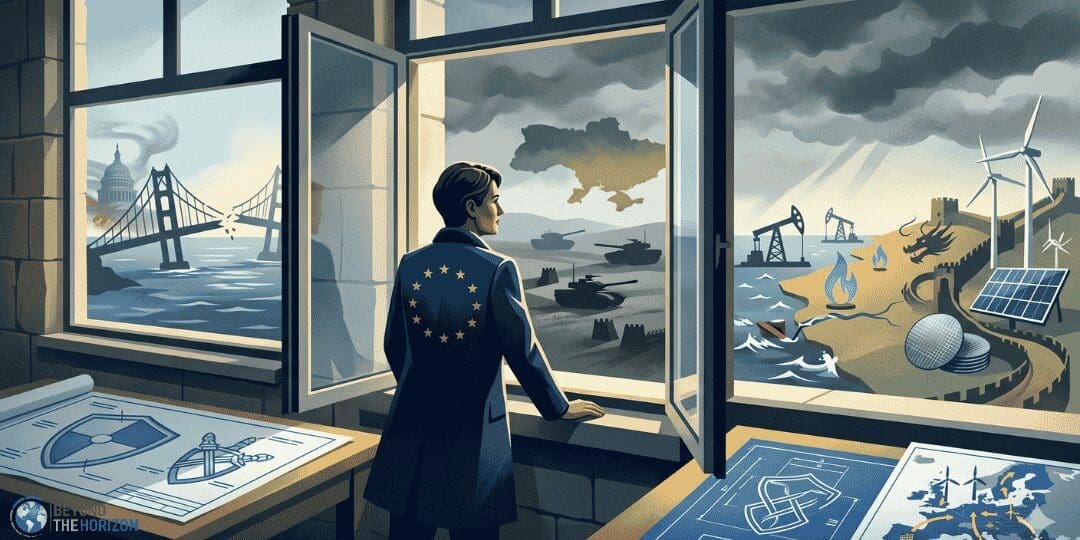
The European Union currently navigates a period defined by what strategic analysts characterize as "fundamental uncertainty"—a state where the magnitude and nature of geopolitical and economic risks are no longer measurable by traditional risk-assessment metrics. This paradigm shift is the culmination of a decade of cascading crises, yet it is the events of 2025 and early 2026 that have finalized the transition of the European project from a peace-oriented trade bloc to a nascent geopolitical power. The central argument of this analysis is that a unique, time-sensitive window of opportunity has opened for Europe to consolidate a more autonomous Union capable of swift and strategic decision-making. This opportunity is not born of choice but of structural necessity, driven by the systemic retreat of the United States from its role as a security guarantor, the violent revisionism of Russia, the expansionist energy and security shocks originating from the Iran war, and the pervasive challenge of China’s rise. Strategic autonomy, once a French-led intellectual ambition, is now the baseline for European resilience and the only viable path to preserving the continent's socioeconomic model.
The Transatlantic Fracture: Trump 2.0 and the End of the American Umbrella
The return of Donald Trump to the White House in January 2025 delivered what has been termed the "Trump Shock," a profound disruption of the transatlantic alliance that surpassed the friction of his first term. The second Trump administration has moved beyond rhetorical skepticism of multilateralism toward a policy of active hostility against the European project, describing the EU as a "globalist entity" designed to "screw" the United States while freeriding on American military protection. This shift is most visible in the systematic undermining of Article 5 of the Washington Treaty, with the President repeatedly questioning whether the U.S. would defend allies who, in his view, fail to meet arbitrary defense spending thresholds.
The "Trump Shock" is categorized by six primary dimensions of instability that have eroded the foundations of transatlantic trust to historic lows. First, domestic political decay and attacks on American democratic institutions have fostered a perception among allies and adversaries alike that Washington is too distracted or polarized to respond effectively to a security crisis. Second, the "confrontational tone" adopted in the November 2025 U.S. National Security Strategy viewed Europe not as a partner but as an economic rival, leading to fears that the U.S. might tolerate Russian pressure on European capitals if it served narrow transactional interests. Third, the "Greenland Crisis" of early 2026, during which Washington increased pressure on Denmark to cede control of the territory—threatening tariffs and refusing to rule out military force—signaled a total disregard for the sovereignty of European NATO members.
Comparative Transatlantic Security Indicators (2024-2026)
| Strategic Metric | 2024 Status | 2026 Status | Impact on Strategic Autonomy |
| U.S. Security Reliability (Public Trust) | 55% viewed U.S. as reliable 4 | >70% in UK, DE, FR view U.S. as unreliable | Mandates independent European defense initiatives. |
| NATO Article 5 Commitment | Formally Questioned/Rhetorical | Conditional and Transactional | Forces shift toward "European pillar" within NATO. |
| U.S. Troop Presence in Europe | ~100,000 personnel | Withdrawal of 5,000 from Germany; Ramstein status uncertain | Signals the "beginning of the end" of the American umbrella. |
| Economic Policy Orientation | Strategic Alignment (Trade & Tech Council) | Active Hostility (Steel/Aluminum Tariffs) | Drives the European Economic Security Strategy. |
| Nuclear Deterrence Credibility | High (Extended Nuclear Deterrence) | Severe Doubts ("Trump Shock") | Accelerates debates on European nuclear autonomy. |
The decision to withdraw significant troop contingents from Germany in early 2026, while modest in number, sent a loud political signal that the "American security umbrella" was no longer a permanent fixture of European security. This "American cutback" serves as the independent variable in the current geopolitical equation, making European strategic autonomy the dependent variable. The result is a pattern of "functional adaptation" where Europe recognizes that tackling the geopolitical challenges on its doorstep without Washington's support is highly costly but unavoidable.
The 2026 Iran War: Energy Chokepoints and the Strategic Realignment
The military campaign launched by U.S. and Israeli forces against Iran in late February 2026 has served as the most significant "wake-up call" for European energy security since the 2022 invasion of Ukraine. The conflict, which began with strikes aimed at curbing Iran's nuclear and missile programs, quickly spiraled into a wider confrontation as Iran blockaded the Strait of Hormuz—the world’s most critical energy chokepoint. This disruption affected approximately 20% of global petroleum consumption and 20% of global liquefied natural gas (LNG) trade.
European economies, heavily reliant on imported energy, took a severe hit as gas prices spiked by 20% and oil prices rose by 8% on the first morning of the conflict. Unlike the 2022 crisis, this "Iran gas shock" occurred when European gas storage levels were significantly lower than in previous years—46 billion cubic meters (bcm) at the end of February 2026, compared to 60 bcm in 2025 and 77 bcm in 2024. This vulnerability has forced a new reckoning with the EU's energy dependence, shifting the focus from simply moving away from Russian gas to reducing structural dependence on all imported fossil fuels traded on volatile global markets.
The Iran conflict has fundamentally compromised the "energy-for-security compact" that governed relations between the United States and Gulf monarchies for five decades. Gulf states, including Saudi Arabia and the UAE, are increasingly questioning whether the current security architecture serves their interests as they absorb retaliatory strikes for decisions taken in Washington without their prior consultation. This has led to an acceleration of "multi-alignment strategies" among regional powers, creating a more fragmented and unpredictable Middle East. For Europe, the conflict has transformed decarbonization from an environmental goal into a strategic imperative to eliminate the "geopolitical risk premium" embedded in fossil fuel prices.
Russia’s Persistent Revisionism and the Frontiers of European Stability
While the Middle East presents an immediate crisis, Russia remains the primary structural threat to European security. The 2022 invasion of Ukraine shattered long-held views that major conventional war was "a thing of the past" on the continent. By 2025, the realization that the situation in Ukraine is a "sustained commitment" rather than a temporary shock has led to a "geopolitical awakening" for the Union. The EU has broken numerous taboos, most notably the financing of lethal arms for Ukraine through the European Peace Facility (EPF) and the imposition of sweeping sanctions that have decoupled the European and Russian economies.
The conflict has served as the strongest push for European defense integration in decades. Initiatives like the European Defence Fund (EDF), Permanent Structured Cooperation (PESCO), and the Coordinated Annual Review on Defence (CARD) have moved from nascent regulatory frameworks to central pillars of a nascent "Defence Union". At the 2025 NATO Summit in The Hague, member states committed to a 5% GDP defense spending pledge, reflecting a massive shift in strategic culture across the continent. This target includes 3.5% for core defense items and 1.5% for defense-related items, aiming to close long-standing capability gaps and strengthen the European Defence Technological and Industrial Base (EDTIB).
Evolution of EU Defense Initiatives (2016-2026)
| Initiative | Original Intent | 2026 Operational Status | Strategic Outcome |
| EDF | Innovation/Prototyping | €7.95bn budget (2021-2027) | Scaled-up funding for collaborative defense technologies. |
| PESCO | Alignment of national plans |
Increased readiness; |
Reduced gaps between national defense systems. |
| CARD | Coordinate capability cycles | Identifies avenues for joint procurement | Synchronized national defense planning. |
| Military Mobility | Cross-border logistics | Part of transport security initiative | Rapid deployment capabilities for the Eastern Flank. |
| ReArm Europe | Proposed investment plan | EUR 800 billion target | Ambition to drive massive defense-industrial investment. |
The "Weimar Triangle" countries—France, Germany, and Poland—have emerged as the catalyst for this increased cooperation. Poland’s ambition to become the "most powerful land force in Europe" with a 300,000-personnel army, combined with Germany’s debt-financed rearmament and France’s nuclear deterrent, creates a potent axis of West-Central-East security. The "East Shield" program and the integration of civilian and military transport corridors illustrate how the Union is blending civilian and defense imperatives to harden its infrastructure against hybrid threats.
The China Challenge and the Strategy of De-risking
The rise of China and its ever-expanding global ambitions pose a systemic challenge to the EU's strategic and economic interests. China's structural deceleration and increasing self-reliance, coupled with its massive industrial policies, have transformed it from an economic partner into a "systemic rival". The EU’s response has converged around the concept of "de-risking"—reducing critical dependencies and strategic exposure without pursuing the total decoupling favored by elements in the United States.
This de-risking strategy is complicated by Europe's deep reliance on China for the "green and digital twin"transitions. China maintains a central position in the value chains for semiconductors, digital technologies, and critical raw materials essential for the net-zero transition. The European Commission has led the pivot toward balancing these dependencies, implementing the Critical Raw Materials Act (CRMA) to reduce reliance on single sources and the Internal Market Emergency and Resilience Act (IMERA) to ensure the availability of critical supplies during crises.28
Sectoral Vulnerabilities and De-risking Objectives
| Sector | Dependency on China | EU De-risking Policy | Strategic Target |
| Critical Raw Materials | High (Rare earths, Lithium) | CRMA (Regulation 2024/1252) | Diversify supply; increase recycling/circularity. |
| Digital Tech/ICT | High (Supply chains, 5G) | Recommendation on outbound investment | Protect against technology leakage and espionage. |
| Green Technology | High (Solar, EV batteries) | Clean Industrial Deal | Restore European industrial competitiveness. |
| Automotive | High (Market & Battery tech) | Anti-subsidy probes | Defend European manufacturing base. |
| Research/Academia | Moderate (Collaborations) | Council Recommendation on Research Security | Mitigate malign influence and misuse of R&I. |
The challenge for the EU is that de-risking remains a "mere future aspiration" in the absence of centralized control and coordination. While powerful member states like France and Germany have begun to shift their national policies, smaller states or those with high levels of Chinese investment (such as Hungary) can act as "veto players" against a collective response. The Nexperia case in late 2025, where the Dutch government seized control of a chipmaker to prevent technology leakage to Chinese-linked entities, illustrates the rising friction and the need for a more comprehensive European approach to "comprehensive security".
Economic Foundations: Competitiveness as a Security Prerequisite
The landmark reports by Mario Draghi (2024) and Enrico Letta (2024) have established a new baseline for European policy: competitiveness and security are no longer separable. Strategic autonomy is now viewed as the necessary precondition for growth, as it helps stabilize the economy and makes it resilient to the coercive threats revealed by recent security crises. Draghi’s analysis warns of a "slow agony" for Europe if it fails to raise productivity and coordinate industrial policy at scale to keep pace with the U.S. and China.
Implementation of the Draghi recommendations has been a primary focus of the 2024-2029 Commission term. By September 2025, the Draghi Observatory found that while progress had been made in transport and critical raw materials, areas such as clean technologies and energy continued to lag. The "Competitiveness Compass," presented in January 2025, provides the strategic framework for the Union to rethink its economic model, combining market integration with strategic public investment and regulatory modernization.
A core tension exists between achieving "good outcomes" (efficiency) and "resilient outcomes" (security). In 2025 and 2026, the EU has increasingly prioritized resilience, recognizing that optimized conditions for short-term performance are often fragile across broader global shifts. This requires moving industrial policy center stage, drawing on past lessons to gain scale and productivity, and deepening the Single Market to reduce external dependencies.
Institutional Reform: Overcoming Gridlock through Agile Governance
The ability of the EU to act "swiftly and strategically" is frequently hampered by the requirement for unanimityin key policy areas such as foreign policy and taxation. The rise of "veto abuse," where member states hijack collective decisions to extract concessions on unrelated issues, has prompted a growing call for institutional reform. Moving toward Qualified Majority Voting (QMV) in the Council is increasingly seen as a recipe for sharpening the minds for consensus and preventing paralysis.
Several institutional pathways to QMV exist without requiring a full treaty overhaul. These include the "passerelle clauses" and "constructive abstention" under Article 31 of the Treaty on European Union (TEU). Furthermore, the concept of a "Sovereignty Safety Net" has been proposed to make the transition to QMV more acceptable for smaller member states. This mechanism would allow a member to oppose a QMV vote for "vital reasons of national policy," transferring the matter to the European Council for high-level political deliberation.
Institutional Pathways to Swifter Decision-Making
| Mechanism | Legal Basis | Current Usage | Strategic Advantage |
| Passerelle Clauses | Art. 31(3) TEU | Limited (once in 2004) | Shift to QMV without full treaty change. |
| Constructive Abstention | Art. 31(1) TEU | Recent usage on Ukraine | Allows action while letting one state opt out. |
| Sovereignty Safety Net | Proposed/Art. 31(2) TEU | Not yet implemented | Mitigates fear of being outvoted on vital interests. |
| Weimar+ / E5 Group | Informal/Minilateral | Active in 2025-2026 | Highly agile "coalition of the capable." |
| LEAP Initiative | Intergovernmental | Launched Feb 2026 | Joint development of AI/drone capabilities. |
The "Weimar+" format (comprising France, Germany, Poland, Italy, Spain, the UK, and the EU) represents a shift toward "differentiated integration" and minilateralism. This group can act as a nucleus and catalyst for increased European cooperation, particularly in defense and security, where its members have the capacity and willpower to "pay the price" of integrated defense The LEAP initiative (Low-Cost Effectors and Autonomous Platforms) for the joint development of AI-driven drone capabilities is a concrete deliverable of this agile format, aiming to improve collective security within NATO and the EU frameworks while circumventing Brussels-based regulatory hurdles.
Public Sentiment: The Mandate for a Geopolitical Union
The pursuit of strategic autonomy is increasingly aligned with the expectations of European citizens. Eurobarometer data reveal that approval of EU membership has reached its highest values in nearly two decades, as citizens view the Union as a "place of stability" in a world of growing instability and security threats. Notably, 81% of Europeans favor a common defense and security policy, the highest result since 2004.
Public perception of threats has also intensified. More than three-quarters of respondents (77%) agree that Russia's invasion of Ukraine is a threat to EU security, and 78% are concerned about the EU's defense and security over the next five years. This high level of support provides a political mandate for leaders to invest in strategic autonomy, even as citizens continue to prioritize the economy and inflation—issues exacerbated by the very geopolitical shocks that strategic autonomy aims to mitigate.
Key Eurobarometer Findings on EU Strategic Direction
| Public Opinion Metric | Result (%) | Strategic Implication |
| Support for Common Defense/Security Policy | 81% | Mandate for a "European Defense Union." |
| Need for Member State Unity | 90% | Demand for more coordinated crisis response. |
| Impact of EU Actions on Daily Life | 72% | Recognition of the EU's role as a protector. |
| Joint Funding for Common Projects | 78% | Support for EU-wide fiscal capacity for security. |
| Optimism about the EU's Future | 66% | Returning confidence in the European model. |
However, a "perceptual gap" remains. While citizens support the goals of strategic autonomy, many remain unaware of the specific EU co-financed projects meant to improve their lives, such as those under the EU Regional Policy or the Clean Industrial Deal.43 Strengthening the public visibility of these initiatives is essential to maintaining the domestic legitimacy of the "independence bid" in 2026.
Conclusion: Seizing the Window of Opportunity
The convergence of the "Trump Shock," the "Iran War," the persistent "Russia Threat," and the "China Challenge" has created a historic window of opportunity for the European Union. Strategic autonomy is no longer a rhetorical preference but the only viable defensive posture in a world defined by the "weaponization of interdependence" and the erosion of traditional alliances. The evidence suggests that Europe is already moving from a reactive to a proactive actor, as seen in the massive surge in defense spending, the refinement of economic security tools, and the emergence of agile minilateral formats.
To successfully navigate this window, the EU must bridge the gap between rhetoric and implementation. This requires:
- Scaling the Defense Industrial Base: Transitioning from fragmented national procurement to a unified "ReArm Europe" plan that can achieve the scale and productivity needed for a "Post-American Era".8
- Accelerating the Clean Energy Transition: Using the current energy shocks as a lever for strategic autonomy by reducing structural dependence on all imported fossil fuels and upgrading grids to harness renewable output.
- Institutional Agility: Implementing QMV safeguards like the "Sovereignty Safety Net" to ensure the Union can make swift decisions while respecting the vital interests of all member states.
- Economic Resilience: Fully delivering on the Draghi recommendations to unlock private investment and restore European competitiveness as a security prerequisite.
The year 2026 marks the end of Europe's "age of innocence". The tools and the public mandate for a more autonomous, geopolitical Union are now in place. The success of this transition will determine whether Europe remains a prosperous and secure anchor of stability or faces a "slow agony" in a world of unconstrained great power politics.