

21 OCTOBER 2026
Europe can finance Ukraine’s defence, but can it keep Ukraine operational when essential services depend on decisions elsewhere? Reported Starshield restrictions, disputed interruptions in attack warnings and complaints over interceptor delays bring that question into sharp focus. The accounts do not establish a coordinated American cutoff, but they expose dependencies that additional funding alone cannot resolve.
Protecting the infrastructure behind military support is equally urgent. MI5’s warnings and investigations into incidents affecting satellite communications facilities highlight vulnerabilities beyond the battlefield. Meanwhile, disagreements over proposed EU defence and military mobility allocations test Europe’s willingness to fund its commitments. Differences with Washington over Russian energy revenues further complicate the effort to sustain coordinated pressure on Moscow.
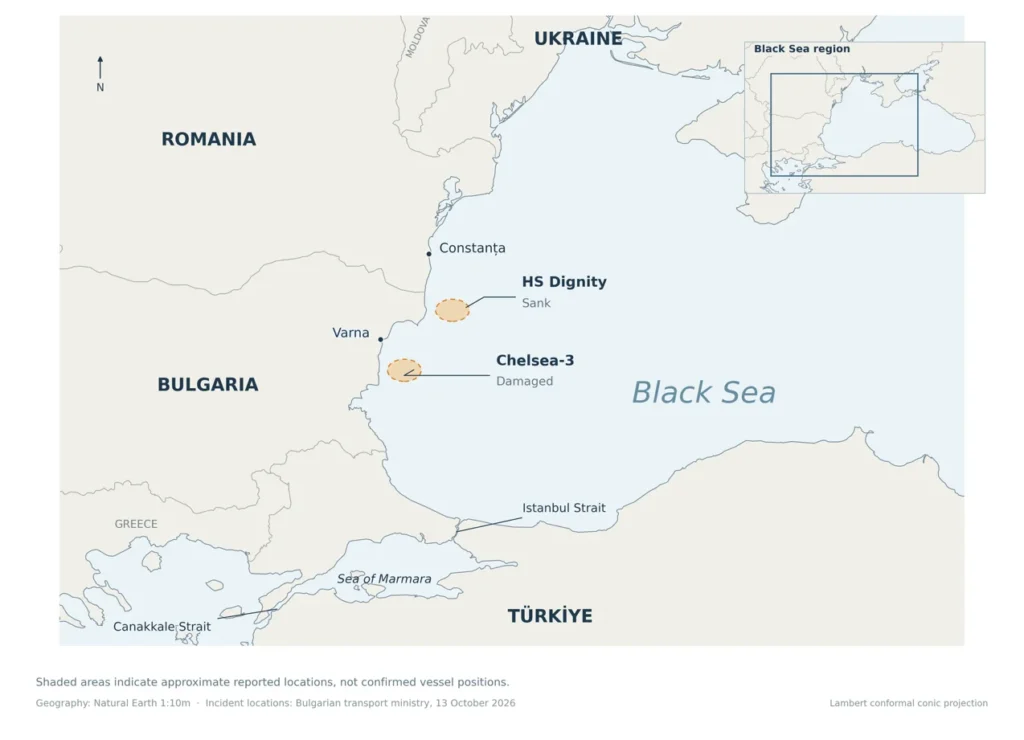
Our Map of the Week turns to the Black Sea’s exposed western coast, locating the approximate areas of the attacks on HS Dignity and Chelsea-3. Their proximity to Bulgaria and connections with Danube ports demonstrate the regional stakes of insecure navigation. Proposals for stronger NATO coordination and a maritime moratorium now face the practical test of protecting commercial shipping.
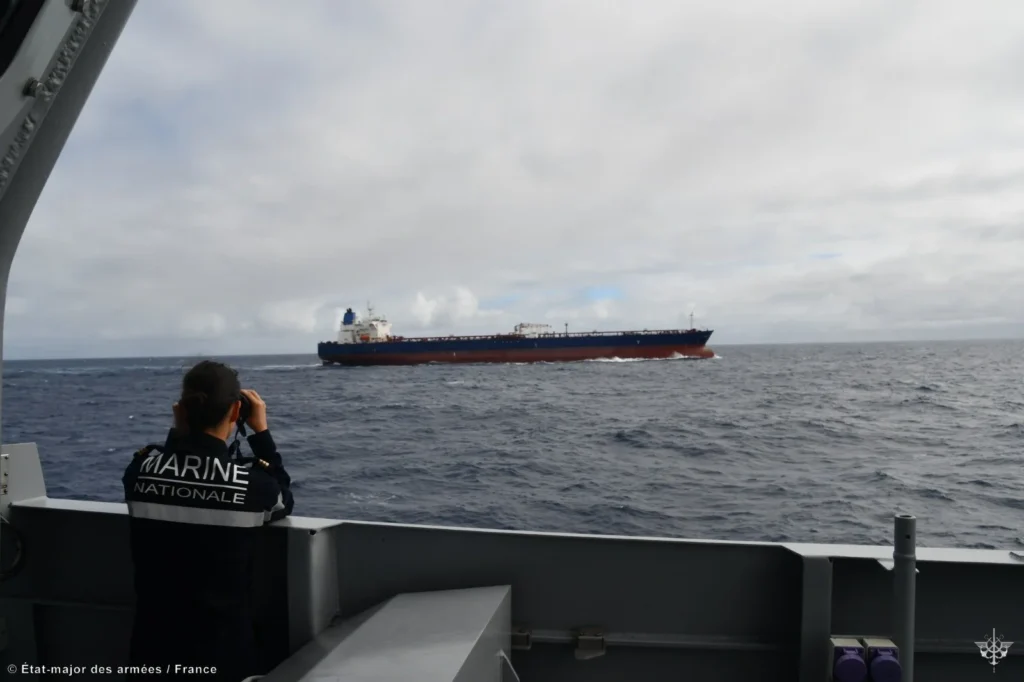
Our Photo of the Week follows French naval enforcement into the Indian Ocean, where the interception of DF Peak illustrates the resources required to investigate suspected maritime violations. The Infographic of the Week examines the wider shadow-fleet problem, connecting sanctions evasion with opaque ownership, environmental exposure and uncertain insurance.
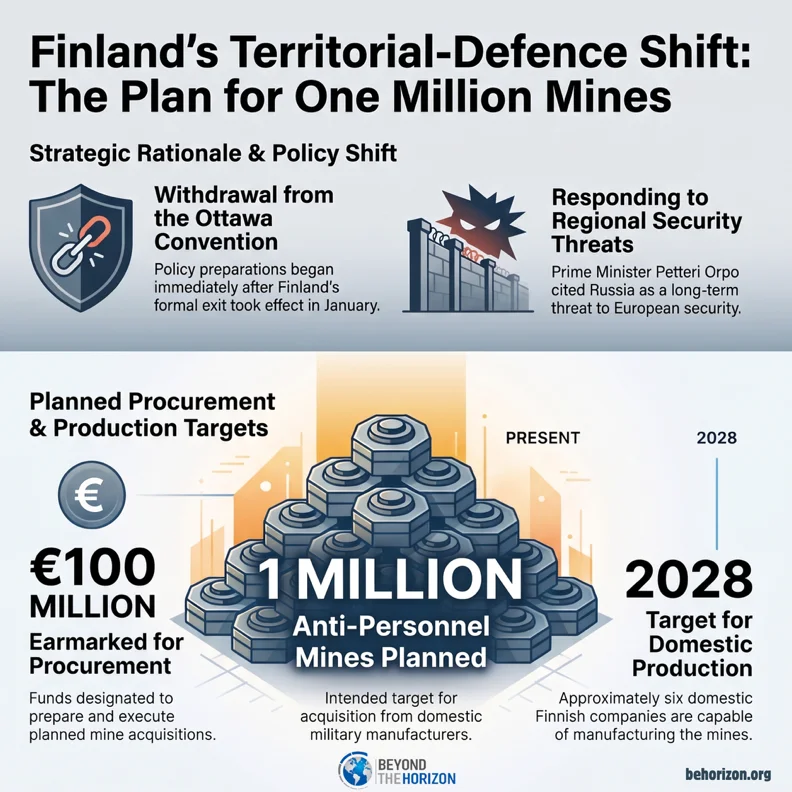
Our Statistics of the Week examines Finland’s planned acquisition of one million anti-personnel mines, with approximately €100 million earmarked and domestic production targeted for 2028. These ambitions mark a significant defence-policy shift while leaving delivery, readiness and long-term responsibilities to be addressed.
Finally, our Analysis assesses Europe’s ability to sustain Ukraine’s communications, intelligence and air defence. It distinguishes alternatives available today from capabilities requiring integration, authorisation or years of development, asking where Europe can already ensure continuity and where dependence on US decisions remains decisive.
- Key Developments
- Statistics of the Week
- Map of the Week
- Photo of the Week
- Infographic of the Week
- Analysis
MI5 Warns of Intensifying Russian and Iranian Hybrid Campaigns
MI5 Director General Ken McCallum warned on 13 October that Russia was intensifying hybrid operations against Ukraine’s supporters, while Iran increasingly sought to target British military installations. He said state threats had quadrupled over a decade and Iran-linked operations had resulted in more than 50 arrests during the previous year. Both governments rejected accusations of hostile activity.
The warning strengthens the case for protecting military facilities and disrupting proxy networks. Effective responses require usable intelligence, cross-border investigations and continuity planning, with attribution grounded in evidence specific to each incident.
France Detains Suspected Shadow-Fleet Tanker in the Indian Ocean
French forces intercepted the DF Peak south of Réunion on 12 October and directed it towards the island for investigation. French authorities questioned the validity of its Benin flag and suspected illicit fuel transportation. The vessel was already subject to Western sanctions. Russia condemned the detention as piracy.
The operation extends European enforcement against suspected sanctions evasion beyond nearby waters. Its wider significance depends on sustained maritime monitoring, defensible legal procedures and cooperation among flag states, ports and insurers. Detention for investigation does not itself establish a final finding of wrongdoing.
Drone Attacks Sink Cargo Ship off Bulgaria and Leave Eleven Missing
Drone attacks struck two cargo vessels off Bulgaria on 13 October. The Guinea-Bissau-flagged HS Dignity sank, leaving eleven sailors missing after five were rescued. All fifteen crew members aboard the damaged, Maltese-flagged Chelsea-3 were rescued. Bulgaria summoned Russia’s ambassador but stopped short of conclusively attributing the attacks.
The incidents expose the vulnerability of commercial shipping near NATO’s southeastern flank. Stronger surveillance, timely warnings and rescue capacity are immediate priorities. Establishing responsibility remains essential to selecting credible responses and avoiding escalation based on unverified assumptions.
European Commission Condemns Attacks on Shipping near Bulgaria
European Commission President Ursula von der Leyen condemned the 13 October attacks on merchant vessels near Bulgaria, warning that the Black Sea had become another area of escalation connected to Russia’s war against Ukraine. She expressed solidarity with Bulgaria, praised its rescuers and called for accountability. Bulgarian Prime Minister Rumen Radev said evidence identifying the perpetrators remained insufficient, although he argued that Moscow benefited from the attacks.
The intervention places maritime security firmly within the EU’s response to the war. Its practical value will depend on assistance that improves detection, investigation and protection of civilian navigation. Political condemnation can support collective action, but effective deterrence requires governments to establish responsibilities and connect their warnings with measures they can sustain.
Bulgaria and Romania Prepare Joint Appeal to NATO over Ship Attacks
Bulgaria and Romania were preparing a joint letter to NATO following attacks on commercial shipping in the Black Sea, Rapporteur reported on 13 October. The initiative sought to bring their shared security concerns before the Alliance. Bulgaria also requested stronger maritime and airspace surveillance during discussions with NATO and EU leaders.
A coordinated appeal could help convert separate national concerns into clearer allied priorities. Its usefulness will depend on identifying specific capability shortages, responsibilities and contributions. Surveillance assets must connect with authorities able to investigate incidents and protect shipping. Preparing a joint letter represents diplomatic coordination; it does not establish that NATO has approved additional forces or a new operation.
Romania Proposes Joint NATO Command for the Black Sea
Romania proposed a joint NATO military command for the Black Sea on 14 October, following consultations with Bulgaria over recent maritime incidents. Defence Minister Radu Miruță advocated arrangements involving the Alliance’s Black Sea coastal members, with rotation of the command’s location and leadership. Bucharest offered to host the structure. The proposal had not become an agreed NATO command arrangement.
A regional command could improve coordination if it has clear operational responsibilities, dependable information and forces available to act. Its relationship with existing NATO headquarters and national authorities would need definition. Türkiye’s participation would also be central to a credible coastal framework. Creating another headquarters would offer limited protection unless it improves decisions, surveillance and operational responses.
Bulgaria Promotes Black Sea Moratorium on Attacks against Civilian Vessels
Bulgaria, Romania and Türkiye would continue pressing for a moratorium on attacks against civilian vessels in the Black Sea, Bulgarian Foreign Minister Velislava Petrova-Chamova said on 14 October. The initiative followed renewed drone attacks on commercial shipping and formed part of a wider effort to secure safe navigation. It remained a diplomatic proposal rather than an implemented agreement.
A workable arrangement would require clear coverage, commitments from the relevant parties and a credible means of recording violations. Protection should extend beyond declarations to reliable reporting channels and practical coordination with ship operators. For European security, the test is whether the initiative reduces attacks and restores confidence in maritime access, while preserving the ability to investigate responsibility when incidents occur.
Eastern Allies Challenge Proposed Cuts to EU Defence and Military Mobility Funding
Poland and Lithuania criticised the Irish Council presidency’s proposed reductions to the EU’s next long-term budget on 13 October. The proposal would lower the allocation for resilience, security, defence industry and space from €131 billion to €113.7 billion, while reducing proposed military mobility funding by €2 billion. Polish Defence Minister Władysław Kosiniak-Kamysz argued that the figures failed to reflect the threats facing Europe’s eastern flank.
The disagreement concerns a negotiating proposal, with final allocations still unsettled. It exposes the difficulty of reconciling spending restraint with commitments to faster reinforcement and stronger defence production. Governments will need to identify which projects would be delayed or reduced under different funding options. Otherwise, budget negotiations risk preserving ambitious readiness objectives without providing the infrastructure and industrial investment needed to meet them.
EU Leaders Maintain Pressure on Russia as Washington Eases Diesel Restrictions
European leaders’ differences with Washington over Russia became clearer around the 15–16 October summit. POLITICO had reported preparations for tougher sanctions as President Donald Trump eased restrictions on Russian diesel exports. The European Council subsequently called for further measures to reduce Russian energy revenues, close sanctions loopholes and strengthen coordinated action against the shadow fleet.
The divergence weakens the consistency of Western economic pressure and complicates negotiations over reciprocal concessions. European governments must assess whether US incentives produce verifiable changes in Russian conduct while maintaining their own enforcement arrangements. Calls for stronger measures also need to be distinguished from newly adopted restrictions: summit conclusions establish political direction, but implementation depends on subsequent decisions and national enforcement.
Britain Accelerates Air-Defence Missile Deliveries to Ukraine
Britain announced that it would accelerate £10 million of a £45 million surface-to-air missile package for Ukraine to meet urgent winter requirements. The support includes Lightweight Multirole Missiles intended to counter increasingly challenging aerial threats, including jet-powered drones. During their 14 October meeting, Prime Minister Andy Burnham and President Volodymyr Zelenskyy discussed the package and faster defensive support.
Accelerated delivery could strengthen protection of Ukrainian cities and energy infrastructure during a demanding period. Its effectiveness depends on available launch systems, trained operators and integration with detection and command networks. The financial value of a package does not establish how many additional targets Ukraine can intercept. Delivery schedules and operational availability therefore provide more useful measures of its immediate contribution.
Meloni Defends Defence Spending and Questions US–Russia Diesel Deal
Italian Prime Minister Giorgia Meloni defended higher defence expenditure in the Senate on 14 October, arguing that the additional fiscal flexibility concerned could not simply be redirected to hospitals or schools. She also criticised Washington’s diesel agreement with Moscow, warning that it risked weakening pressure on Russia and financing its war.
Her intervention connects the domestic politics of rearmament with the credibility of Europe’s Ukraine policy. Spending permissions and the wider economic costs of borrowing remain separate questions: restricted fiscal flexibility does not eliminate competing demands on public resources. Italy’s contribution will depend on translating expenditure into useful capabilities while sustaining public support and coordinating sanctions policy with European partners.
Germany Reaffirms Ukraine Support while Emphasising Reform Expectations
German Finance Minister Lars Klingbeil said on 15 October that Berlin’s support for Ukraine remained clear but carried expectations of political reform. He also rejected treating Russia’s participation in international meetings as a return to normal relations and opposed negotiations conducted over Ukraine’s head.
The position combines continued assistance with demands for accountable government. Its credibility requires clear reform benchmarks and predictable financing. The remarks did not announce an aid suspension or a new conditionality mechanism; their significance lies in how existing commitments are implemented.
Norwegian Review Proposes Reopening Wealth Fund to Allied Nuclear-Arms Producers
A Norwegian commission recommended on 15 October that the sovereign wealth fund be permitted to invest in nuclear-weapons manufacturers based in allied nuclear-weapon states recognised under the Non-Proliferation Treaty. The proposal could restore eligibility for several British, French and American companies currently excluded. Other exclusions, including those concerning biological and chemical weapons, landmines and cluster munitions, would remain. Consultation and parliamentary consideration are still required.
The recommendation reflects tensions between Norway’s investment ethics and its reliance on allied nuclear deterrence. Changing eligibility could alter the fund’s exposure to major defence companies, but would neither compel investment nor constitute a procurement commitment. The debate will test how Norway defines the relationship between responsible investment, national security and the industrial foundations of allied defence.
Renew Europe Seeks European Satellite Communications Support for Ukraine
Renew Europe urged EU leaders on 15 October to purchase satellite communications capacity for Ukraine from Eutelsat OneWeb following reported interruptions affecting Ukrainian military operations. Its proposals included temporary access to GOVSATCOM, additional services from European commercial operators, support for terminals and faster development of IRIS². The intervention was a political request, with procurement and access arrangements still requiring agreement.
The proposal addresses Ukraine’s exposure to externally controlled communications services. Diversification would require compatible terminals, sufficient capacity and integration with military systems; purchasing access alone would not resolve every operational dependency. European governments should assess alternatives against specific battlefield requirements and continuity arrangements. The immediate priority is dependable service, while longer-term investment must establish who controls access and how restrictions can be imposed.
Lithuania Links Attempted Starlink-Site Arson to Russian Sabotage
Lithuanian Prime Minister Mindaugas Sinkevičius said on 18 October that Russia was the likely instigator of an attempted arson attack against a company hosting Starlink communications equipment. Authorities discovered flammable liquids at the site, and investigations continued. Lithuania subsequently raised alert levels at more than fifteen strategic infrastructure locations, according to reporting on 19 October.
The incident highlights the physical vulnerability of infrastructure supporting satellite services and Ukraine’s defence. Protective measures must cover ground stations, power supplies and contractors alongside the satellites themselves. Lithuania’s attribution remains an official assessment requiring investigative substantiation. Cross-border information sharing and rapid protective action can proceed while authorities establish who organised the attempted attack and whether it connects to other incidents.
Proposed Trump–Putin–Xi Meeting Raises Questions over Ukraine’s Participation
Reuters reported on 19 October, citing The Wall Street Journal, that Vladimir Putin had proposed discussions with Donald Trump and Xi Jinping on ending the war in Ukraine, potentially alongside November’s APEC summit. Trump subsequently expressed openness to a three-way meeting, emphasising nuclear arms and possible trade discussions. A meeting and its agenda remained unconfirmed.
The proposal raises questions about how Ukraine and European governments would participate in decisions affecting their security. Arms-control discussions could have value, but they do not confer authority to determine Ukraine’s future without its involvement. European diplomacy should seek clarity on the agenda, preserve coordination with Kyiv and distinguish exploratory contacts from an agreed negotiating framework or settlement.
Background: Baltic Presidents Call for Stronger NATO Air Defence
On 21 May 2026, the presidents of Estonia, Latvia and Lithuania called for NATO’s Baltic air-policing mission to become an air-defence mission and for additional counter-drone capabilities. Their joint statement followed airspace violations involving unmanned aircraft arriving from the direction of Russia and Belarus. They also rejected Russian allegations that Baltic territory had been used to launch attacks against Russia. This statement predates the current reporting week.
The statement provides context for continuing debates over protection of NATO’s eastern flank. A more demanding mission would require suitable sensors, interception capabilities, command arrangements and agreed responsibilities. Political calls for a transition should be assessed separately from changes already implemented. The operational measure is whether allied forces can identify and defeat relevant threats reliably.
Montenegro Maintains EU Accession Priority while Deepening China Dialogue
Montenegrin President Jakov Milatović met Chinese Foreign Minister Wang Yi in Cetinje on 17 October. According to the Chinese official account, Milatović reaffirmed EU accession as Montenegro’s foreign-policy priority while supporting continued cooperation with China in infrastructure, trade and tourism. Wang presented European integration as compatible with closer Chinese relations and highlighted infrastructure projects. The leaders also discussed Ukraine.
The meeting illustrates China’s continuing engagement with countries approaching EU membership. For European security, the relevant questions concern procurement transparency, infrastructure dependencies and alignment with EU policies. Diplomatic warmth alone does not establish strategic realignment. Assessment should focus on the terms of concrete projects and Montenegro’s subsequent decisions, while recognising that the available account reflects Beijing’s presentation of the meeting.
Croatian President Backs Dialogue with China amid European Trade Disputes
Croatian President Zoran Milanović met Wang Yi in Zagreb on 16 October. China’s official readout described support for stronger bilateral cooperation and dialogue over EU–China economic disputes. It also reported Milanović’s reaffirmation of Croatia’s adherence to the EU’s common foreign and security policy, alongside his favourable assessment of aspects of China’s economic position. Wang argued for resolving differences through consultation.
The exchange demonstrates the range of national perspectives within Europe’s China debate. Presidential statements do not themselves change EU trade measures or establish a common European position. For European security, engagement should be assessed through reciprocal access, protection of sensitive technologies and consistency with agreed policies. Independent confirmation of specific commitments would be necessary before presenting the meeting as a substantive policy shift.
Finland Plans Domestic Procurement of One Million Anti-Personnel Mines
Finland intends to acquire one million anti-personnel mines from domestic manufacturers, with approximately €100 million earmarked and production targeted to be operating by 2028. Reporting on 19 October said preparations followed Finland’s withdrawal from the Ottawa Convention, which took effect in January. Finnish officials identified several domestic companies capable of manufacturing the weapons.
The programme reflects Helsinki’s reassessment of territorial defence under a deteriorating security environment. The announced quantity and funding should remain distinct from contracts completed, production achieved and stocks delivered. Its wider implications include industrial capacity, training and the enduring risks mines pose to civilians. Record-keeping, controlled use and eventual clearance would need to accompany any operational employment.
Russian Strikes Expose Gaps in Ukraine’s Warning and Air-Defence Support
Russian attacks killed ten people and disrupted electricity to more than half a million households on 19 October. Zelenskyy complained about absent advance warning and delayed US supplies. Ukraine’s air force clarified that it received no warning before an initial ballistic attack but did receive information before a second. Marco Rubio denied a US intelligence-sharing pause.
The episode underscores the need for dependable warning and interceptor supplies. The cause of the initial information gap remained unresolved; it should not be presented as proof of a complete intelligence cutoff.
Reported Starshield Restrictions Highlight Ukraine’s Communications Dependence
Reuters reported on 15 October that an instruction to restrict Ukraine’s Starshield service originated inside the White House, citing US and Western officials. Ukrainian sources said limitations affected terminals on fast-moving platforms and hindered drone operations. A senior US official denied that Trump had requested the restriction; the report did not establish who issued the instruction.
The case concerns control over military communications services, separately from physical attacks on Starlink infrastructure. It strengthens the case for contractual clarity, redundant communications and alternatives capable of meeting operational requirements.
Further Arrests Reported in Investigation of Polish Starlink-Station Fire
Reuters reported on 13 October that Polish broadcaster RMF FM put the number detained over September’s Starlink-station fire at four. German federal police confirmed coordinating information exchanges concerning three detained individuals. The report’s fourth detention lacked equivalent official confirmation. The fire had affected the station’s power system and backup generator.
The investigation illustrates the cross-border cooperation needed to protect infrastructure supporting Ukraine. Arrests remain investigative steps, with individual roles and criminal responsibility still to be established. Reliable reporting should preserve the distinction between broadcaster accounts and officially confirmed developments.
EU Opens Further Accession Negotiations with Ukraine and Moldova
The EU opened negotiations with Ukraine and Moldova on two additional accession clusters on 13 October: internal market, and competitiveness and inclusive growth. Separate intergovernmental conferences in Luxembourg advanced both countries’ membership processes under the Irish Council presidency. The decisions opened substantive negotiations; they did not close the chapters concerned or establish accession dates.
The development strengthens the institutional dimension of Europe’s support for two countries exposed to Russian pressure. Alignment with EU rules can support economic resilience and more predictable investment, but benefits depend on implementation and administrative capacity. Enlargement also requires sustained political agreement within the Union. Progress should therefore be measured through reforms completed and negotiating benchmarks met.
Britain Allocates £17 Million to Repair Chornobyl’s Protective Structure
Britain announced £17 million on 15 October towards repairs to Chornobyl’s protective shelter, damaged by a Russian drone strike in 2025. The funding forms part of an international programme coordinated by the European Bank for Reconstruction and Development with Ukraine and G7 donors. Work will address confinement and ventilation functions and protect the structure’s intended lifespan.
The commitment connects assistance to Ukraine with the protection of long-term nuclear safety. Damage to containment infrastructure creates obligations extending well beyond the immediate military situation. Effective support requires coordinated financing, access for specialist teams and verification that repairs restore the necessary functions. Funding is an essential step, while completion and technical assurance will determine the resulting safety improvements.
Russia Places More European-Owned Assets under Temporary Administration
A Russian decree issued on 15 October placed additional European-owned business assets under temporary administration. Companies affected included Tarkett, Menshen and Ontex. The Kremlin portrayed the measure as retaliation for actions against Russian property and described it as reversible; Tarkett said it was losing effective control of its Russian operations.
The move increases the exposure of remaining European investments to political coercion. Describing administration as temporary does not guarantee recovery of control or value. European governments and companies must account for these risks when assessing sanctions, investment and commercial dependencies.
European Security Impact Dashboard
|
Development |
Significance level |
Why it matters for European security |
|
Russian strikes expose gaps in Ukraine’s attack warnings |
High |
Highlights the consequences of unreliable warning and delayed military supplies for civilian protection. Kyiv’s account raises urgent questions about support continuity; Washington denies suspending intelligence sharing. |
|
Reported Starshield restrictions affect Ukrainian operations |
High |
Exposes Ukraine’s dependence on externally controlled satellite services for military operations. The reported restrictions raise operational and sovereignty concerns, while responsibility for the order remains disputed. |
|
Drone attacks hit shipping off Bulgaria |
High |
Brings lethal maritime insecurity close to NATO territory and threatens commercial navigation. The sinking and damage increase pressure for allied protection, while responsibility remains unconfirmed. |
|
MI5 warns of intensified Russian and Iranian hybrid campaigns |
High |
Shows that support for Ukraine and Middle East tensions carry direct domestic-security consequences for Europe. Proxy activity and threats to infrastructure stretch intelligence and protective-security resources. |
|
Lithuania suspects Russian involvement in attempted Starlink sabotage |
High |
Highlights the vulnerability of ground infrastructure supporting satellite connectivity and Ukraine’s defence. Heightened protection is warranted, although Lithuania’s attribution remains an assessment under investigation. |
|
Eastern members challenge proposed EU defence-related budget cuts |
High |
Exposes a gap between European rearmament ambitions and proposed funding. Reductions affecting defence-related programmes and military mobility could weaken readiness, but the budget remains under negotiation. |
|
Europe presses Russia as US sanctions policy diverges |
High |
Tests whether Europe can sustain pressure on Russian revenues when Washington eases restrictions. Divergent policies risk weakening sanctions coherence; the EU summit’s direction still requires implementation. |
|
Putin reportedly proposes talks with Trump and Xi |
High |
Raises the prospect of Ukraine’s future being discussed without Kyiv or European governments. The diplomatic stakes are substantial, but no trilateral meeting or agreed settlement framework is confirmed. |
|
UK accelerates air-defence missile deliveries to Ukraine |
High |
Responds to immediate pressure on Ukrainian air defences and improves protection against evolving drone threats. Its value depends on delivery speed, available stocks and sustained replenishment. |
|
France detains another suspected shadow-fleet tanker |
Medium |
Extends enforcement pressure on shipping linked to Russian oil revenues. The detention tests flag and sanctions compliance, but one seizure alone does not fundamentally constrain Russia’s export network. |
|
Romania proposes a joint NATO Black Sea command |
Medium |
Could improve regional coordination and maritime awareness, including cooperation with Türkiye. The proposal has strategic potential, but no new NATO command or operational mandate has been agreed. |
|
Bulgaria and Romania prepare a joint appeal to NATO |
Medium |
Turns shared concern over ship attacks into coordinated pressure for stronger allied surveillance and protection. A joint letter signals urgency but does not itself commit NATO forces. |
|
Bulgaria advances a Black Sea shipping moratorium proposal |
Medium |
Offers a diplomatic route to reducing attacks on civilian navigation. Its effectiveness would depend on participation, credible monitoring and compliance; no enforceable moratorium is yet in place. |
|
EU leadership condemns attacks on ships off Bulgaria |
Medium |
Reinforces European solidarity and the political importance of safe navigation. Condemnation raises diplomatic pressure, but adds no operational protection or agreed attribution on its own. |
|
Renew Europe seeks European satellite connectivity for Ukraine |
Medium |
Identifies a practical need to diversify Ukraine’s communications and reduce dependence on a single external provider. The initiative remains a political request, with procurement and deployment still required. |
|
Further arrests follow the Polish Starlink-site fire |
Medium |
Shows the cross-border investigative effort needed to protect infrastructure supporting Ukraine. Arrests advance the inquiry, but do not establish guilt or conclusively resolve responsibility for the incident. |
|
Finland plans a major anti-personnel mine purchase |
Medium |
Signals a stronger emphasis on territorial denial and domestic munitions production after withdrawal from the Ottawa Convention. The planned purchase concerns future capability, rather than mines already delivered. |
|
Norway considers allowing wealth-fund investment in nuclear-arms producers |
Medium |
Could widen access to capital for allied nuclear-weapons manufacturers and alter Norway’s investment ethics. The commission’s proposal still faces consultation and parliamentary consideration; it is not adopted policy. |
|
Klingbeil links sustained Ukraine support to reform expectations |
Medium |
Underscores the importance of governance and accountability to maintaining European support for Kyiv. The remarks signal political expectations, without announcing an aid suspension or new formal conditions. |
|
Meloni defends defence spending and criticises US Russia policy |
Medium |
Illustrates the domestic fiscal pressures behind European rearmament and unease over sanctions divergence. The intervention clarifies Italy’s political position but announces no new military capability. |
|
EU opens further accession clusters with Ukraine and Moldova |
Medium |
Deepens both countries’ institutional integration with Europe and strengthens the reform framework underpinning long-term resilience. Opening negotiating clusters is progress, but does not guarantee membership or an accession date. |
|
UK commits additional funding to Chornobyl shelter repairs |
Medium |
Supports containment of a persistent nuclear-safety risk after damage to the protective shelter. The contribution strengthens international risk reduction, with practical impact dependent on repair progress. |
|
Russia places more European assets under temporary administration |
Medium |
Shows Moscow using corporate control as an instrument of retaliation. The measures increase exposure for European firms and reinforce the economic-security costs of remaining invested in Russia. |
|
Montenegro pursues Chinese ties alongside EU accession |
Medium |
Highlights the need to reconcile investment and infrastructure partnerships with EU integration in the Western Balkans. The meeting signals engagement, without demonstrating a change in Montenegro’s accession priority. |
|
Croatia maintains high-level dialogue with China |
Medium |
Reflects continued Chinese engagement with an EU and NATO member. The talks matter for economic influence and European cohesion, but do not establish a Croatian departure from EU foreign policy. |
One Million Mines: Finland’s Territorial-Defence Shift
This week’s statistics highlight the scale of Finland’s planned return to anti-personnel mines: one million mines, approximately €100 million earmarked for procurement, and a target of 2028 for domestic production to be operating. According to Yle’s 19 October report, preparations followed Finland’s withdrawal from the Ottawa Convention, which took effect in January 2026. Colonel Riku Mikkonen of the Army Command identified around six Finnish companies capable of manufacturing the weapons. These figures describe procurement ambitions and potential industrial capacity. They do not establish that contracts have been awarded, production volumes achieved or operational stockpiles delivered. Crucially, the 2028 target concerns establishing production; it is not a confirmed deadline for delivery of all one million mines.
For European security, the programme illustrates how Finland’s assessment of the Russian threat is reshaping both territorial-defence policy and domestic industrial priorities. Its significance will depend on converting funding and manufacturing potential into a sustained, usable capability. The number of prospective suppliers alone says little about production rates, delivery schedules or the resources required for training and stockpile management. Assessment must also account for civilian protection and eventual clearance, rather than treating acquisition costs as the programme’s entire burden. The central measure of progress is therefore whether Finland can deliver its intended defensive capability while providing credible arrangements for control, accountability and the long-term consequences of any use.
The Black Sea’s Exposed Western Coast
This week’s map locates the approximate areas of the 13 October drone attacks on HS Dignity and Chelsea-3 off Bulgaria. HS Dignity sank off the northern Bulgarian coast, while Chelsea-3 was damaged farther south and its 15 crew members were rescued. The shaded areas indicate approximate reported locations rather than confirmed vessel positions. By placing the incidents alongside Varna, Constanța, Ukraine and the Turkish Straits, the map shows their wider maritime setting. The Istanbul Strait, Sea of Marmara and Çanakkale Strait connect Black Sea shipping with the Mediterranean, while the inset situates the exposed western coast within the wider basin.
This geography explains why attacks on merchant shipping create a regional security problem extending beyond Ukraine. Both vessels were bound for Danube ports: HS Dignity for Brăila in Romania and Chelsea-3 for Giurgiulești in Moldova. Disruption along this coast can therefore affect commercial access, port activity and transport connections across several countries. For Bulgaria, Romania and Türkiye, the practical challenge is coordinating maritime surveillance, warnings to shipping, rescue capacity and protection against further attacks. The map highlights a shared security requirement: sustaining safe navigation along a coast connecting NATO members, Ukraine and the Danube region.
French Naval Enforcement Reaches the Indian Ocean
A French sailor observes the tanker DF Peak from a naval vessel on 12 October 2026, during an operation approximately 450 nautical miles south of Réunion. French forces intercepted the suspected shadow-fleet tanker to verify its claimed flag registration. According to the French Joint Staff, inspectors discovered documentary irregularities, prompting the public prosecutor to order the vessel’s diversion under naval escort for further investigation. The photograph captures the surveillance supporting an operation that combined naval deployment, boarding and judicial action.
The operation demonstrates how efforts to constrain Russia’s maritime trading networks extend beyond European waters. France’s presence in the southwestern Indian Ocean provides the ships, personnel and logistical support needed to act along distant shipping routes. However, effective enforcement depends on establishing vessel identity, documenting suspected violations and sustaining investigations after interception. Russia’s condemnation of the seizure as “piracy” also highlights the diplomatic friction surrounding these operations. For European security, the photograph illustrates the practical resources required to support sanctions enforcement—and the importance of translating an individual interception into a legally defensible outcome.
Russia’s Shadow Fleet: Sanctions Evasion and Maritime Risk
This week’s infographic examines how Russia’s shadow fleet connects oil revenues, sanctions evasion and maritime insecurity. Opaque ownership, changes of vessel identity and manipulation of tracking systems complicate efforts to identify operators and enforce restrictions. Ageing vessels, inadequate maintenance and risky transfers at sea also threaten crews and coastal environments. Weak or unverifiable insurance creates a further problem: compensation and clean-up costs may be difficult to recover after an accident. The fleet therefore presents European governments with overlapping economic, environmental and security challenges.
France’s interception of the DF Peak, reported on 13 October, illustrates the increasingly operational character of enforcement. French authorities cited doubts about the tanker’s claimed flag registration and directed it towards Réunion for investigation; Russia condemned the action as “piracy”. The distinction matters: sanctions designation, suspected false registration and the legal grounds for boarding are separate questions. For Europe, effective action requires coordinated vessel identification, scrutiny of ownership and insurance, and legally grounded interventions. Success should be measured by sustained disruption of sanctions evasion and reduced maritime risk, while managing the potential for confrontation with Russia.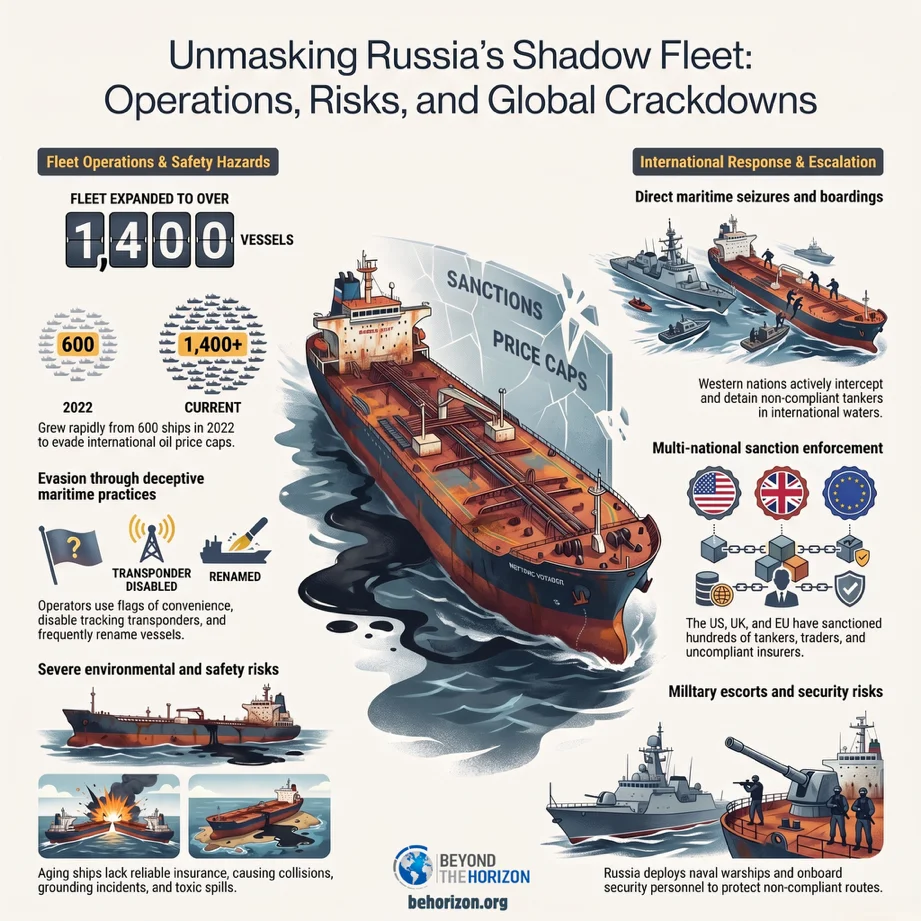
Keeping Ukraine Operational: Can Europe Reduce Its Dependence on US Decisions?
The reported restrictions on Ukraine’s Starshield service expose a vulnerability that additional European funding cannot resolve by itself: military capability depends on continuing access to services whose operating conditions can change. Reuters reported that instructions to limit Starshield originated inside the White House, citing two US officials and a Western official. However, they did not identify who authorised or implemented the decision, while a senior US official denied that President Trump had requested it. Ukrainian officials described restrictions affecting terminals on fast-moving platforms, disrupting strike and interceptor drones. Responsibility remains contested, but the operational question is clear: can Ukraine continue essential missions when a provider or foreign government changes the terms of access?
The disputes over attack warnings and interceptor deliveries reinforce that question without establishing a single, coordinated American cutoff. President Volodymyr Zelensky said intelligence sharing had briefly been interrupted; Secretary of State Marco Rubio denied any pause. Separately, Zelensky alleged delays to Patriot deliveries already financed by allies. A source told Reuters that a US weapons package purchased through NATO’s Prioritised Ukraine Requirements List, or PURL, still awaited Defence Secretary Pete Hegseth’s authorisation, but could not confirm whether it contained Patriots. These accounts require careful attribution. Nevertheless, they expose distinct points of dependence: permission to operate equipment, access to time-sensitive information and approval to release supplies. Each requires a different European response.
For communications, Europe can provide useful alternatives immediately, although replacing Starshield across Ukraine’s operations would be substantially harder. Eutelsat confirmed to Reuters that it already supplies connectivity in Ukraine through its low Earth orbit and geostationary networks. However, existing Starlink terminals cannot simply connect to OneWeb; switching requires compatible equipment. The practical opportunity is therefore to diversify selected missions first, with terminals, bandwidth and support allocated in advance. A service suitable for a headquarters may not meet the weight, power, mobility and responsiveness requirements of a drone. Operational continuity must be demonstrated under those conditions and at the number of simultaneous connections Ukraine actually needs.
Europe’s public satellite programmes offer additional capacity on different timescales. GOVSATCOM has been operational since January 2026, pooling participating governments’ satellite resources for authorised users. Its existence does not establish that Ukraine has access to sufficient capacity for particular military missions; allocation, equipment compatibility and permission remain essential. Meanwhile, the European Commission schedules the first IRIS² launches for 2029, with early services following. It cannot address the immediate winter requirement. European governments should therefore distinguish capacity available for deployment now from capacity announced for later. Agreements should specify who controls service restrictions, how changes are communicated and how Ukrainian units move to an alternative connection.
Intelligence presents a more difficult substitution problem because different forms of satellite support perform fundamentally different tasks. Europe can expand access to imagery: Ukraine’s January agreement with Finland’s ICEYE, for example, increased access to radar imagery capable of observing the ground through cloud and darkness. That capability does not provide an equivalent to the persistent infrared sensing used by the US Space-Based Infrared System for missile warning. Reuters identified the absence of a comparable European capability as a central constraint. A resilient communications network can transmit an alert, but it cannot generate warning information that its users never receive. Europe can immediately improve imagery access, analysis and dissemination; recreating the missing warning capability requires a longer programme of sensors, processing and operational integration.
The intelligence challenge also concerns authority and timing. Satellite ownership alone does not guarantee that Ukrainian operators can request observations, receive the resulting information or distribute it quickly enough. European support should therefore include agreed priorities for collection, standing permissions for sharing and tested links into Ukrainian command systems. Performance should be assessed through coverage, reliability and the time between detection and receipt by the relevant unit. Until an alternative warning system demonstrates those functions, continued US cooperation remains necessary. Political assurances would be more useful if accompanied by clear procedures for identifying interruptions and restoring the affected information flow.
Air defence combines an immediate supply problem with a longer industrial one. PURL enables allies to purchase US equipment for Ukraine, making European money operationally valuable while preserving dependence on American supply and release decisions. Europe can also strengthen particular layers of defence through its own systems. Britain’s accelerated Lightweight Multirole Missile deliveries target threats including jet-powered drones, while IRIS-T SLM provides protection against targets including drones and cruise missiles. These contributions should be assessed against the threats they address; they cannot automatically be counted as equivalent replacements for Patriot’s ballistic-missile defence role. Reducing dependence requires both suitable interceptors and the ability to replenish them throughout sustained attacks.
The Franco-Italian SAMP/T and Aster family offers a European route to strengthening ballistic-missile defence, but delivery and integration remain decisive. France and Ukraine’s July declaration envisaged two temporary SAMP/T deployments, accelerated Aster deliveries and progressive delivery of SAMP/T NG components from 2027. It also committed to authorising licensed Aster production in Ukraine before the end of 2026. These are commitments, rather than evidence that the complete capability is already available. Radars, launchers, trained crews, maintenance and interceptor stocks must arrive in a usable combination. Production agreements become strategically meaningful when factories deliver a sustained output sufficient to replace expenditure and build reserves.
Europe can therefore reduce Ukraine’s exposure through selective substitution now, stronger continuity arrangements for capabilities it cannot yet replace and sustained investment in the remaining gaps. European alternatives also need scrutiny: governments must establish who can authorise transfers, release intelligence or restrict services, including within Europe itself. The measure of progress should be operational—how quickly units can switch communications, whether warnings arrive in time and whether interceptor deliveries sustain the required defence. More funding is necessary, but dependence has only been reduced when Ukraine can keep performing essential missions through a disruption in external support.