
Key Takeaways
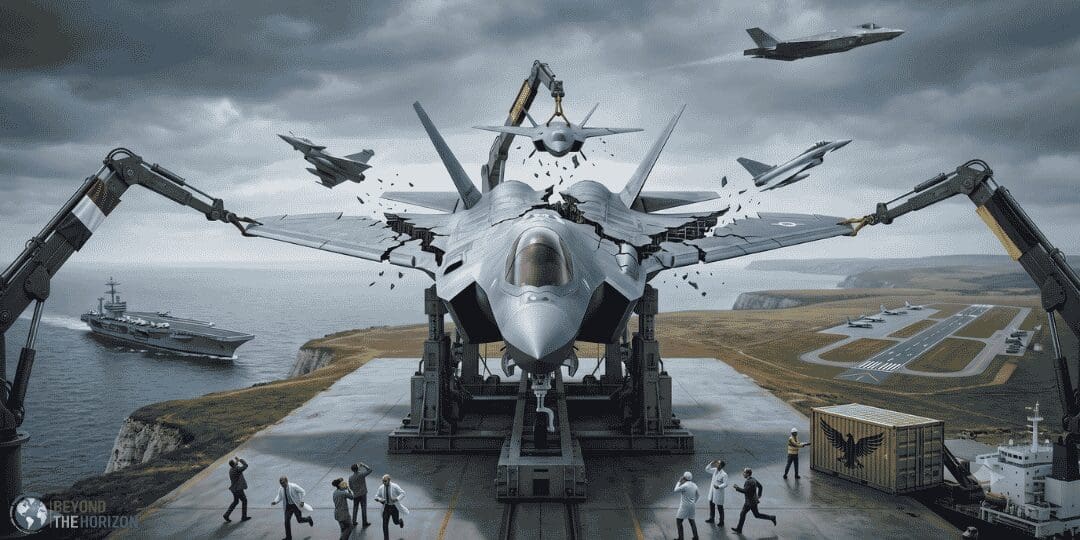
- FCAS is not merely a procurement failure; it is a stress test for European defence autonomy. The breakdown of the fighter-jet pillar shows that Europe still struggles to convert strategic ambition into operational capability when sovereignty, industrial control and military requirements collide.
- Europe’s defence-industrial cooperation remains structurally weak. National champions, workshare disputes, intellectual-property concerns and competing claims over technical authority continue to obstruct genuinely integrated programme governance.
- France, Germany and Spain entered FCAS with different strategic priorities. France’s need for a carrier-capable and nuclear-relevant platform did not fully align with Germany’s focus on conventional NATO-oriented airpower, making a common aircraft politically and technically difficult.
- The risk is not only delay but fragmentation. If FCAS collapses into separate national or mini-lateral projects, Europe may repeat the old pattern of Rafale, Eurofighter and Gripen at a time when it can least afford duplication.
- Dependence on U.S. systems will deepen if Europe cannot deliver its own high-end platforms.Continued reliance on the F-35 may provide capability in the short term, but it also reinforces software, sustainment, upgrade and political dependencies.
- European defence autonomy requires discipline, not declarations. The central lesson of FCAS is blunt: Europe needs stronger programme authority, fewer prestige projects, clearer leadership and a willingness to subordinate national industrial comfort to collective military output.
Introduction
Europe’s defence problem is often described as a shortage of money. That diagnosis is too narrow. The reported collapse of the core fighter-jet pillar of the Franco-German-Spanish Future Combat Air System, or FCAS, points to a deeper weakness: Europe still struggles to organise power collectively when sovereignty, industry and military requirements collide.
FCAS was never meant to be only a sixth-generation combat aircraft. It was intended to become the technological and political symbol of a Europe capable of designing, funding and fielding high-end military systems without permanent dependence on the United States. It promised a networked system of systems: a next-generation fighter, drones, sensors, combat-cloud architecture and secure connectivity. In political terms, it was supposed to demonstrate that European strategic autonomy could move from speeches into hardware.
Its breakdown therefore matters well beyond airpower. It exposes the structural obstacles standing between European ambition and European defence autonomy. The problem is not that Europe lacks strategic slogans. It has plenty of them. The problem is that Europe still lacks the political machinery, industrial discipline and common strategic culture required to translate those slogans into deployable military capability.
FCAS reveals four hard limits of European defence unity: fragmented industrial governance, divergent strategic requirements, duplication across the defence-industrial landscape and continued dependence on American systems. Together, these limits show that European autonomy cannot be produced by declarations alone. It requires authority, hierarchy and compromise.
Industrial Governance: Cooperation Without Control
The first problem is industrial governance. FCAS did not falter because European leaders lacked ambition. It faltered because the industrial actors could not agree on control, workshare, intellectual property and technical authority. Airbus and Dassault were not passive contractors implementing a political vision. They were power centres defending national industrial ecosystems.
This is the uncomfortable reality behind European defence cooperation. Governments speak the language of integration, but their defence-industrial bases remain organised around national champions, national jobs, national technologies and national prestige. Each major programme becomes not only a military project but also a contest over industrial sovereignty. Who leads? Who owns the intellectual property? Who receives the most valuable workshare? Who controls the design authority? These questions are not secondary. They determine whether cooperation produces capability or paralysis.
The FCAS dispute shows that Europe has not solved the governance problem at the heart of multinational defence procurement. A next-generation combat-air system requires tight integration between aircraft design, propulsion, sensors, electronic warfare, unmanned systems, communications and software architecture. Such a project cannot be managed as a diplomatic compromise in which every participant receives politically convenient shares of the programme. Advanced military technology requires clear leadership, rapid iteration and enforceable decision-making.
Europe’s current approach too often confuses cooperation with consensus. Consensus may be useful for political declarations, but it is a poor operating principle for complex defence engineering. A programme such as FCAS needs a hierarchy of authority. Someone must decide which requirement takes precedence, which design path survives, which industrial actor leads and which national preference must be subordinated to the collective outcome.
Without that authority, European defence cooperation becomes vulnerable to vetoes by companies, ministries and national political systems. The result is delay, cost growth and mistrust. Worse, the process erodes confidence in European solutions just when Europe most needs them. If governments cannot impose discipline on flagship projects, then strategic autonomy remains a slogan attached to an industrial system still driven by national protection.
Strategic Divergence: One Programme, Different Airpower Visions
The second problem is strategic divergence. France and Germany did not want exactly the same aircraft. That is not a technical inconvenience. It is a political fact with major implications.
France needs a future combat aircraft that can operate from an aircraft carrier and preserve the airborne component of its nuclear deterrent. French airpower is shaped by expeditionary reach, national command authority and nuclear sovereignty. Germany’s requirements are different. Berlin needs a conventionally armed system primarily designed for NATO airpower, territorial defence and integration into alliance structures. Spain adds another layer of industrial and capability interests.
None of these priorities is irrational. France’s requirements reflect its status as a nuclear power with global military responsibilities. Germany’s priorities reflect its strategic culture, its NATO dependence and its post-Zeitenwende attempt to rebuild conventional defence capacity. Spain’s position reflects the logic of a medium-sized European state seeking industrial participation and technological relevance.
The problem is not that these countries have different requirements. The problem is that they tried to place them inside one flagship programme without first resolving the political hierarchy between them. A common platform requires more than shared funding. It requires shared assumptions about risk, sovereignty, operational use and future war. FCAS was expected to carry too much political symbolism before the partners had reached enough strategic convergence.
This is where the rhetoric of European defence unity becomes thin. European states can agree that they want more autonomy, more capability and less dependence on Washington. But agreement at that level is not enough. The decisive questions are harder: autonomy for whom, under whose command, for which missions and with what nuclear, expeditionary or alliance obligations?
France and Germany do not occupy the same strategic position. France sees autonomy partly as freedom of national action. Germany often sees European defense through the framework of NATO reinforcement and burden-sharing. These visions overlap, but they are not identical. FCAS exposed the cost of pretending that they are.
Fragmentation: The Return of Europe’s Old Defence Pattern
The third problem is fragmentation. FCAS was never developing in a clean European landscape. It existed alongside the UK-Italy-Japan Global Combat Air Programme, continuing European purchases of the U.S. F-35, Sweden’s aerospace ambitions and Türkiye’s national fighter project. If FCAS breaks into separate national or mini-lateral efforts, Europe risks reproducing the familiar pattern of Rafale, Eurofighter and Gripen — but under more dangerous strategic conditions.
That would be a serious failure. In earlier decades, Europe could absorb some duplication because the United States remained the unquestioned backbone of European defence. The strategic environment was more forgiving. The industrial inefficiencies of multiple combat-air platforms were costly but manageable. Today, the logic is different. Russia’s war against Ukraine has demonstrated the importance of mass, production speed, sustainment capacity and interoperability. At the same time, American political reliability is less certain, and Washington is pressing Europeans to assume more responsibility for their own security.
Against this background, duplication is not a harmless expression of national technological pride. It is a strategic liability. Separate fighter programmes divide funding, engineering talent, production capacity and political attention. They produce smaller fleets, more complicated supply chains and weaker economies of scale. They also make interoperability harder, especially in a future battlespace where software, data fusion and networked systems will matter as much as airframes.
The danger is that Europe will call this autonomy because the systems are European. That would be misleading. Autonomy achieved through duplication is not real autonomy. It is fragmentation with a European label. A continent that cannot concentrate resources on a limited number of high-priority systems will remain militarily dependent even if more of its equipment is manufactured at home.
The lesson from FCAS is therefore not simply that one programme failed. The lesson is that Europe has still not answered the basic question of defence-industrial consolidation. Does it want national aerospace sovereignty, or does it want collective military effectiveness? It cannot fully maximise both. Pretending otherwise only delays the moment of choice.
The U.S. Dependence Trap
The fourth problem is dependency. If Europe cannot build a credible next-generation combat-air system together, it will continue buying American platforms for the most sensitive layers of airpower. The F-35 is an advanced and capable aircraft, and for many European states it offers immediate operational benefits. But reliance on U.S. systems also creates dependencies in software, sustainment, upgrades, data architecture and operational sovereignty.
This is not an argument for crude anti-Americanism. NATO remains central to European defence, and U.S. capabilities remain indispensable. The problem is different: Europe cannot simultaneously worry about American unpredictability and allow its most ambitious defence projects to collapse through internal rivalry. That is a strategic contradiction.
The more Europe relies on U.S. platforms, the harder it becomes to sustain an independent high-end defence-industrial base. Procurement choices shape industrial futures. Once states invest heavily in American systems, they also invest in American training, maintenance, logistics and operational concepts. Over time, this reduces the political and financial space for European alternatives.
This matters especially in combat air, where technological cycles are long and industrial ecosystems are difficult to rebuild once weakened. A failed FCAS would not simply mean the loss of one aircraft. It would weaken Europe’s ability to remain a serious player in the most demanding areas of aerospace, software-defined warfare, electronic combat and system integration.
The dependence trap is therefore self-reinforcing. European states buy American systems because European programmes are delayed or divided. European programmes then become harder to sustain because national budgets and air forces are already committed elsewhere. The result is a cycle in which Europe’s inability to cooperate deepens the very dependence it claims to oppose.
What FCAS Reveals About European Defence Autonomy
FCAS exposes a basic truth: European defence autonomy is not mainly a question of ambition. It is a question of discipline. Europe does not lack statements of intent. It lacks mechanisms that force political and industrial actors to accept trade-offs.
A serious autonomy agenda would require fewer prestige projects, clearer leadership structures, common requirements and stricter programme governance. It would also require governments to be honest with their publics and industries. Not every country can lead every project. Not every national company can receive the most valuable workshare. Not every military requirement can be included without consequence. Cooperation means compromise, and compromise means loss as well as gain.
This is the part of European defence unity that leaders often avoid. They prefer to describe cooperation as a win-win process in which all states gain capability, influence and industrial benefit. In practice, major defence projects require hierarchy. Some states lead; others follow. Some industries dominate; others specialise. Some requirements shape the design; others are dropped. Until European governments are willing to accept this reality, large collaborative projects will remain unstable.
The alternative is not the abandonment of cooperation. That would be equally damaging. No single European state, including France or Germany, can easily sustain the full spectrum of next-generation defence innovation alone. The real alternative is harder and more selective cooperation: fewer programmes, stronger management, clearer division of labour and political agreements that are settled before industry begins fighting over the architecture.
FCAS failed because it tried to turn unity into hardware before Europe had created the authority to enforce unity. That is the central lesson. Capability does not emerge from symbolism. It emerges from institutions that can make decisions, absorb conflict and deliver output on time.
Conclusion
The breakdown of FCAS should end one comfortable illusion: European defence unity will not emerge automatically from higher spending, harsher threat perception or repeated declarations of strategic autonomy. Money matters, but money without governance produces duplication. Threat perception matters, but threat perception without strategic convergence produces incompatible requirements. Industrial capacity matters, but industry without political discipline protects national advantage before collective capability.
FCAS was supposed to demonstrate that Europe could act as a strategic power. Instead, it has shown how difficult that remains. The project exposed the unresolved contradictions of European defence: national sovereignty versus shared command, industrial protection versus military efficiency, strategic autonomy versus NATO dependence, and political symbolism versus programme discipline.
Europe does not need another declaration of autonomy. It needs the ability to decide who leads, who compromises, who pays and what capability must arrive on time. That requires political courage, not only financial commitment. It also requires accepting that genuine cooperation is not the same as equal distribution of benefits.
If Europe responds to FCAS by multiplying separate national or mini-lateral fighter projects, it will preserve industrial pride at the cost of strategic coherence. If it responds by strengthening governance, narrowing requirements and accepting hard trade-offs, the failure may still produce a useful lesson.
The central point is blunt: European defence autonomy will remain more aspiration than force until Europe can subordinate national industrial comfort to collective military output. FCAS did not fail because Europe lacked ambition. It failed because ambition was not matched by discipline.