
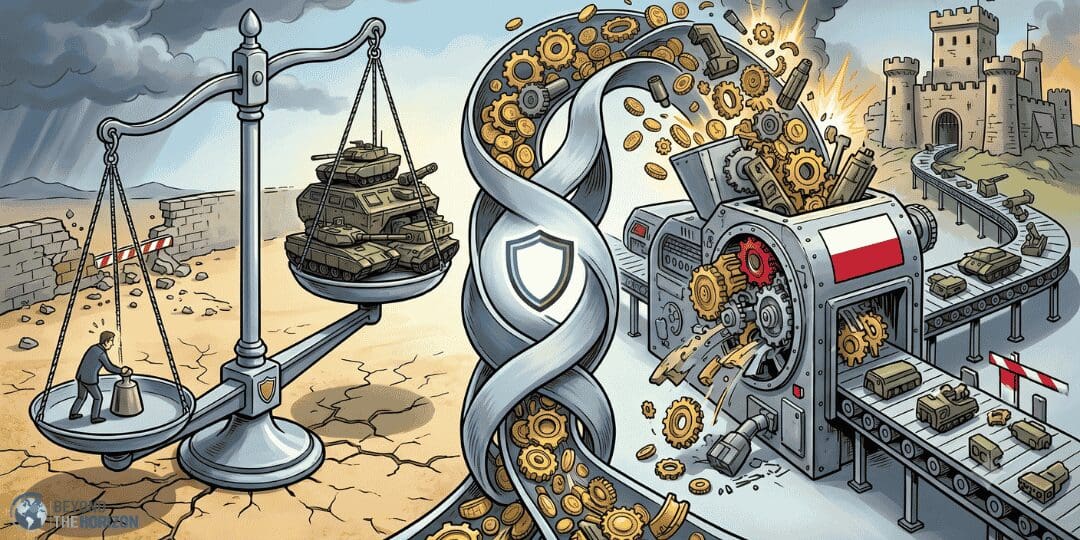
Key Takeaways
- Europe’s rearmament problem is shifting from financing to execution and consent. SAFE shows that money can be mobilised, but Italy and Poland reveal that funds only matter if governments can politically justify them and administratively convert them into capability.
- Italy’s possible SAFE retreat is a warning that public consent is now a strategic constraint. With weak domestic support for higher defence spending, Meloni’s government is testing whether NATO and EU rearmament goals can survive contact with voters who do not yet accept the cost of deterrence.
- Poland’s first SAFE payment makes Warsaw the programme’s absorption test case. Its challenge is not willingness to spend, but whether it can turn large-scale EU-backed financing into rapid, interoperable and cost-disciplined procurement.
- SAFE should now be treated as an allocation-discipline mechanism, not merely a loan facility. Funds should move toward governments that can demonstrate credible plans, political durability, procurement capacity and contribution to common European capability gaps.
- The core strategic risk is an uneven European rearmament geography: frontline states move quickly, while more reluctant allies lag behind. That would deepen Europe’s dependence on a small number of high-commitment countries and weaken NATO burden-sharing credibility.
- The policy lesson is blunt: Europe needs both democratic legitimacy and procurement discipline. Without public persuasion in reluctant countries and competent absorption in willing ones, SAFE will produce impressive financial architecture but insufficient deterrent power.
Introduction
Europe’s rearmament debate is entering a more difficult phase. The first phase was about recognising the threat environment after Russia’s war against Ukraine and admitting that European defence capacity was inadequate. The second was about creating instruments to finance rapid capability expansion. The EU’s Security Action for Europe, or SAFE, belongs to this second phase: a €150 billion defence-loan instrument designed to support procurement, industrial capacity and military readiness. Yet the cases of Italy and Poland show that Europe has already moved into a third phase, in which the central question is no longer whether money can be mobilised. It is whether governments can convert money into political consent, timely procurement and usable capability.
Italy and Poland illustrate two sides of the same problem. In Italy, Giorgia Meloni’s government is reportedly considering reducing its planned SAFE request by as much as two thirds, from around €15 billion to below €5 billion, amid domestic resistance to higher arms spending. In Poland, by contrast, Warsaw has become the first EU member state to receive SAFE pre-financing, taking €6.6 billion, equal to 15% of its €43.7 billion allocation. Italy exposes the consent bottleneck. Poland exposes the absorption bottleneck. Together, they show that European rearmament is not primarily constrained by the availability of EU financing. It is constrained by the political and administrative capacity of member states to use that financing well.
Italy and the Politics of Consent
Italy’s possible retreat from SAFE is strategically more important than the size of the loan reduction itself. A cut from roughly €15 billion to below €5 billion would be significant, but the deeper issue is what the reversal reveals: defence spending remains politically fragile even when external threats are obvious and financing is available on favourable terms. Italy is not simply hesitating because of budget arithmetic. It is hesitating because the domestic coalition required to sustain rearmament is weak.
The reported figure that only 16% of Italians support higher defence spending is the key political fact. It suggests that Rome faces not merely scepticism over one EU instrument, but a broader public-consent deficit. That matters because NATO’s new spending framework points allies toward 3.5% of GDP for core defence and 1.5% for wider security by 2035. For a country such as Italy, which has long spent below NATO’s preferred levels, this creates a widening gap between alliance expectations and domestic tolerance.
Meloni’s difficulty is therefore structural. She must present herself internationally as a serious Atlanticist while managing a domestic audience that does not yet accept the cost of deterrence. Her government’s reported use of SAFE as leverage in a wider argument over fiscal flexibility, particularly regarding energy costs, is politically understandable. Citizens facing pressure on living standards may find it incoherent that fiscal room appears available for tanks but not for household or industrial energy burdens. Yet that argument also exposes a weakness. If defence spending can only be justified when it is fiscally painless, then Europe has not built a durable rearmament consensus.
This is the uncomfortable point: deterrence is not free, and pretending otherwise is politically evasive. Defence loans do not abolish the trade-off. They move it through time. SAFE may reduce near-term financing pressure, but beneficiary states still carry repayment obligations, and the equipment still requires maintenance, personnel, training and integration. If governments sell SAFE as costless rearmament, they will lose credibility when future bills arrive. If they sell it honestly, they must admit that social, fiscal and security priorities are competing for scarce political attention.
Italy’s case therefore turns rearmament into a test of democratic persuasion. The Italian government must explain why armoured vehicles, tanks and industrial defence capacity matter to citizens who do not perceive immediate danger in the same way as Poland or the Baltic states. That task cannot be outsourced to Brussels or NATO. It must be performed domestically, in the language of national security, industrial resilience and alliance credibility. So far, Rome appears to be struggling.
Poland and the Problem of Absorption
Poland represents the opposite problem. Unlike Italy, Poland has political momentum behind rearmament. It is a frontline state, it has a direct perception of the Russian threat, and it has already committed to high levels of defence spending. Its €43.7 billion SAFE allocation makes it the largest recipient under the instrument, and the first €6.6 billion pre-financing payment turns Warsaw into the programme’s practical test case.
The question is not whether Poland wants to rearm. It plainly does. The question is whether it can absorb financing at scale without producing waste, duplication or industrial distortion. Prime Minister Donald Tusk’s government says it will finalise around 100 billion zlotys in military deals under SAFE. That level of ambition is strategically welcome, but it also raises obvious risks. Rapid procurement can solve urgent capability gaps, but it can also weaken price discipline, compress scrutiny and privilege politically connected domestic suppliers.
This is not a minor administrative concern. Europe’s defence problem is partly a problem of insufficient spending, but it is also a problem of inefficient spending. Fragmented procurement, national industrial protection and incompatible systems have long weakened European defence output. SAFE is supposed to improve capability generation, not simply inject borrowed money into national procurement pipelines. If Poland turns SAFE into fast but poorly coordinated purchasing, then the instrument may strengthen Polish defence capacity in the short term while doing less for European interoperability and industrial rationalisation.
The absorption challenge has three dimensions. The first is speed. Procurement must move faster than traditional European defence timelines, which are often too slow for the threat environment. The second is quality. Contracts must produce capabilities that are usable, maintainable and relevant to NATO planning. The third is discipline. Spending must avoid becoming a subsidy mechanism for national champions without sufficient regard for price, performance or common European needs.
Poland is therefore under pressure to succeed in two contradictory ways. It must move quickly enough to prove that SAFE is not another slow EU funding channel. But it must move carefully enough to avoid demonstrating that EU-backed rearmament produces rushed, expensive and nationally captured procurement. That tension will define the credibility of SAFE more than the first payment itself.
SAFE as an Allocation-Discipline Test
Italy’s possible reduction also creates a second-order problem for the EU: allocation discipline. If Rome scales back its request, other member states may seek access to the unused lending capacity. The Commission’s indication that a second round of SAFE funding could be possible shows that demand exists elsewhere. This is strategically healthy in one sense. Money that Italy cannot use politically should not sit idle if other governments are ready to convert it into capability.
Yet this also changes the politics of SAFE. The instrument is no longer simply a symbol of collective European resolve. It becomes a scarce resource that should be allocated according to seriousness, readiness and strategic value. That is a harder standard. If governments request large allocations but then retreat under domestic pressure, the EU must ask whether initial national bids were credible. If governments can absorb funds but only through narrow national-industrial channels, the EU must ask whether spending advances European security or merely national procurement preferences.
This is where Italy and Poland intersect. Italy shows that political absorption matters. Poland shows that administrative and industrial absorption matter. A serious allocation framework must judge both. It is not enough for a member state to say it wants money. It must show that it can sustain domestic support, sign contracts efficiently, contribute to capability priorities and avoid wasteful duplication.
The EU should therefore treat SAFE not as a passive loan facility but as a strategic allocation mechanism. That means rewarding credible plans, not just large requests. It means favouring projects that improve interoperability, ammunition production, air and missile defence, mobility, armoured capability and industrial surge capacity. It also means being willing to reallocate funds away from governments that cannot or will not use them.
Such discipline will be politically sensitive. Member states will resist any perception that Brussels is ranking national seriousness on defence. But without allocation discipline, SAFE risks becoming another compromise instrument: large enough to sound impressive, flexible enough to satisfy capitals, but too diffuse to transform European capability.
The Strategic Meaning for NATO and the EU
The NATO dimension makes this debate more urgent. The July summit will intensify pressure on low-spending allies, and Italy’s hesitation will not be viewed in isolation. It will be read as evidence of a wider European problem: many governments accept the rhetoric of deterrence but struggle with its domestic cost. This gap between strategic language and fiscal-political reality is now one of the central vulnerabilities in European security.
For NATO, the issue is burden-sharing credibility. If allies endorse higher spending targets but then fail to prepare their publics for the implications, targets become performative. For the EU, the issue is instrument credibility. SAFE can provide favourable financing, but it cannot manufacture political will or procurement competence. The EU can borrow, disburse and coordinate; it cannot make national leaders win the argument at home.
The strategic risk is that Europe ends up with an uneven rearmament geography. Frontline states with strong threat perceptions move fast. Southern and western states with weaker public urgency move slowly. Industrial capacity then develops unevenly, procurement becomes fragmented, and NATO planning continues to rely heavily on a small group of high-commitment countries. That would reproduce the very imbalance SAFE is supposed to mitigate.
The policy implication is clear. European rearmament must be treated as a political economy project, not just a defence-finance project. Governments need to connect defence spending to jobs, industrial resilience, infrastructure, technological capacity and national survival in a harsher security environment. But they must avoid dishonest messaging. Rearmament cannot be sold only as industrial policy. It is ultimately about preparing for the possibility of war in order to deter it. Publics may dislike that argument, but avoiding it only delays the reckoning.
Conclusion
Italy’s possible SAFE retreat and Poland’s first SAFE payment mark a decisive moment in Europe’s rearmament effort. Italy demonstrates that financing is useless without public consent. Poland demonstrates that political will is insufficient without disciplined absorption. The EU’s challenge is to ensure that SAFE becomes neither a politically toxic symbol of misplaced priorities nor a hurried procurement machine vulnerable to waste and national capture.
The harder truth is that Europe’s defence problem has moved beyond money. SAFE has shown that financing can be mobilised. NATO’s new framework has shown that higher targets can be articulated. What remains uncertain is whether European governments can persuade voters, discipline procurement systems and coordinate industrial output at the speed required by the threat environment.
Meloni’s dilemma is therefore not an Italian sideshow. It is a warning. Tusk’s opportunity is not merely a Polish success story. It is a test. Europe’s rearmament will succeed only if it can pass both tests at once: democratic legitimacy in countries reluctant to spend, and rapid but disciplined execution in countries ready to move. Without both, Europe will have instruments, targets and communiqués, but not the credible deterrent capacity it claims to be building.