
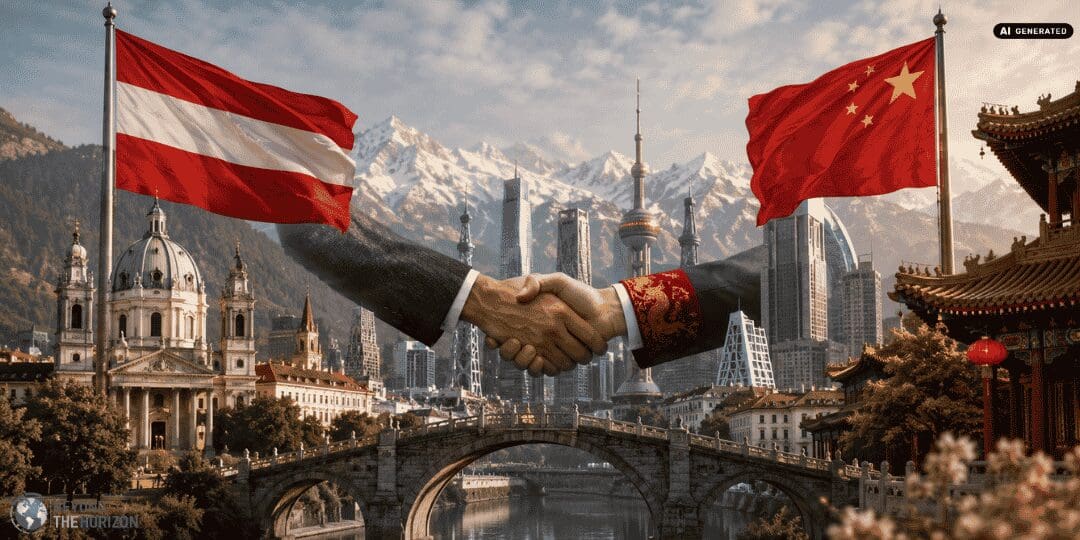
Bilateral Alignment & Sovereignty
Pragmatic Bilateralism Meets European Alignment
In 2026, Austria-China relations are characterized by a highly calculated **pragmatic bilateralism**. As an EU member state, Austria aligns its core strategic directives with Brussels' broader **"de-risking"** (rather than de-coupling) doctrine. Simultaneously, Vienna utilizes its traditional stance of active neutrality to foster direct, practical diplomatic channels with Beijing on climate, high-tech industrial supply chains, and security.
Historical Foundation
55 Years of Ties
Establishing official diplomatic relations in 1971, 2026 marks over half a century of unbroken collaboration. What began as formal recognition has matured into complex industrial and cultural reciprocity.
Trade & Industry
Structured Asymmetry
Austria grapples with a persistent structural trade deficit with China. However, this asymmetry is balanced by highly specialized, high-margin Austrian technological niches that play key roles in China’s modernization.
Global Diplomacy
UNSC Dynamic Leverage
Austria's landslide election to a non-permanent seat on the UN Security Council (2027/28) shifts the geopolitical weight of this relationship. It makes constructive bilateral communication with China (a permanent veto-wielding member) a central Austrian priority.
Soft Power & Exchange
Culture, Science & Eco-Tourism
Deep cultural affinities underpin diplomatic interactions. Austria’s soft power—driven by classical music, cultural heritage preservation, and alpine tourism—creates structural pathways for high-level research, academic networks, and tourism flows.
- Music & Heritage: High resonance of classical music (Vienna Philharmonic, Mozart) in major Chinese metropolitan hubs.
- The Alpine Connection: Mutual knowledge-sharing on sustainable winter sports, accelerated by China's growing post-Olympic alpine market.
- Science & Education: Coordinated university research frameworks targeting climate change mitigation and sustainable manufacturing.
Chronological Milestone Map
2025–2026 Strategic Roadmap Timeline
Stocker Coalition Formed
Chancellor Christian Stocker forms the cabinet. Liberal NEOS party leader Beate Meinl-Reisinger assumes the role of Federal Foreign Minister, shaping a newly balanced pragmatic approach toward Beijing.
Chinese Foreign Minister Wang Yi's Visit to Vienna
Bilateral foundations are prepared in Vienna, mapping out economic parameters, green transition coordination, and setting the cooperative roadmap for the 2026 ministerial travels.
UN Security Council Seat Secured
Austria wins its non-permanent seat for the 2027/28 term, boosting its strategic value to permanent global players.
Foreign Minister Beate Meinl-Reisinger's Working Visit to China
An official five-day ministerial mission to Beijing highlights the 55th anniversary of bilateral relations. Talks concentrate on balancing trade imbalances, resolving market entry barriers, and aligning on UN security affairs.
Strategic Leadership
Key Figures Steering Bilateral Dynamics
Beate Meinl-Reisinger
Federal Foreign Minister
Heads the liberal NEOS party. Promotes a pragmatic, commercial approach combined with clear adherence to EU-wide strategic goals.
Christian Stocker
Federal Chancellor
Oversees the 2025/2026 coalition cabinet, anchoring policy in Austria's constitutional neutrality framework while protecting EU markets.
Wang Yi
Chinese Foreign Minister
Managed key initial dialogue in Vienna (2025), aiming to secure trade access and stable tech channels in the European heartland.
Gregor Koessler
UN Representative
Secured Austria's prominent UN Security Council seat. Bridges working-level ties with permanent Security Council delegations.