
Key Takeaways
- Europe agrees it needs stronger defence, but it still struggles to turn plans into real military capability.
- The EU can raise money faster than it can produce weapons, ammunition, drones, and air defence systems.
- Buying defence equipment remains too slow, fragmented, and expensive across different European countries.
- Joint defence spending will only work if countries agree on common needs, common standards, and shared procurement.
- Europe’s support for Ukraine is still too vulnerable to national vetoes and political disagreements.
- Eastern European countries understand the Russian threat most clearly, but their urgency must become a shared European strategy.
- Ukraine should be treated as a defence partner with valuable battlefield experience, not only as a country receiving aid.
- Defence autonomy will not come from speeches or funding announcements. It will depend on factories, contracts, delivery speed, and political discipline.
Introduction
Europe’s defence debate has moved beyond the stage of strategic diagnosis. The problem is no longer that European governments fail to understand the deterioration of their security environment. Russia’s war against Ukraine, uncertainty about future U.S. commitments, China’s industrial pressure, and the demands of sustained military support for Kyiv have already made the case for a stronger European defence posture. The political vocabulary has changed accordingly. European leaders now speak more confidently about autonomy, preparedness, industrial capacity, and strategic responsibility.
But this rhetorical shift should not be mistaken for structural transformation. Europe is not short of declarations. It is short of conversion mechanisms: the institutions, procurement habits, industrial depth, and political discipline required to turn financial resources into usable military power. That is the central challenge now facing the emerging Defence Union. Europe has accepted that it needs to spend more, produce more, coordinate more, and depend less. Yet the systems through which it is trying to achieve these goals were built for a slower, less dangerous, and more politically permissive era.
The result is a widening gap between ambition and delivery. Europe can mobilise funds faster than it can manufacture equipment. It can announce common instruments faster than it can impose common standards. It can identify threats faster than it can build consensus around risk-sharing. It can praise Ukraine’s battlefield experience faster than it can integrate that experience into procurement, planning, and industrial production. The Defence Union is therefore entering the hard part: not the politics of recognising danger, but the politics of building power.
Money Is Moving Faster Than Capability
The most immediate problem is the mismatch between Europe’s new financing instruments and its still-fragmented defence-industrial base. The Ukraine Support Loan, SAFE, European Peace Facilityreimbursements, and national rearmament programmes all suggest that Europe is becoming more serious about mobilising money. This is not trivial. For years, European defence debates were constrained by underinvestment, fiscal caution, and reliance on the United States. A larger financial envelope marks real movement.
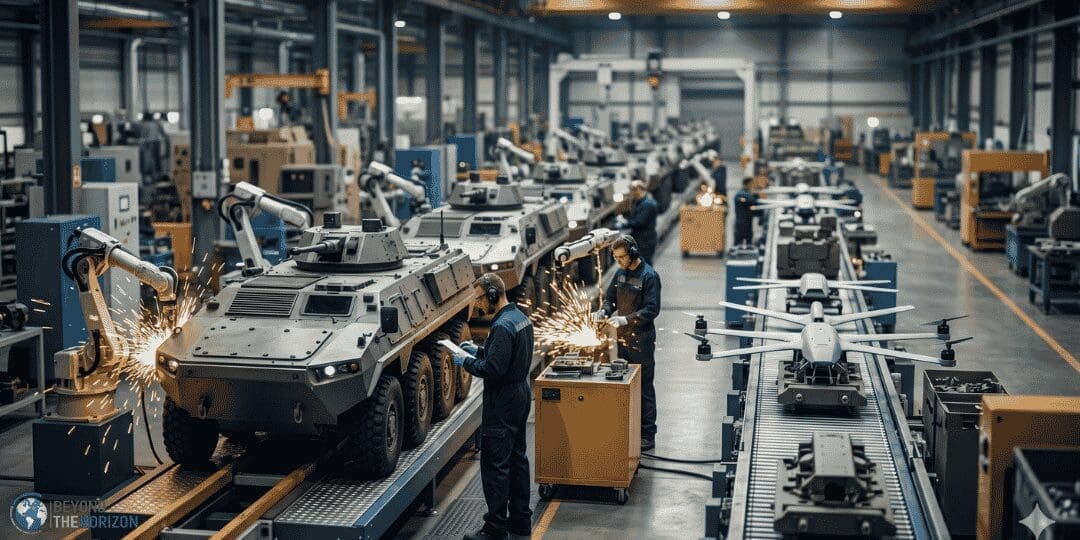
But money is not capability. Defence autonomy is not achieved when Brussels announces a loan, when member states increase headline spending, or when leaders repeat that Europe must “do more.” It is achieved when factories produce ammunition, drones, armoured vehicles, air defence systems, electronic-warfare tools, and secure communications equipment at scale, at speed, and according to specifications that armed forces can actually use.
Europe is still weak on precisely these points. Its defence market remains divided by national preferences, duplicative platforms, incompatible standards, and political protection of domestic industrial champions. Procurement cycles remain slow. Requirements often differ from one capital to another. Industrial surge capacity is limited. Long-term demand signals are still weaker than companies need in order to expand production lines confidently. The result is a dangerous imbalance: Europe can increasingly mobilise cash, but it cannot yet reliably translate that cash into battlefield-relevant output.
This matters most in Ukraine. If financial support arrives faster than Europe’s industry can deliver usable equipment, the EU risks appearing financially serious but militarily inadequate. That is not a harmless contradiction. It raises expectations among partners, creates frustration among frontline states, and exposes the limits of European power at exactly the moment when deterrence requires visible credibility. Defence credibility is not measured by budget announcements. It is measured by delivery schedules, stockpile replenishment, production depth, and battlefield effect.
Procurement Is Becoming the Core Political Test
The Defence Union will succeed or fail on procurement. That may sound technocratic, but it is fundamentally political. Procurement determines whether Europe’s new spending strengthens common capability or simply subsidises national fragmentation at a higher price.
Romania’s threat to scrap overpriced SAFE-funded contracts illustrates the risk. Instruments designed to accelerate joint investment can be distorted by urgency. When governments face compressed timelines, limited suppliers, and political pressure to move quickly, large defence primes gain leverage. Prices rise. Governments accept weak terms. Smaller suppliers struggle to enter the market. “European rearmament” then becomes a transfer of public money to a narrow contractor base without necessarily solving Europe’s strategic weaknesses.
This is not a marginal concern. If Europe reacts to urgency by tolerating inflated pricing and weak procurement discipline, it will reproduce the dysfunction it claims to overcome. Fragmentation will not disappear; it will become more expensive. Dependency will not end; it will shift from external suppliers to a small set of protected European firms. The political case for higher defence spending will then erode quickly, especially in countries facing fiscal pressure and social discontent.
The European Defence Agency’s effort to strengthen procurement capacity is therefore important, but it should not be romanticised. Better staffing, contractual expertise, collaborative purchasing, and off-the-shelf acquisition can improve performance. Yet the EDA cannot solve a problem that member states refuse to solve politically. The agency can coordinate. It can advise. It can help structure joint purchases. But it cannot force governments to surrender national preferences, pool requirements, or abandon domestic industrial carve-outs.
This is the deeper obstacle. European governments often support integration in principle while defending national discretion in practice. They want scale, but not standardisation. They want lower costs, but not fewer national platforms. They want industrial resilience, but also national jobs, national champions, and national visibility. These preferences are understandable, but they are incompatible with the scale and speed Europe now requires.
A credible Defence Union will therefore need procurement discipline in three areas:
- First, member states must converge on common specifications for priority capabilities.
- Second, they must use joint demand to create predictable production pipelines.
- Third, they must accept that not every country can receive equal industrial returns from every programme. Without that political maturity, Europe will continue confusing coordination with integration.
Unity Cannot Depend on Political Luck
European defence solidarity remains too vulnerable to vetoes, domestic politics, and leadership changes. Hungary’s possible shift on European Peace Facility reimbursements may ease one immediate blockage, especially for countries that transferred weapons to Ukraine while expecting compensation. But the broader lesson is uncomfortable: one government was able to obstruct a major support mechanism for too long.
That is not institutional resilience. It is institutional fragility temporarily relieved by political circumstance. A more cooperative government in Budapest may make European defence cooperation easier, but autonomy cannot depend on the personality or positioning of one national administration. If the EU’s major defence-support instruments can be delayed or held hostage by a single capital, then Europe does not yet have a serious wartime governance model.
This problem sits at the heart of the Defence Union debate. A Europe that wants to act as a strategic power cannot rely on procedures designed for low-stakes consensus politics. Unanimity may protect national sovereignty, but it also gives obstructionist governments disproportionate leverage. In peacetime, this is inefficient. In a deteriorating security environment, it is dangerous.
Mario Draghi’s idea of “pragmatic federalism” points toward one possible answer: willing states should move faster where unanimity is impossible. This logic is compelling. Europe cannot allow its most exposed members to be slowed indefinitely by governments that do not share their threat perception. Smaller coalitions can generate momentum, build capability, and demonstrate proof of concept.
Yet variable geometry carries its own risks. A multi-speed Defence Union could harden political divisions inside the EU. Frontline states may integrate faster, while others remain semi-detached. Larger western states may participate selectively, preserving national autonomy while endorsing European rhetoric. Southern states may resist initiatives that appear overly shaped by eastern security priorities. The danger is that differentiated integration becomes not a bridge toward unity, but a formalisation of fragmentation.
The challenge, then, is to use coalitions of the willing without abandoning the goal of common strategic architecture. Europe may need flexible formats, but those formats must feed into shared planning, interoperable systems, and EU-wide industrial capacity. Otherwise, Defence Union will become another label for a patchwork.
Eastern Urgency Must Become European Strategy
Eastern Europe has a strong claim to leadership in the Defence Union debate. Frontline states have warned for years about Russia’s intentions. They have less room for strategic ambiguity and less patience for western hesitation. Their urgency is not theatrical. It reflects geography, history, and direct exposure to coercive power.
This urgency is valuable because it punctures complacency. It forces western and southern Europe to confront the fact that defence is not an abstract policy domain but a condition of political survival. It also pushes the EU to treat Ukraine not merely as a recipient of assistance but as a strategic partner with battlefield knowledge, industrial lessons, and operational experience that Europe badly needs.
Ukraine’s integration into Europe’s defence architecture should therefore be understood as more than solidarity. It is a matter of strategic learning. Ukrainian forces have accumulated experience in drone warfare, electronic warfare, distributed command, air defence adaptation, battlefield repair, and rapid innovation under fire. European militaries and industries should be absorbing these lessons systematically. Ukraine is not only a consumer of European capability. It is also a source of knowledge about modern war.
But eastern leadership contains a trap. If Defence Union becomes perceived as an eastern-flank project, it will fail to become a European project. Western and southern states may treat it as regional pressure rather than common strategy. The agenda could then become politically segmented: eastern members demanding urgency, western members demanding industrial balance, southern members demanding attention to the Mediterranean and migration, and neutral states demanding legal flexibility.
The task is not to dilute eastern urgency. It is to translate it into a strategic framework that all of Europe can recognise. That means connecting the Russian threat to wider questions of industrial resilience, technological sovereignty, energy security, infrastructure protection, cyber defence, and democratic stability. Eastern Europe can lead, but it must lead in a way that binds the Union rather than creating another caucus within it.
Fiscal Politics Could Break the Consensus
The most underestimated constraint on European rearmament is domestic affordability. Governments can raise defence spending for a period, especially under conditions of acute threat. But rearmament cannot be sustained indefinitely if voters experience it as a direct competitor with wages, welfare, energy affordability, housing, and public services.
Italy’s warning over SAFE exposes this tension. The argument that energy resilience and defence should be treated together is not simply opportunistic. Defence capacity depends on industrial capacity, and industrial capacity depends on energy costs, infrastructure, and supply-chain resilience. A Europe that creates fiscal space for weapons while refusing comparable flexibility for energy and industrial competitiveness risks undermining the very production base it needs.
This is politically explosive. Defence spending is easier to justify when it is presented as protection. It becomes harder when citizens see it as austerity by another name. If governments ask voters to accept higher military expenditure while living standards stagnate, the consensus will weaken. Populist parties will exploit the trade-off. Neutralist arguments will gain traction. Ukraine fatigue will deepen. Strategic seriousness will be reframed as elite indifference to domestic hardship.
A sustainable Defence Union must therefore link rearmament with social and industrial resilience. This does not mean pretending that every public expense is a defence expense. That would be analytically lazy and fiscally dangerous. It means recognising that defence production depends on energy systems, transport networks, skilled labour, critical minerals, digital infrastructure, and public legitimacy. Military power is not produced in isolation from the economy that sustains it.
Neutrality Is Useful, But It Is Not Solidarity
Austria’s neutrality debate illustrates another structural complication. Neutral states can contribute to European security in meaningful ways. They can support resilience, civil protection, logistics, cyber defence, industrial production, air defence initiatives, and EU financing instruments. Their participation should not be dismissed.
But neutrality cannot be treated as equivalent to full defence solidarity. A neutral state that contributes selectively is useful; it is not the same as a state willing to assume alliance risk. Europe needs to be honest about this distinction. Pretending that all forms of participation are strategically equal may make diplomacy easier, but it weakens analytical clarity.
The Defence Union will have to accommodate different constitutional traditions while still building credible collective capacity. That balance will be messy. Neutral states should be integrated where they add value, but the core of European defence credibility will depend on states willing to plan, procure, deploy, and, if necessary, fight together. Strategic autonomy cannot be built entirely around opt-outs.
Conclusion
Europe’s Defence Union is not failing, but it is not yet succeeding either. It is entering the decisive phase where language must become machinery. The question is no longer whether Europe understands the need for autonomy. It does. The question is whether it can build the systems that autonomy requires.
That requires a severe shift in political behaviour. Money must become production. Procurement must become discipline. National preferences must give way to common specifications. Eastern urgency must become European strategy. Neutrality must become usable contribution without being confused with full solidarity. Fiscal flexibility must support both rearmament and the economic base that makes rearmament sustainable. Above all, unity must be institutionalised rather than hoped for.
The central danger is performative seriousness: a Europe that speaks the language of power while retaining the habits of dependency. Announcements, funds, summits, and strategy papers matter only if they reduce the time between political decision and military effect. In defence, credibility is cumulative and material. It is built through stockpiles, factories, contracts, logistics, trained personnel, interoperable systems, and trusted decision-making procedures.
Europe is closer than it was to understanding what autonomy means. But understanding autonomy is not the same as possessing it. The next phase will be unforgiving because it will expose whether the EU can convert crisis awareness into durable capability. If it cannot, Defence Union will remain an ambitious vocabulary attached to an inadequate machine. If it can, Europe may finally begin to close the gap between its strategic environment and its strategic capacity.