
Key Takeaways
- Hedging is strategy, not drift: Europe’s Indo-Pacific moves reflect insurance-seeking behavior under high uncertainty, combining diversification, engagement, and risk reduction rather than indecision.
- The EU–India trade deal is meaningful but bounded: Its scale and symbolism matter, but carve-outs, quotas, phase-ins, and rules-of-origin limit any claim that India can rapidly substitute for China in European supply chains.
- Regulatory power constrains geopolitics: Instruments like CBAM demonstrate that EU trade agreements do not override core regulatory commitments; they export governance models that can deepen ties while generating new frictions.
- Engagement with China is risk management, not realignment: Cases such as Finland show that dialogue and economic contact coexist with hard security ceilings set by NATO membership and threat perceptions.
- The UK mirrors the dilemma in sharper form: Outside the EU, London faces stronger growth and investment pressures with fewer collective tools, reinforcing that engagement does not imply trust or tilt.
- Strategic autonomy has limits: Europe can diversify partners and preserve options, but it cannot escape structural dependencies or indefinitely postpone harder alignment decisions.
- The hedge buys resilience, not resolution: Europe’s current approach mitigates vulnerability to shocks, but it does not settle the underlying question of how far economic interdependence can coexist with systemic rivalry.
Introduction: Hedging and strategic autonomy in an age of shocks
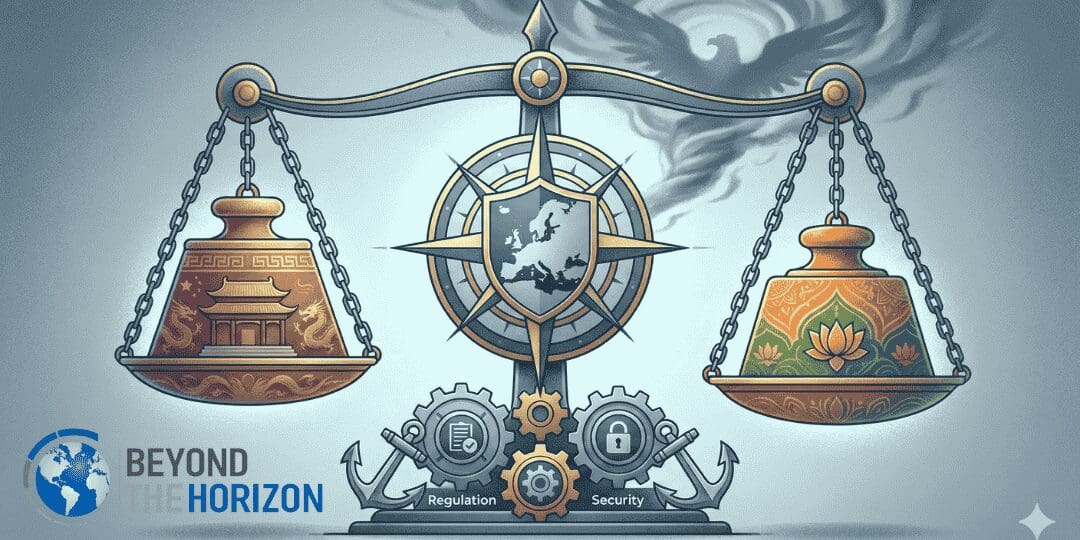
“Hedging” is not a synonym for indecision. In international-relations scholarship, it is typically defined as insurance-seeking behavior under high uncertainty and high stakes: states avoid taking rigid sides and instead combine partly contradictory moves to preserve fallback options.
That definition matters because Europe’s recent Indo-Pacific-facing decisions look less like a linear pivot and more like a portfolio strategy: diversify economic exposure, preserve diplomatic access, and reduce vulnerability to coercion—without pretending that hard alignment choices have disappeared.
This logic is already embedded in the EU’s own doctrine. The EU’s 2023 Economic Security Strategy explicitly frames security as rooted in resilience: diversify and strengthen value chains, partner broadly, and “further… and finalis[e] free trade agreements” while investing in “secure links” globally.
In parallel, the EU’s Indo-Pacific strategy (2021) says the bloc intends to increase its engagement across a region “increasingly strategically significant for Europe,” while maintaining a dual-track approach to China: cooperate where possible, protect essential interests, and push back where “fundamental disagreements” exist (including on human rights).
What changed in early 2026 is not Europe’s conceptual interest in this balancing act; it is the perceived cost of not acting. The EU–India trade deal has arrived amid intensified uncertainty about US trade policy and alliance management, including tariff pressure and provocative signals towards Europe, such as threats relating to Greenland and tariff rhetoric. If hedging is “caused by uncertainty,” then that political economy backdrop is not incidental—it is a driver.
The EU–India trade pact as a diversification move with real constraints
The EU–India agreement is, on its face, unusually consequential. Negotiations concluded after roughly two decades of stop-start talks, with leaders publicly framing it as transformational and geared toward opening up a historically protected Indian market while expanding opportunities for European exporters. The macroeconomic baseline also matters. The EU-India trade deal is more than just a symbol of the relationship between the two sides, as shown by the $136.5 billion in trade that took place between them in India's fiscal year, which ended in March 2025.
In terms of trade mechanics, the reported market-access package is extensive but not unconditional. Tariffs on around 96.6% of EU exports to India (by value) would be eliminated or reduced, with the EU projecting significant savings in customs duties for European firms and expecting EU exports to India to double by 2032. Over seven years, the EU would cut tariffs on 99.5% of goods imported from India, with many tariff lines falling to zero (including segments such as textiles, chemicals, leather and footwear, and gems and jewellery).
Yet calling this a clean “turn to India” is analytically sloppy. The deal is as notable for its carve-outs, quotas, and long phase-ins as for its liberalization headline. In the politically sensitive showcase sector of automobiles, there are threshold exclusions, quota ceilings and staged tariff reductions. There is explicit disagreement about how quickly the full reductions will occur, with Indian officials suggesting a faster timeline than an EU official. Agriculture is also constrained: major agricultural items (such as beef, rice, sugar, dairy, and poultry) excluded, and safeguard mechanisms contemplated for market disruption.
The more fundamental critique of “India as Europe’s supply-chain alternative” is that agreements do not automatically rewire production networks. The same Reuters detail sheet makes clear that rules-of-origin and anti-circumvention provisions are built in precisely because both sides anticipate complex re-routing incentives and political backlash.
The timeline is also not yet finalised: legal vetting and approval steps are still pending from EU governments, the European Parliament and India, with implementation expected within roughly a year and the legal review taking months.
Carbon rules illustrate what “hedging” can and cannot buy
The user-provided framing emphasizes diversification and insulation from external shocks. That is plausible—but the EU–India deal also reveals a hard edge: Europe’s regulatory state is itself a source of friction, and trade agreements do not automatically neutralize it. The clearest example is the EU’s Carbon Border Adjustment Mechanism (CBAM). Official EU documentation states CBAM’s definitive regime begins in 2026 (after a transitional phase), with requirements tied to emissions embedded in imports of carbon-intensive goods. The EU–India deal does not modify CBAM; EU officials stressed there is neither the intention nor even the legal possibility to discriminate among countries in CBAM implementation. India sought reassurances about not receiving worse treatment than other partners; the EU position was effectively: “no special carve-outs for anyone,” because the mechanism is designed as non-discriminatory trade policy aligned to EU climate law.
This matters for the hedging thesis because it undercuts a common rhetorical leap: the idea that mega-deals automatically “anchor” geopolitical alignment. They do not. Instead, the EU is exporting a governance model (carbon accounting, border administration, enforcement). That can deepen interdependence, but it can also generate distributive conflict—especially for sectors like steel. Specific numbers that highlight this constraint: even as India gains market access, there is no India-specific exemption from carbon duties; and technical workstreams are created to help verify carbon footprints.
China’s Finland diplomacy shows engagement under security shadow
The second pillar of the “hedge” is selective engagement with China. The Finland case is instructive precisely because it sits at the intersection of economics, security, and narrative contestation.
During the Beijing visit of Finnish Prime Minister Petteri Orpo, Xi framed China as a partner for upholding a UN-centered international system and for advancing a multipolar order rooted in economic globalization—while explicitly encouraging Finland to play a “constructive role” in promoting stable China–EU relations. This is classic Beijing messaging: “multipolarity” plus “international system,” coupled to an invitation for European interlocutors to help stabilize relations with the EU as a bloc. The Chinese foreign ministry’s readout echoes that framing and goes further: it asserts “China and the EU are partners, not rivals,” invites Finnish firms into China’s market, and highlights “strategic autonomy” language attributed to Orpo.
However, it would be wrong to treat this as evidence of European realignment. It is important to note that Finland’s engagement is taking place amid heightened security concerns relating to Arctic strategy, NATO planning and incidents involving undersea infrastructure. Orpo’s own public messaging was explicitly conditional: he raised Ukraine, called the EU–China trade relationship “unbalanced,” and said human rights issues and the rules-based order were discussed.
Engagement with China is not merely transactional; it is also risk management in a security environment where European states have strong incentives to keep channels open while preparing for worst-case contingencies. Finland is a NATO ally (formally joining in April 2023), which structurally ties its defense posture to the Euro-Atlantic security system. That fact alone makes a “pivot to China” interpretation close to absurd: the strategic ceiling for Finland’s China policy is set by alliance commitments and threat perceptions, not by trade diplomacy.
The UK’s China reset: a non-EU version of the same dilemma
The UK case matters because it shows this balancing logic is not confined to EU institutions. Starmer’s January 2026 visit was the first by a British prime minister in eight years, framed as a reset emphasizing cooperation on trade, investment, and technology. Practical deliverables include 30 days of visa-free access for British citizens and reduced tariffs on whisky, as well as a $15 billion investment commitment announced in China.
Amid global turbulence, London and Beijing called for a 'strategic partnership', both sides implicitly referencing U.S.-driven disruption to the international order. However, the reset is surrounded by controversy at home and among allies, with espionage allegations, China’s stance on Russia’s war in Ukraine and repression in Hong Kong cited as key sources of distrust. UK officials are attempting to reconcile economic opportunity with the insistence that the relationship must allow for open dialogue on disputes, including human rights concerns such as the case of Jimmy Lai.
Analytically, the UK illustrates a sharper version of the European constraint problem. Outside the EU, London has fewer collective economic instruments but remains vulnerable to growth pressures, investment needs, and supply-chain risk—while its security establishment remains among the most China-skeptical in Europe. A reset is therefore not a sign of pro-China tilt; it is a bet that engagement can be bounded—and that boundaries will hold under pressure.
Conclusion
Europe’s Indo-Pacific posture is best understood not as a drift toward a new center of gravity, but as a structured response to compounding uncertainty. The EU–India trade pact, selective engagement with China, and parallel moves by non-EU actors such as the UK are not steps along a single vector. They are components of a hedge: an attempt to preserve room for maneuver as economic interdependence, security commitments, and regulatory power increasingly pull in different directions.
What distinguishes the current moment is not conceptual novelty but urgency. Heightened volatility in U.S. trade policy, sharper geopolitical shocks, and the weaponization of economic ties have raised the cost of passivity. Europe is acting less because it has resolved its strategic dilemmas than because not acting now appears riskier. Yet the cases examined here show that hedging has hard limits. Trade agreements do not rewire supply chains overnight, regulatory instruments like CBAM impose non-negotiable constraints, and security alignments—NATO membership above all—set clear ceilings on how far engagement with China can go.
The result is an Indo-Pacific strategy that is neither incoherent nor decisive in the traditional sense. It is internally consistent but structurally constrained: diversification without decoupling, engagement without alignment, and autonomy without illusion. Any analysis that reads these moves as a clean “pivot” to India or a softening toward China misses the point. Europe is not choosing sides so much as buying time—and insurance—under conditions where long-term choices remain unresolved and potentially unavoidable.