Training Tomorrow’s Leaders Today: The Role of AI-Driven Simulations in Modern Defence
Europe is at a turning point in defence innovation. Modern military leaders operate in an environment of growing complexity; hybrid threats, multi-domain operations, cognitive warfare, and rapid technological change all demand fast, accurate decisions under intense pressure.[1] Conventional training methods, which rely on a limited set of predefined scenarios and static exercises, are increasingly unable to build the agility and judgment that tomorrow’s conflicts will require.
The European Defence Fund (EDF) 2026 offers Europe a timely and strategic opportunity to take the lead in responsible, human-centred AI for defence. One of its key research topics, Modelling and Simulation-Supported AI Framework for Military Decision-Making and Training (EDF-2026-RA-SIMTRAIN-MSAI), directly addresses this gap.[2] With an indicative budget of €16 million, the topic calls for intelligent simulation environments that generate realistic scenarios, draw on historical data and doctrinal models, and deliver dynamic, adaptive learning experiences. When built with operational context, ethical safeguards, and end-user needs at their core, these systems can deliver far more than better training. They can create more resilient, adaptable, and trustworthy military capabilities for the decades ahead.
Why Traditional Training Falls Short
Static exercises and scripted simulations have served military training well for decades. But the modern battlespace is fundamentally different. Multi-Domain Operations (MDO), where actions across land, sea, air, cyber, and space must be coordinated in real time, demand a level of cognitive adaptability that fixed-format training rarely develops. Hybrid threats blur the line between war and peace. Cognitive warfare targets the decision-making process itself.
Against this backdrop, NATO’s Allied Command Transformation has recognised that the Alliance must shift “from static, event-driven training to competitive, free-play events in a persistent, advanced modelling and simulation environment.”[3] This is precisely the gap that AI-driven simulation is designed to fill.
What AI-Driven Simulations Make Possible
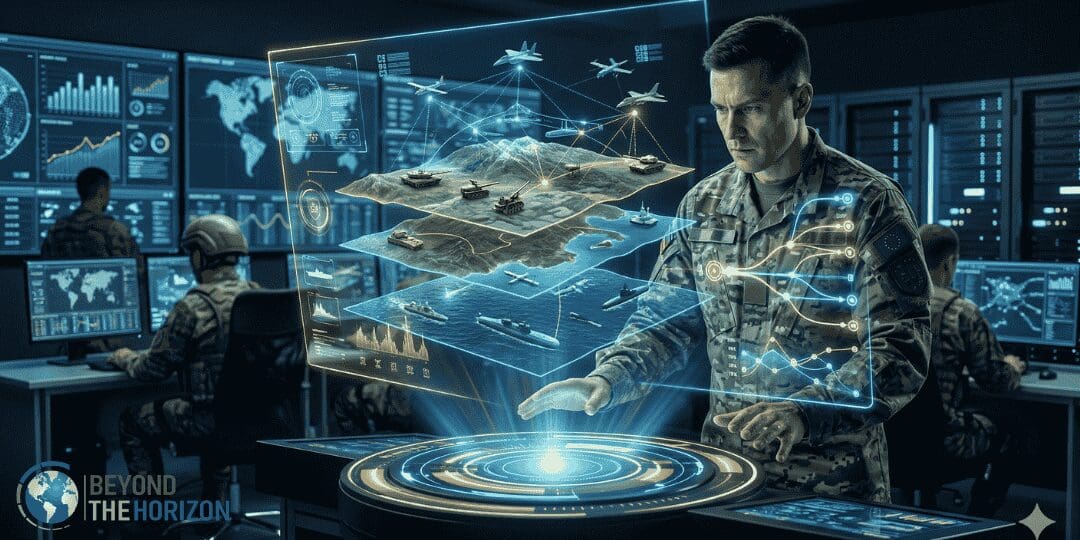
AI-powered simulation environments can generate thousands of varied scenarios in seconds. They allow commanders and staff officers to rehearse difficult decisions, analyse multiple courses of action, observe outcomes, and refine their judgment, in a completely risk-free environment.[4] The result is faster skill development, deeper institutional learning, and significantly higher collective readiness.
The EDF 2026 call outlines four concrete use cases that capture the scope of this potential:[2]
- Multi-Domain Operations performance assessment — AI generates synthetic terrain, operation orders, and experiment sequences, while providing real-time guidance during execution and automated analysis at the conclusion.
- Human-Machine teaming — Adaptive levels of automation allow flexible transitions between human and AI control, exploring how authority and decision-making can be shared effectively under uncertainty.
- AI-assisted Course of Action (COA) development — AI reduces the time and cognitive load required to develop, analyse, and select the most suitable course of action for the next phase of an operation.
- Synthetic data generation for AI training — Where real-world data is unavailable or too dangerous to collect, simulation generates the training data that AI systems need to learn from.
NATO’s own experience with AI in wargaming points in the same direction. Generative AI tools have already been used to simulate red and blue team strategies during strategic-level wargames, helping participants explore complex decision spaces more dynamically and receive faster, more tailored feedback.[5] NATO’s Modelling & Simulation Centre of Excellence (M&S COE) is developing similar capabilities through initiatives such as its WISDOM platform and the emerging MAIDEN (Military AI for Decision-making Experimentation in NATO) concept, which uses synthetic environments to train neural networks through iterative simulation.[6]
Recent NATO Science and Technology Organization (STO) research has demonstrated that next-generation simulation systems, integrating dynamic multi-agent models with virtual and augmented reality, can be validated through NATO-aligned standards and deployed in complex multi-domain environments.[7] This establishes a clear technical foundation for the ambitions set out in EDF 2026.
The Human Dimension: Why Technology Alone Is Not Enough
Across all these advances, one principle holds firm: humans must remain in command. AI should function as an intelligent assistant, offering insights, highlighting risks, and accelerating analysis, while human judgment, ethical reasoning, and final responsibility stay central.[5]
This is why the EDF 2026 call explicitly requires Explainable AI (XAI) features, configurable Human-in-the-Loop (HITL) and Human-on-the-Loop (HOTL) control layers, and compliance with international law and military rules of engagement.[2] These are not bureaucratic checkboxes. They are the foundations of trustworthy AI, and trustworthiness is what makes AI usable in high-stakes operational environments.
Ethics by design, careful attention to human factors, and robust Concepts of Operations (CONOPS) must therefore be integrated from the earliest stages of system development. Doing so ensures that AI capabilities are not only technically sound, but operationally viable, legally compliant, and accepted by the military users who will rely on them.
Building a European Ecosystem for Defence Simulation
EDF 2026 is not only about developing individual tools. It aims to build a European simulation ecosystem, one that integrates academia, industry, and defence stakeholders, promotes common AI ethics frameworks and validation protocols, and establishes shared standards for interoperability across EU Member States and partner nations.[2]
This is an ambitious but necessary goal. As the EDF call document notes, the maturity of AI standards varies significantly across EU countries and industries. Creating a common, scalable, and reusable AI development environment, one that integrates seamlessly with existing command-and-control (C2) systems, is a precondition for sustained European strategic autonomy in defence.[2] The NATO M&S Centre of Excellence, which brings together over 300 modelling and simulation experts from more than 30 nations, demonstrates what a mature collaborative ecosystem can achieve, and sets a benchmark for what Europe must now build at scale.[8]
Achieving this will require more than technical excellence. It will require proposals that combine advanced AI capabilities with realistic hybrid and multi-domain threat scenarios, strong integration of social sciences and humanities, and practical training curricula that military users can readily adopt. It will also require effective project coordination, meaningful dissemination of results, and a clear path from research to operational capability.
How Beyond the Horizon ISSG Can Contribute
At Beyond the Horizon ISSG, we bring together former military officers, war academy instructors, and NATO-experienced defence professionals. We understand both the operational requirements that drive these challenges and the research and policy frameworks through which solutions must be developed.
We believe that the most competitive EDF 2026 proposals will achieve the right balance between technical ambition and operational relevance, and that this balance does not happen automatically. It requires deliberate attention to human factors, ethics by design, CONOPS development, and end-user engagement throughout the project lifecycle.
We warmly invite system integrators, research institutes, and technology developers preparing proposals to consider collaboration with us. As an experienced horizontal partner, we can lead or make a significant contribution to work packages covering:
- Ethics by design and responsible AI frameworks
- Human factors in AI-supported training environments
- CONOPS development and military validation
- Dissemination, exploitation, and project coordination
We are committed to ensuring that promising technical solutions translate into operationally viable, ethically compliant, and strategically valuable outcomes, for Europe’s military users and for Europe’s long-term defence.
References
- NATO, Strategic Concept (2022). https://www.nato.int/en/about-us/official-texts-and-resources/strategic-concepts/nato-2022-strategic-concept
- European Commission, EDF 2026 Call Topic Descriptions, Topic EDF-2026-RA-SIMTRAIN-MSAI (December 2025). https://defence-industry-space.ec.europa.eu/document/download/2cd25753-d14f-4019-8fdf-68cca55b7f17_en
- NATO Allied Command Transformation, Building Deterrence: Pushing the Boundaries of Defence Innovation — I/ITSEC 2024 (December 2024). https://www.act.nato.int/article/iitsec-2024/
- NATO Science and Technology Organization (STO), Developments in Artificial Intelligence – Opportunities and Challenges for Military Modeling and Simulation (2023). https://www.sto.nato.int/document/developments-in-artificial-intelligence-and-opportunities-and-challenges-for-military-modeling-and-simulation/
- NATO Allied Command Transformation, Harnessing Artificial Intelligence: ACT at the Forefront of NATO Innovation (April 2025). https://www.act.nato.int/article/harnessing-artificial-intelligence/
- Naval Technology, DSET 2025: NATO Disclose Priorities in Modelling and Simulation (July 2025). https://www.naval-technology.com/news/dset-2025-nato-disclose-priorities-in-modelling-and-simulation/
- NATO STO, Next-Generation Immersive Simulation System: Integrating Dynamic Multi-Agent Simulation with VR/AR for Advanced Military Training, Planning, and Operations, STO-MP-MSG-229 (2025). https://www.sto.nato.int/document/next-generation-immersive-simulation-system-integrating-dynamic-multi-agent-simulation-with-vr-ar-for-advanced-military-training-planning-and-operations/
- NATO M&S Centre of Excellence, Advancing NATO’s Capabilities Through its Modelling & Simulation Centre of Excellence (August 2024). https://www.act.nato.int/article/ms-coe-2024/
Related Publications