Key Takeaways
- Trump’s second-term strategy explicitly revives Monroe-style hemispheric dominance, defining the Western Hemisphere as a privileged U.S. sphere and treating migration, cartels, and Chinese influence as primary security threats.
- The regime-change operation against Nicolás Maduro represents an extraordinary assertion of U.S. custodianship over Venezuela’s political future—revanchist in tone and imperial in practice.
- Europe is deliberately downgraded: Ukraine is pressured toward settlement, U.S. troop commitments are reconsidered, and allies are expected to shoulder greater burdens regardless of their preferences.
- China is framed primarily as an economic rival, while Russia is treated as a potential partner in restored “strategic stability,” reflecting a transactional rather than ideological lens.
- Despite anti-interventionist rhetoric, the administration uses military force aggressively across the Middle East and Africa, particularly against Iran-linked actors and insurgents.
- The underlying logic is nationalist and hierarchical: U.S. interests trump alliance norms, sovereignty is conditional in the hemisphere, and multilateralism is subordinated to leverage.
- The long-term risks are substantial—regional backlash, weakened alliances, and strategic vacuums that adversaries may exploit.
Introduction
In his second term, President Donald Trump has pursued a foreign policy that many argue revives the spirit of the 19th-century Monroe Doctrine. Under the banner of “America First,” Trump’s strategy has tilted toward asserting U.S. primacy in the Western Hemisphere while pulling back from some traditional commitments in Europe and elsewhere. This analysis examines recent developments – from the dramatic detention of Venezuela’s Nicolás Maduro to shifts in Ukraine, China-Russia, Middle East, and Indo-Pacific policies – and compares the Trump Doctrine with the original Monroe Doctrine.
The Monroe Doctrine Reborn in Spirit
The Monroe Doctrine (1823), proclaimed by President James Monroe, warned European powers against further colonization or interference in the Western Hemisphere. In exchange, the U.S. would stay out of European wars. It established the Americas as a U.S. sphere of influence and laid the groundwork for future U.S. interventions in Latin America. The doctrine was fundamentally defensive – “keep the Old World out of the New” – but over time it gained an interventionist twist (e.g. the Roosevelt Corollary) to justify U.S. policing of the hemisphere.
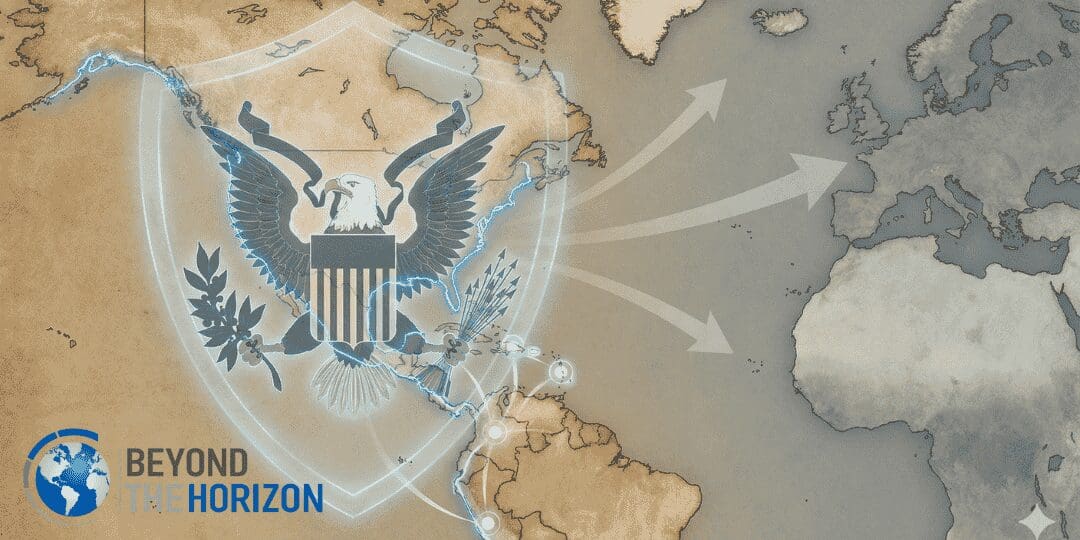
The Trump Doctrine (2025-), as reflected in Trump’s new National Security Strategy (NSS), explicitly reiterates the Monroe Doctrine with a “Trump Corollary” for the 21st century. The 2025 NSS refocuses U.S. priorities on homeland defense and the Western Hemisphere, unabashedly asserting a neo-imperialist presence in the region. It identifies three primary threats in the Americas: mass migration, drug cartels and crime, and Chinese influence. Trump’s strategy regards any significant migration into the U.S. as a security threat, and it claims the right to deploy U.S. military force against cartels or “criminal organizations” anywhere in the hemisphere. This muscular stance goes hand-in-hand with a rejection of past U.S. apologies – a sharp contrast to prior diplomacy – even at the cost of inflaming regional resentments about Yankee imperialism.
A central element of Trump’s approach is pushing external powers out of Latin America, hearkening back to Monroe’s aim of excluding European meddling. The administration has vowed to roll back China’s economic and strategic footprint in the Americas – from port projects to telecom networks – effectively declaring Latin America off-limits to Beijing’s influence. Russian ventures in the region are similarly unwelcome. In fact, Trump’s NSS “Trump Corollary” frames the Western Hemisphere as uniquely vital to U.S. security and signals that extra-hemispheric powers like China and Russia will be excluded from significant influence in the region. In spirit, this is a revival of Monroe’s doctrine of hemispheric dominance, albeit enforced with modern U.S. military and economic power.
At the same time, much like Monroe pledged non-involvement in Europe, Trump has shown a willingness to “keep out of Europe’s quarrels” – or at least to downgrade them – as part of his America-first ethos. The NSS even speaks of a Monroe Doctrine for the 21st century implying a U.S. pullback from European entanglements. As discussed below, this has manifested in a cooler commitment to NATO and a pressure campaign for Ukraine to seek peace on Russia’s terms, underscoring that the Trump Doctrine is as much about retrenchment abroad as it is about domination in the U.S. backyard.
Regime Change in the Western Hemisphere: Maduro’s Detainment
The clearest example of Trump’s Monroe Doctrine–style assertiveness was the U.S. operation to capture Venezuelan president Nicolás Maduro on January 3, 2026. In a bold military strike, U.S. special forces detained Maduro and transferred him to the United States to face trial on drug trafficking charges – a move unprecedented in recent Latin American history. Trump announced that this was not merely an extradition but a full-fledged regime change effort. In his words, the U.S. would “run the country” temporarily until a “safe and judicious transition” to new Venezuelan elections could occur. Effectively, Washington has assumed custodianship of Venezuela’s political future, a staggering extension of U.S. power in the hemisphere.
From Trump’s perspective, the hemisphere-first strategy is already yielding dividends. The Maduro raid was touted as one of the top foreign-policy victories of Trump’s new term (alongside forcing NATO allies to boost defense spending and clandestine strikes degrading Iran’s nuclear program). It dramatically demonstrated U.S. military might and, reestablished deterrence globally showing rivals in Beijing and Moscow that the U.S. will enforce a security order on its terms. Still, the aftermath in Venezuela is fraught with uncertainty. The U.S. has effectively decapitated Caracas’s regime, but it now “bears responsibility for the eventual outcome in Venezuela,” including shepherding a stable transition in a country rife with armed gangs and factions. Washington’s bold move may open a path to democracy in Venezuela, or it could unleash chaos if regime loyalists resist – a risk the administration acknowledges as it signals it won’t shy away from future interventions in the region.
Ukraine: Reluctant Support and Pressure for Peace
Trump’s second-term approach to Russia’s war in Ukraine marks a sharp departure from the robust support Ukraine received in the intervening Biden years. While not openly renouncing the Ukrainian cause, the Trump administration has been notably reluctant to deepen U.S. involvement and has instead pressured Kyiv to consider a negotiated end to the conflict – even if that means painful concessions. European allies have been “taken aback” by Trump’s refusal to commit additional military aid to Ukraine and his heavy pressure on President Volodymyr Zelenskyy to accept Russian demands. In practice, Washington under Trump has signaled that Ukraine may have to cede sovereignty over some Russian-occupied territories to stop the war. This stance horrifies many Europeans, who believe anything short of Russia’s defeat could embolden Kremlin aggression across Europe.
Trump defends his Ukraine policy as realism: Europe, with far more at stake, should carry more of the burden, and the U.S. must avoid a potential World War III scenario. In line with a quasi-Monroe Doctrine mindset, the administration has de-emphasized Europe’s conflicts in favor of challenges at home and in Asia. The Pentagon’s guidance reflects this shift – U.S. defense officials have been directed to “accept increased risk in Europe” so that military resources can be redirected elsewhere. Indeed, Trump’s Defense Secretary Pete Hegseth launched a review likely to reduce the U.S. troop presence in Europe, signaling that defending Ukraine (and even deterring Russia) is now a lesser priority.
China and Russia: Confrontation and Realignment
China and Russia pose the central great-power challenge in U.S. foreign policy, and Trump’s second-term strategy has recalibrated America’s stance toward each. In many ways, Trump’s approach to these rivals mixes toughness with a transactional bent and diverges from the traditional U.S. posture of the past decades.
With China, the Trump administration has maintained a hard line, especially on economic and geopolitical fronts – yet with some notable differences in emphasis. The 2025 NSS describes China primarily as an unfair economic competitor and a technological rival, “viewed almost entirely through an economic lens” rather than as a looming military threat. Trump has doubled down on tariffs, trade deal renegotiations, and export controls on advanced technology to “rebalance” the U.S.-China economic relationship toward something more “mutually advantageous.” At the same time, his strategy does affirm key elements of continuity in the Indo-Pacific: it opposes any unilateral Chinese takeover of Taiwan, it supports freedom of navigation operations in the South China Sea, and it endorses the Quad alliance (U.S., Japan, India, Australia) as a bulwark in the region. In other words, on paper Trump upholds the Indo-Pacific commitments familiar to past administrations – defending the status quo in Taiwan Strait, keeping sea lanes open, and working with allies – but in practice, his prioritization is different. The NSS pointedly does not elevate the Indo-Pacific as the foremost theater; in fact, Asia “does not emerge as a focal point until nearly halfway through the document”, and the U.S. military is expected to play only a supporting role in Asia. The burden of deterring China, Trump implies, should increasingly fall on regional allies (who he expects to spend more on their own defense and do more of the fighting if conflict comes).
Trump’s handling of China is thus a mix of combative economic nationalism and selective security commitments. Importantly, his revived Monroe Doctrine at home means China’s influence in Latin America or other parts of the Western Hemisphere is being actively rolled back. Projects from Chinese telecom contracts to port leases have been curtailed or scrutinized under U.S. pressure, and Beijing’s attempts to forge strategic ties with Latin states face an emphatic U.S. “no.” This regional exclusion mirrors Cold War-era moves to keep Soviet influence out – a clear modern application of Monroeist thinking to America’s peer competitor.
On Russia, Trump has pursued a controversial course aiming at rapprochement or at least de-escalation. From the start of his second term, he signaled an openness to restoring ties with Moscow once the Ukraine war can be resolved. His National Security Strategy even expresses a goal of “restoring strategic stability with Russia, someday” – suggesting that, in the long run, Washington hopes to mend fences with the Kremlin. This is a striking contrast to the confrontational stance of the previous administration. Trump’s reluctance to isolate Putin completely (evident in the pressure on Ukraine to negotiate) indicates a belief that the U.S. can “do business” with Russia to balance against China or simply to reduce nuclear risks. Indeed, whereas China is cast as a systemic rival, Russia is often downplayed in Trump’s rhetoric – he frequently notes Russia’s economy is small and its power is limited, implying the threat is overstated. By effectively freezing the Ukraine conflict and forgoing further expansion of NATO in Russia’s neighborhood, Trump aims to remove key irritants in U.S.-Russia relations. The flipside is that East Europeans feel their security being bargained away. Still, Trump appears to calculate that a Russia not backed into a corner could eventually be peeled away from China’s orbit, or at least convinced to return to arms control talks, reviving a degree of U.S.-Russia “stability” (as per Cold War tradition).
Middle East Policy: Hard Line on Iran and Unconventional Engagement
In the Middle East, Trump’s second-term policies have been characterized by an aggressive stance on Iran, an unabashed pro-Israel tilt, and a willingness to use force well beyond what his “no more endless wars” slogan might suggest. Far from disengaging, the U.S. has been militarily active across the region and North Africa – albeit on its own terms.
Iran has been a principal target of the administration’s hard line. President Trump effectively declared that Iran will never be allowed to obtain a nuclear weapon, and he has backed that up with action. On June 22, 2025, U.S. forces reportedly conducted strikes on Iranian nuclear facilities, citing intelligence that Tehran was moving dangerously close to a bomb. Trump triumphantly claimed to have “degraded Iran’s nuclear program” through these strikes, though independent analysts debate the actual effectiveness. The operation drew Iran’s condemnation and raised regional tensions, yet it underscored Trump’s readiness to cross borders to neutralize threats.
Beyond Iran, Trump’s Middle East footprint has included supporting Israel and Arab allies in unprecedented ways. During his first term, Trump brokered the Abraham Accords between Israel and several Arab states; in his second term, that trend continued. By 2025, Saudi Arabia and Israel were reportedly on the cusp of a historic normalization deal, encouraged by Trump’s White House. (This was momentarily derailed by regional flare-ups, but the effort signaled Trump’s intent to redraw Middle East diplomacy.) Trump has also given Israel wide latitude in security operations. His administration firmly backed Israel’s hardline policies toward Palestinians, aligning with Prime Minister Benjamin Netanyahu’s government with little criticism. Trump’s priority was clearly realpolitik: strengthen U.S.-Israel-Gulf partnerships to isolate Iran and terrorism, rather than press for elusive peace deals.
Meanwhile, Trump has quietly ramped up direct counterterrorism and counterinsurgency strikes in the broader Middle East and Africa. Despite his anti-interventionist rhetoric, 2025 saw record numbers of U.S. airstrikes in countries like Yemen, Somalia, Iraq, Syria, and even beyond (e.g. Nigeria in West Africa). The administration loosened rules of engagement in places like Yemen, aiming to hit Iran-backed Houthi militants and Al Qaeda fighters more aggressively – though this “carelessly” led to civilian casualties when U.S. bombs went astray. In Nigeria, U.S. airstrikes targeted Islamist insurgents with mixed results, showcasing a willingness to act outside traditional Middle East theaters. All these actions paint a picture of a U.S. president very much willing to “wage war” where he sees fit, even as he professes to dislike prolonged deployments of ground troops. It’s a kind of high-intensity, short-duration use of force – raids, strikes, and decapitations – which Trump believes avoid the quagmires of large occupations, yet allow the U.S. to eliminate threats decisively.
Conclusion
Taken together, Trump’s second-term foreign policy amounts to a selective revival of Monroeist logic—hemispheric dominance paired with strategic retrenchment elsewhere—but executed with far less restraint than the 19th-century original. The “Trump Corollary” openly asserts a hierarchical regional order in which Latin American sovereignty is subordinated to U.S. security preferences, even to the point of regime decapitation in Venezuela. Meanwhile, Europe is effectively downgraded as a strategic concern, with Ukraine pressured toward settlement and NATO treated as a burden to be minimized rather than a pillar of U.S. leadership.
At the same time, Trump’s economic confrontation with China, tentative courtship of Russia, and punitive military posture toward Iran reveal a willingness to wield state power assertively—but often in short, transactional bursts rather than as part of a coherent long-term strategy. His administration proclaims an end to “endless wars,” yet it is perfectly willing to conduct aggressive strikes and covert operations across multiple regions. The real novelty here is not isolationism or adventurism per se, but the unapologetic re-nationalization of U.S. grand strategy: alliances become tools rather than commitments, norms become optional, and hemispheric primacy becomes the bedrock assumption.
Whether this approach is sustainable remains doubtful. It risks alienating European allies, radicalizing Latin American resentment, and encouraging authoritarian bargains in the name of “stability.” It also depends on the questionable premise that a reduced U.S. footprint in Europe and Asia will not invite revisionist opportunism. If this truly is the return of the Monroe Doctrine, it is a version stripped of subtlety, infused with contemporary nationalism, and underpinned by the belief that power can be exercised decisively without enduring costs. History suggests that confidence may be misplaced.