Key Takeaways
- Duration is the decisive variable: The economically sustainable length of disruption at Hormuz defines the feasible duration of the conflict itself.
- The shock is historically unprecedented: A simultaneous disruption of ~20% of global oil and LNG flows creates systemic, not cyclical, risk.
- Mitigation capacity is structurally insufficient: Pipelines and strategic reserves can buffer only 1–3 months of “manageable” disruption before economic tolerance erodes.
- Nonlinearity is the central danger: The crisis will not deteriorate gradually; it will tip rapidly from price volatility into physical shortages and industrial shutdowns.
- LNG is the critical vulnerability: Unlike oil, gas markets lack storage depth and logistical flexibility, making them the primary trigger for systemic failure.
- East Asia is the global shock absorber: The region’s disproportionate exposure transforms an energy disruption into a global manufacturing and technology crisis.
- Industrial cascades amplify the crisis: Energy shortages propagate into semiconductors, mining, chemicals, and logistics—creating multi-sector breakdowns.
- Economic warfare targets systems, not sectors: The crisis illustrates how disrupting energy flows destabilizes entire production ecosystems.
- Geopolitics is being reordered by material constraints: States are prioritizing energy security over alliance cohesion, accelerating trends toward strategic autonomy.
- Credibility is now logistical, not just military: The ability to maintain stable energy and trade flows is becoming the core metric of geopolitical influence.
Introduction: The Intersection of Military Conflict and Global Economic Stability
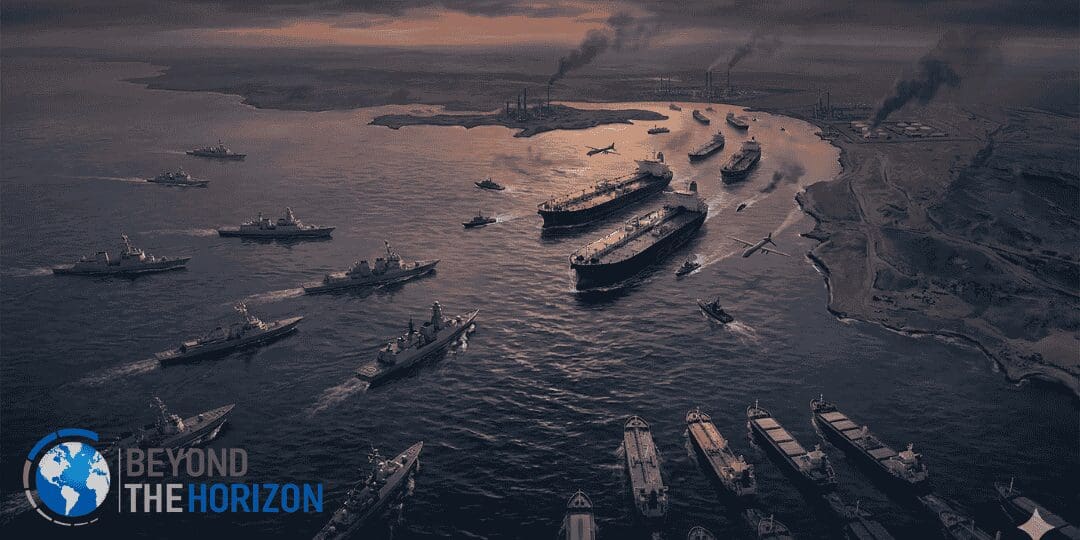
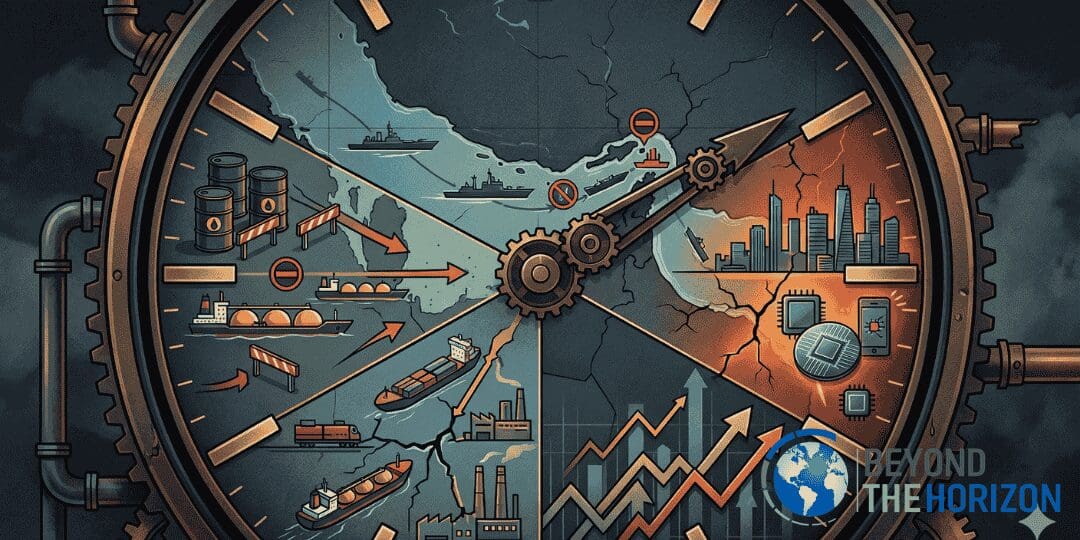
The March 2026 crisis in the Strait of Hormuz represents a profound escalation in the weaponization of maritime chokepoints. Far more than a transit corridor, the Strait has become the “economic clock of war”—the primary mechanism where military duration meets the limits of global economic tolerance. In this high-stakes environment, the duration of effective disruption at Hormuz serves as a direct proxy for the economically viable length of the conflict itself.
The current crisis, precipitated by coordinated U.S.-Israeli strikes on Iran and the subsequent Iranian closure of the Strait, has effectively paralyzed the transit of roughly 21 million barrels per day (bpd) of petroleum liquids. While strategic reserves and bypass pipelines offer a temporary buffer, this analysis argues that the disruption is cumulative and nonlinear. A short-term closure constitutes a manageable oil shock; however, the persistent halt of nearly 20% of global oil demand and 20% of global gas exports threatens a transition into a systemic crisis characterized by rampant inflation, industrial paralysis, and a collapse in global growth.
Quantifying the Disruption: A Comparative Analysis of the 2026 Shock
The 2026 Hormuz crisis is historically unprecedented, dwarfing previous energy shocks in both absolute volume and its simultaneous impact on both oil and gas markets. Unlike the 1973 embargo, which primarily affected oil, the current shock strands 20% of global Liquefied Natural Gas (LNG) trade, creating a “just-in-time” fragility that traditional energy security architectures are ill-equipped to manage.
| Event | Volume Lost (bpd) | Share of Global Demand (%) |
| 1956 Suez Crisis | 2.0 million | 11.4% |
| 1973 Arab Oil Embargo | 4.3 million | 7.4% |
| 1979 Iranian Revolution | 5.6 million | 8.6% |
| 1980 Iran-Iraq War | 4.1 million | 6.8% |
| 1990 Iraq-Kuwait War | 4.3 million | 6.5% |
| 2026 Hormuz Crisis | 20.0 million | ~20.0% |
The acute fragility of the LNG market is compounded by the fact that the disruption is not merely maritime but infrastructural. Following Iranian drone strikes on the Ras Laffan complex—the world’s largest LNG export facility—Qatar has declared force majeure and halted production. This represents a catastrophic loss for Asia, which relies on the Strait for 27% of its total LNG imports. Unlike the crude market, which benefits from established strategic reserves, LNG operates on a logistics-heavy, inventory-lean model. The lack of scalable bypass options for Qatari gas means that once “just-in-time” shipments are exhausted, the crisis shifts from a price event to a fundamental reliability failure in power and industrial sectors.
The Efficacy of Mitigation: Pipelines, Reserves, and the “Stock-to-Flow” Reality
Policymakers and C-suite executives must distinguish between physical availability and economic manageability. While buffers exist, they are being rapidly depleted by a massive net supply shortfall.
The combined available capacity of Saudi and Emirati bypass pipelines is estimated at only 3.5 to 5.5 million bpd. When measured against the 20 million bpd typically flowing through Hormuz, the market faces a Net Shortfall of 14.5 to 16.5 million bpd. This gap represents the actual volume that global markets must offset using emergency stocks.
The IEA’s coordinated release of 400 million barrels—the largest in history—buys time but does not resolve the deficit. Using a “stock-to-flow” ratio based on current net supply losses, the 1.2 billion barrels of public emergency stocks provide a window of only 73 to 83 days. While total emergency stocks (including industry holdings) theoretically extend this to 109–124 days, the “economically manageable window” is significantly shorter—likely one to three months. Political and macroeconomic tolerance for the crisis will likely collapse well before the tanks are empty.
The crisis is already manifesting as a secondary inflationary shock that bypasses physical reserves. Singapore gasoil prices have surged 57% (143.88/bbl), while jet fuel has expanded by 114% (199.66/bbl). We are seeing a Diesel price multiplier effect of 2.3x relative to crude increases, and a Jet fuel premium expansion of 150-200%. These spikes, coupled with the withdrawal of war-risk insurance and record shipping rates, are creating a “Circle of Pain” for global logistics.
The Asymmetry of Exposure: Mapping the Asian Shock Absorber
East Asia bears the brunt of the Hormuz closure, absorbing 80–84% of the direct impact. This regional exposure creates distinct vulnerability hierarchies that dictate the geopolitical “clock.”
- Tier 1: High Resilience (Japan & South Korea): While Japan (254 days) and South Korea (208 days) maintain extensive SPRs, they are acutely vulnerable to the financial volatility of spot markets. Their tech-heavy economies are already reeling, with the Kospi falling 12% and the Nikkei 225 dropping 8.6%.
- Tier 2: The Insulated Giant (China): Beijing possesses significant insulation, with 84.4% energy self-sufficiency and alternative overland routes (Russia/Central Asia). However, its 35-day gas reserve limits its ability to support regional stability, as evidenced by its immediate restrictions on refined fuel exports.
- Tier 3: The Acute Risk (Taiwan & India): These economies face immediate industrial threats. Taiwan holds only 11 days of LNG supply. India, despite official capacity claims, is operating on actual refinery inventories of just 20 to 25 days, creating a critical threshold for domestic stability.
Sectoral Cascades: From Energy Prices to Semiconductor Sovereignty
The crisis illustrates how energy-intensive advanced manufacturing transforms a fuel shock into a technological supply chain catastrophe.
In Taiwan, TSMC accounts for 9% to 10% of total national electricity consumption. The reliance on imported LNG for power generation, combined with minimal reserves, creates a direct threat to AI and high-performance computing chip fabrication. Market realization of this risk has seen TSMC shares and the TAIEX index both fall by 5%.
A critical systemic risk has emerged in the “Mining-Energy” loop. Australia consumes 40% of its diesel in its mining sector. Without access to refined fuel, Australian iron ore production—which accounts for 75% of China’s seaborne iron ore imports—faces a shutdown. This creates a secondary crisis for China’s steel industry and the global construction supply chain.
Simultaneously, the “Chemical Pressure Point” is tightening. Over 90% of global sulphur is a byproduct of oil refining. The halt in refining activity, combined with the suspension of downstream gas production at Qatar’s Ras Laffan, has throttled the supply of sulfuric acid. As a critical input for chip etching and cleaning, this shortage threatens to halt semiconductor production even if power is maintained.
The Geopolitical Reordering: Strategic Autonomy and the Erosion of US Credibility
The conflict forces East Asian governments to navigate the hazardous gap between alliance commitments and energy survival.
- Diplomatic Divergence: China is leveraging the crisis to frame itself as a “responsible stakeholder,”contrasting its calls for de-escalation with what it terms “U.S. unilateralism.” While Japan and Taiwanhave reflexively aligned with the U.S. narrative, South Korea and most ASEAN states have retreated into a “crisis-management neutrality,” prioritizing energy security over military alignment.
- The U.S. Strategic Cost: The “ticking clock” is complicated by the U.S. midterm elections in November. The administration’s policy duration is constrained by the domestic political cost of 114% jet fuel spikes and general inflation. This perception of U.S. policy as a “volatile risk factor” is eroding credibility, pushing allies toward strategic autonomy and alternative diplomatic platforms that prioritize delivery security over traditional security architectures.
Conclusion: The Compression of War into Economic Time
The 2026 Strait of Hormuz crisis demonstrates that modern conflict is no longer primarily constrained by battlefield dynamics, but by the tolerance thresholds of globally integrated economic systems. What emerges is not simply an energy shock, but a structural revelation: duration itself has become the decisive variable of power. The side that can endure economic dislocation longer—not merely militarily, but systemically—gains the upper hand.
The notion of the Strait as an “economic clock” is not rhetorical flourish; it is analytically precise. With a net supply deficit exceeding any historical precedent, mitigation mechanisms—strategic reserves, rerouted pipelines, and financial hedging—serve only to delay, not resolve, systemic stress. Crucially, this delay is nonlinear: the transition from manageable disruption to systemic breakdown is abrupt, not gradual. Once critical thresholds in LNG availability, refined fuel logistics, and industrial inputs are crossed, cascading failures propagate across sectors with increasing speed and decreasing reversibility.
Equally important is the asymmetry of exposure. East Asia’s role as the primary shock absorber transforms a regional energy crisis into a global industrial and technological crisis. The tight coupling between energy inputs and high-value manufacturing—particularly semiconductors—means that energy insecurity now directly threatens the continuity of the digital economy. This is not an ancillary effect; it is central to how economic warfare now operates.
Finally, the geopolitical consequences are neither incidental nor delayed. The crisis accelerates an ongoing shift away from alliance-centric security toward supply-centric pragmatism. States are not abandoning alliances outright, but they are recalibrating priorities under material constraints. Energy reliability, not ideological alignment, becomes the organizing principle of state behavior. In this environment, credibility is measured less by deterrence and more by the capacity to stabilize flows—of energy, goods, and prices.
What the Hormuz crisis ultimately reveals is stark: in a tightly coupled global economy, war is bounded not by military exhaustion, but by systemic economic failure. The “clock” does not tick in days or weeks, but in barrels, shipments, and reserves—and it is running faster than most strategic frameworks are designed to comprehend.