Key Takeaways
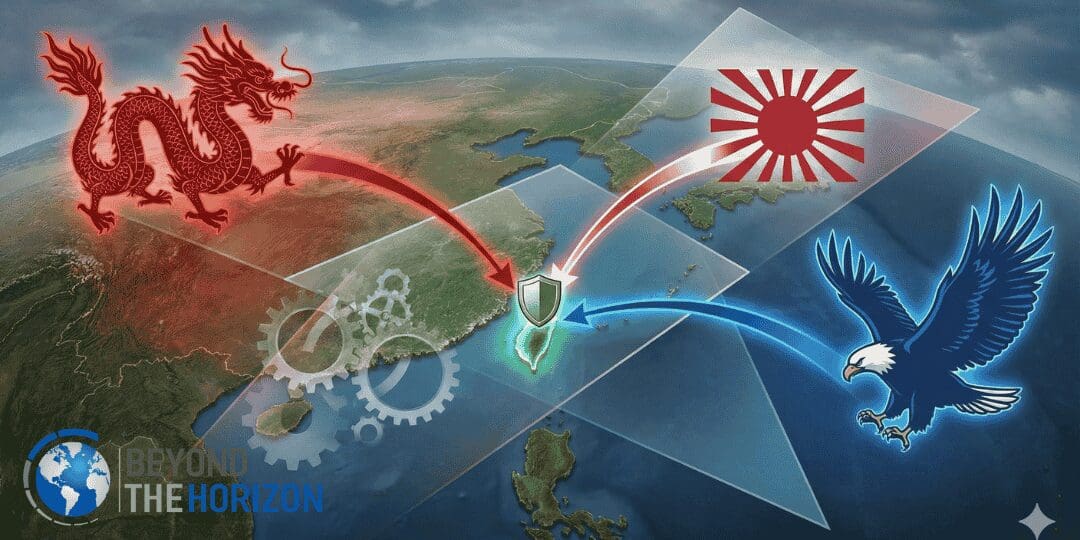
- A Shift to “Strategic Overdrive”: The East Asian security landscape has moved beyond “managed competition” into a volatile four-way dynamic involving China, the U.S., Japan, and Taiwan. This new phase is characterized by the aggressive weaponization of history, where diplomatic narratives and military signaling are inextricably intertwined, making the region more prone to escalation than ever before.
- Beijing’s Weaponization of History (“Lawfare”): President Xi Jinping has launched a “lawfare” offensive by explicitly invoking the 1943 Cairo and 1945 Potsdam Declarations to frame Taiwan’s “return” as a mandate of the post-WWII international order. This strategy aims to trap the U.S. in a diplomatic paradox (implying that supporting Taiwan betrays the Allied victory over fascism) and to leverage historical guilt against Japan to curb its support for the island.
- Taiwan’s Unambiguous Rejection and Militarization: Taiwanese Premier Cho Jung-tai delivered a firm rebuttal to Beijing, declaring that “return is not an option” and asserting the sovereignty of the “Republic of China, Taiwan.” To back this democratic mandate with hard power, President Lai Ching-te’s administration has proposed a massive US $40 billion supplementary defense budget to acquire asymmetric capabilities—such as drones and missiles—signaling that Taiwan is preparing to make any invasion prohibitively costly.
- Washington’s “Crisis Manager” Role: The U.S. is executing a delicate dual-track strategy: publicly emphasizing stability in U.S.-China relations (omitting Taiwan from official readouts to preserve trade talks), while privately restraining allies to prevent accidental escalation. This was highlighted by President Trump’s unusual move to call Japanese PM Takaichi and advise her to “lower the volume” on her rhetoric, reflecting U.S. fears that uncoordinated ally assertiveness could trigger a conflict Washington is not ready to handle.
- Japan’s Strategic Pivot to Centrality: Under Prime Minister Sanae Takaichi, Japan has shed its traditional strategic ambiguity, openly defining a Taiwan contingency as a “survival-threatening situation” that could trigger collective self-defense. Despite facing personal insults and economic coercion (such as seafood bans) from Beijing, Tokyo views the defense of Taiwan as inseparable from its own national security, effectively complicating China’s war planning by guaranteeing a multi-front conflict.
Introduction: A Region Re-Entering Strategic Overdrive
East Asia has entered a period of heightened geopolitical tension. In late November 2025, a flurry of high-level exchanges underscored the complex four-way dynamic among the United States, China, Taiwan, and Japan. A rare phone call on November 24 between China’s President Xi Jinping and U.S. President Donald Trump – followed immediately by Trump’s outreach to Japanese Prime Minister Sanae Takaichi – reactivated the longstanding strategic interplay in the region. Taiwan’s government, for its part, issued its clearest rejection to date of Beijing’s claims of sovereignty over the island. These interactions – Beijing’s assertive invocation of the post–World War II order, Taipei’s firm rebuttal, Washington’s balancing act, and Tokyo’s newly vocal posture – illuminate a critical shift. East Asia appears to be moving from an era of managed competition into one where historical narratives, diplomatic symbolism, and unresolved claims are wielded as instruments of coercive statecraft. In this evolving context, the quadrilateral relationship between China, the U.S., Taiwan, and Japan is no longer merely reactive; it is becoming the primary arena for redefining the regional order and testing the limits of each player’s resolve.
China Reasserts Its Historical Narrative – Testing U.S. Resolve
In late November 2025, the geopolitical equilibrium of East Asia entered a volatile new phase, driven not merely by the movement of fleets and aircraft, but by the aggressive weaponization of history. Beijing has placed a specific interpretation of the past at the very center of its case for Taiwan, executing a calculated bid to legitimize its position globally while simultaneously probing the depth of Washington’s commitment. This strategy was unveiled with stark clarity in the official Chinese readout of the November 24 call between President Xi Jinping and U.S. President Donald Trump. In this exchange, Xi pointedly framed Taiwan’s “return to China” not as a matter of current political dispute, but as “an integral part of the post-war international order.” By invoking the foundational outcomes of World War II—specifically the 1943 Cairo Declaration and the 1945 Potsdam Declaration—Xi anchored China’s modern claims in the legitimacy of wartime settlements, arguing that these documents legally affirmed Taiwan’s restoration to China following Japan’s defeat.
This was no casual historical reference; it was a deployment of “lawfare”—legal warfare—designed to trap the United States in a diplomatic paradox. By tying the Taiwan question to the Allied victory over fascism, Beijing is attempting to rewrite the rules of engagement. If the “return” of Taiwan is a cornerstone of the post-1945 order, then American resistance to unification is cast not as a defense of democracy, but as a revisionist betrayal of the very peace framework the U.S. helped build. This narrative shift serves as the foundation for a complex, four-way strategic contest involving China, the United States, Japan, and Taiwan, where historical memory has become as potent a variable as military capability.
The Logic of Beijing’s Historical Offensive Xi Jinping’s historical maneuver serves multiple, overlapping strategic objectives for the People’s Republic of China (PRC). First and foremost is the quest for International Legitimacy. By casting the Taiwan issue as a matter of historical justice and fulfilled Allied agreements, China seeks to portray unification as the natural, inevitable end-state of WWII, rather than a contemporary act of expansionism. The message is calibrated for the Global South and international legal bodies: opposing Taiwan’s absorption is equated to challenging the legitimacy of the United Nations system and the post-war peace. By tying Taiwan to a “solid legal and historical foundation,” Beijing hopes to win international acquiescence or, at the very least, discourage third-party countries from offering explicit support for Taiwan’s de facto independence.
Secondly, the narrative is a tool for Pressure on Washington. The historical framing tests U.S. resolve and signals expectations of American deference. By reminding Trump that China and the U.S. “fought side by side against fascism and militarism,” Xi implied a shared moral duty to uphold the war’s outcomes, including China’s territorial claims. This places the onus on the Trump administration: to openly refute China’s interpretation of Cairo and Potsdam is to risk a diplomatic rupture over history itself. Indeed, China later publicized that Trump told Xi he “understands how important the Taiwan question is to China,” suggesting Beijing pressed for—and perhaps received—a degree of tacit acknowledgment. Although U.S. officials did not confirm this, and Trump’s own readout omitted Taiwan entirely, Beijing’s ability to insert the WWII narrative into the dialogue forces Washington to walk a fine line between rejecting Beijing’s claims and acknowledging the sensitivities of their shared wartime past.
Thirdly, this history is Leverage Against Japan. Invoking the post-war settlement allows China to push back aggressively against Japan’s emerging support for Taiwan. Xi’s reference serves as a stark reminder that Japan renounced sovereignty over Taiwan in 1945. It acts as a subtle warning that Tokyo’s recent rhetoric on defending Taiwan deviates from its post-war pacifist commitments. Chinese state media and officials were swift to amplify this point. Following Prime Minister Sanae Takaichi’s speculation about Japanese military involvement in a Taiwan contingency, Foreign Minister Wang Yi blasted the remarks as “shocking,” accusing Tokyo of “attempting military intervention” in China’s internal affairs. Wang warned that all countries have a responsibility to “prevent the resurgence of Japanese militarism”—a historically charged phrase designed to isolate Japan diplomatically. By raising the specter of militarism, Beijing leverages the historical trauma of the 1930s and 40s to discredit Tokyo’s current security concerns as a dangerous revival of imperial aggression.
Taiwan’s Response: A Clash of Identities
The day after Xi’s historical claim, Taiwan delivered one of its strongest and most unambiguous rebuttals to date, exposing the fundamental disconnect between Beijing’s historical entitlements and Taiwan’s democratic reality. On November 25, Taiwanese Premier Cho Jung-tai emphatically rejected the notion that Taiwan’s future could be determined by any narrative of “return” or wartime arrangements made eight decades ago.
“We must once again emphasize that the Republic of China, Taiwan, is a fully sovereign and independent country,” Cho declared, standing outside Parliament in Taipei. His invocation of the formal state name—the Republic of China (ROC)—was a deliberate historical counter-move. It reminded the world that the government in Taipei traces its legitimacy to a pre-Communist Chinese state that was a signatory to the UN Charter, and which was never under the control of the People’s Republic of China. Cho stated plainly that for Taiwan’s 23 million people, “‘return’ is not an option.”
This rejection is rooted in the democratic will of the Taiwanese people. Cho noted that Beijing’s historical framing “does not reflect the will of Taiwan’s 23 million people,” stressing that the modern Taiwanese populace has no interest in being absorbed by an authoritarian neighbor. He reiterated that both forced unification and Beijing’s “one country, two systems” formula—which has been thoroughly discredited in the eyes of the Taiwanese by the crackdown in Hong Kong—are wholly unacceptable. In Taiwan, the narrative is not about 1945; it is about the right to self-determination in 2025.
Taipei’s uncompromising response is fueled by intensifying threat perceptions. In recent years, China has dramatically escalated its military activities, eroding the status quo. During large-scale PLA drills in April 2025, Taiwan’s defense ministry reported detecting 76 Chinese military aircraft in a single day, a level of activity that underscores the existential threat the island faces. This pressure has only hardened public opinion.
To back its rhetoric with capability, Taiwan is fortifying its defenses. President Lai Ching-te’s administration unveiled a proposal in November 2025 for an extra US $40 billion in defense expenditures over the coming years. This massive supplementary budget—pushing defense outlays toward 3.3% of GDP—is earmarked for asymmetric capabilities: new missiles, swarms of drones, and advanced air defense systems, many developed in cooperation with the United States. Taiwan is signaling that it will not simply debate history; it is preparing to make any attempt at “historical correction” by force prohibitively costly for Beijing.
Washington’s Dual Messaging
Caught between its statutory commitment to Taiwan’s security and the imperative to manage great-power tensions, the United States has been forced into a diplomatic high-wire act. The U.S. response to the November exchanges was notably two-tracked—emphasizing stability in the direct U.S.–China relationship while quietly managing alliance dynamics to prevent inadvertent escalation.
Publicly, the U.S. response was muted. President Trump, prioritizing the optics of stability and economic engagement, lauded his “very good” discussion with Xi and the “extremely strong” state of relations. His omission of Taiwan in the public summary suggested a tactical decision to avoid fanning the flames, likely to preserve momentum for trade negotiations and upcoming summits.
However, the private track revealed the complexity of Washington’s position. Within hours of speaking with Xi, President Trump placed a call to Prime Minister Takaichi in Tokyo. According to reports, Trump’s message was a diplomatic nudge toward restraint, advising the Japanese leader to “lower the volume” of her public remarks on Taiwan. This is a highly unusual dynamic: an American president counseling a staunch ally to dial back support for a partner democracy. It reflects a fear in Washington that Tokyo’s new assertiveness, while strategically welcome in the long term, could trigger a short-term crisis that the U.S. is not yet ready to handle. American diplomats worry that Takaichi’s explicit linkage of Japan’s survival to Taiwan might cross China’s red lines too aggressively, provoking a spiral of retaliation that drags the U.S. into a conflict on unfavorable terms.
This dual approach highlights Washington’s role as the region’s crisis manager. It is attempting to strike a balance between engagement and deterrence. On one track, the administration is re-engaging Beijing to stabilize the relationship and prevent competition from veering into war. On the other, it continues to arm Taiwan and support Japan’s military buildup. The call to Takaichi was essentially a calibration mechanism: Washington wants Japan to be strong, but it wants the alliance to move in lockstep, without Tokyo outrunning U.S. strategy.
This balancing act is further complicated by uncertainties regarding Trump’s own worldview. Allies in Tokyo fear that the transactional nature of the “America First” doctrine could lead to Taiwan being used as a bargaining chip in a grand trade deal. By intervening to restrain Japan, Trump may have been signaling that he wants to control the tempo of the confrontation, ensuring that alliance commitments do not interfere with his bilateral negotiations with Xi.
Japan’s Transformation: From Ambiguity to Centrality
Perhaps the most significant shift in the strategic landscape is the transformation of Japan’s role. Traditionally cautious and reliant on strategic ambiguity, Japan has emerged as an assertive, vocal player in the Taiwan Strait equation, driven by the hawkish leadership of Prime Minister Sanae Takaichi.
Her declaration that a Chinese attack on Taiwan could constitute a “survival-threatening situation” for Japan shattered decades of diplomatic taboo. This legal terminology is significant; under Japan’s security laws, a “survival-threatening situation” allows the Self-Defense Forces to exercise the right of collective self-defense. Takaichi was signaling that Japan views the defense of Taiwan as inseparable from the defense of Japan itself.
This shift is driven by hard geography. Taiwan lies a mere 110 km from Japan’s westernmost island of Yonaguni. If Taiwan were to fall to the PLA, hostile forces would sit astride Japan’s critical sea lanes and on the doorstep of the Okinawa island chain, which hosts the bulk of U.S. forward-deployed forces. Japan’s defense planners have concluded that they cannot afford to be passive. This realization has spurred a historic military buildup, including the deployment of long-range missiles and the reinforcement of southwestern island garrisons.
Beijing’s reaction to this new Japanese assertiveness has been vitriolic. The Chinese state apparatus singled out Takaichi for unusually personal attacks. State broadcasters and diplomats used language that breached standard diplomatic protocol, with one consul-general posting a threat about “cutting off the head” that interferes. Beyond rhetoric, Beijing unleashed economic coercion, suspending tourism groups and banning Japanese seafood—a classic “grey zone” tactic designed to inflict domestic political pain on Takaichi’s administration.
However, these tactics appear to have backfired, hardening Japanese resolve. Japan’s entry into the strategic calculus changes the equation fundamentally. For China, a Taiwan contingency is no longer just a potential clash with the U.S.; it now almost certainly guarantees a conflict with Japan as well. This creates a multi-front dilemma for the PLA, complicating their invasion plans. For the U.S., Japan’s support is a force multiplier, but as the Takaichi call demonstrates, it also introduces a new variable that requires constant management.
Conclusion
The recent events demonstrate that the Asia-Pacific security landscape has moved beyond the era of quiet diplomatic management and into a phase of “strategic overdrive.” The traditional triangular balance—centered on the U.S., China, and U.S.-allied Japan—has been upended and expanded by the agency of Taiwan, creating a volatile four-way dynamic.
We are witnessing a collision of incompatible worldviews. Contested Legitimacy is at the heart of the conflict: China claims a historical mandate rooted in 1945, while Taiwan asserts a democratic mandate rooted in the present. The Strategic Mistrust runs deep, with Beijing viewing the U.S.-Japan-Taiwan alignment as an “Asian NATO” designed to encircle it, while the democracies view China’s military expansion as a prelude to aggression.
Most dangerously, History, Diplomacy, and Military Posture are now inextricably intertwined. Xi’s historical lecture was not abstract; it was paired with rocket force drills. Taiwan’s defense of its sovereignty is backed by a $40 billion spending hike. Japan’s rhetoric is underpinned by missile deployments. Words are now immediately translated into military signaling.
In this evolving contest, Taiwan is the crucible in which the future order of Asia is being forged. Whether the coming years bring a catastrophic conflict or a tense new equilibrium will depend on the ability of all four parties to navigate this complex web of red lines. The U.S. must reassure its allies without emboldening them to recklessness; China must realize that intimidation is forging the very coalition it fears; and Japan and Taiwan must balance their necessary defense preparations with diplomatic prudence. The status quo is straining under the weight of these competing narratives, and the margin for error has never been thinner.
Related Publications