Key Takeaways
- SAFE has become the nucleus of Europe’s defence-industrial integration. What began as a financing tool is now the organizing framework around which procurement, production, standards, and long-term capability planning are being aligned.
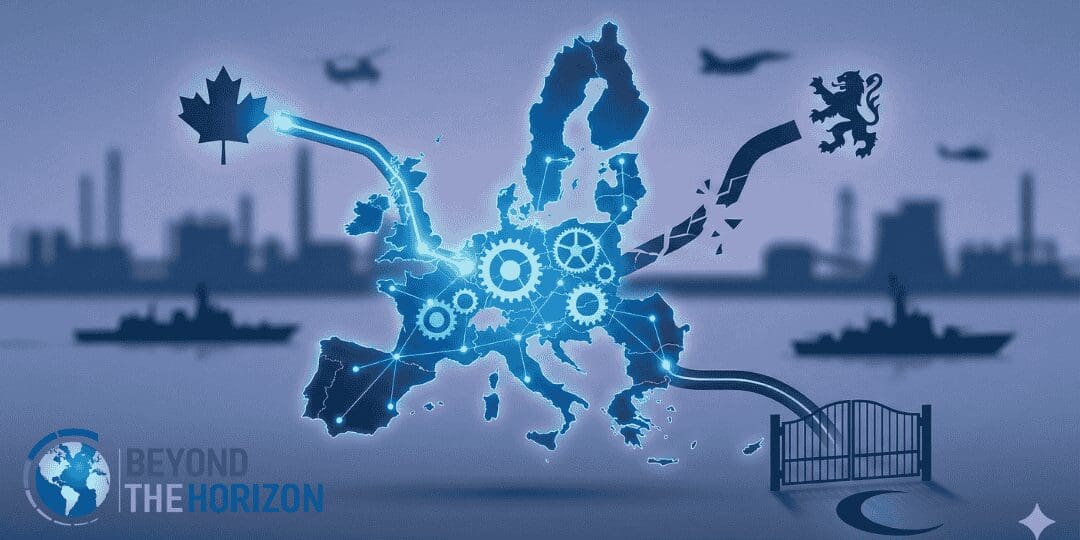
- Canada’s accession demonstrates SAFE’s centripetal pull beyond Europe. A G7 country voluntarily binding itself to EU defence financing and standards shows the mechanism’s growing geopolitical relevance and signals that strategic autonomy is not at odds with broader democratic cooperation.
- The UK’s withdrawal exposes a persistent post-Brexit strategic rift. London’s refusal to accept SAFE’s governance and content rules places it outside the core of Europe’s defence-industrial consolidation, with long-term implications for influence, market access, and interoperability.
- Türkiye’s failure to secure entry highlights the EU’s political gating. Despite its capabilities and NATO role, Ankara remains excluded not for lack of strategic value but because of unresolved political frictions inside the EU—underscoring the tension between NATO’s inclusiveness and the EU’s internal consensus requirements.
- SAFE participation now signals political alignment as much as industrial cooperation. Who is inside or outside the framework increasingly defines strategic orientation, industrial opportunity, and access to shared defence planning.
- Divergent membership trajectories are reshaping the transatlantic and Euro-NATO landscape. Canada’s integration broadens the defence ecosystem, the UK’s absence leaves a conspicuous gap, and Türkiye’s limbo deepens the EU–NATO coordination problem.
Introduction: SAFE as Europe’s Defence Catalyst
The European Union’s Security Action for Europe (SAFE) mechanism has rapidly become the crucible of an evolving European security order. Launched in 2025 under the “Readiness 2030” agenda, SAFE is a €150 billion defence-financing instrument designed to fill long-standing capability gaps, support joint procurement, and bolster Europe’s strategic autonomy. Unlike previous piecemeal initiatives, SAFE represents the EU’s most ambitious attempt yet to knit together the defence industries and procurement plans of its member states – and even certain partners beyond the Union. In essence, what began as a technical loan program is fast transforming into the institutional core of Europe’s defence strategy. The developments of the past week – Canada’s successful accession, the UK’s withdrawal, and Türkiye’s missed entry window – illustrate how SAFE is becoming more than a funding tool. It is an emerging geopolitical filter that determines who aligns with Europe’s new defence core, and under what conditions, in the coming decade. Each of these three developments provides a revealing snapshot of the political, strategic, and industrial tensions shaping Europe’s defence future.
Canada’s Entry: A Turning Point for Transatlantic Defence Cooperation
Canada’s accession on 1 December 2025 marks the first time a non-European G7 country has been integrated into an EU defence-financing architecture. Ottawa’s decision to join SAFE is a strategic milestone for several reasons. First, it expands SAFE beyond Europe’s borders, signaling that the EU’s pursuit of strategic autonomy is not turning into isolationism or “Fortress Europe.” Instead, Brussels is constructing a coalition model built around industrial interoperability, shared procurement, and common technology standards with like-minded democracies. EU officials had designed SAFE to be open to partners – Ukraine and EFTA countries have equal standing in projects, and even NATO allies with special agreements can participate. The inclusion of Canada validates this openness. It shows the EU can strengthen its own defence capacity while inviting close partners into the fold, reinforcing Western cohesion rather than excluding it. As one Baltic minister put it, Europe “shouldn’t close our defense industries to others … If we practice protectionism now, we will lose,” emphasizing that allies like the UK, Norway, and Türkiye should be included in Europe’s defence initiatives. Canada’s entry into SAFE thus underscores that European strategic autonomy can be compatible with transatlantic and global partnership.
Second, for Canada, SAFE offers a concrete path to diversify defence ties beyond the United States. Canadian defence procurement has historically been overwhelmingly reliant on U.S. suppliers, with over 70% of Canada’s military capital spending going to American firms in recent years. By joining the EU’s program, Canadian industry gains access to a massive €150 billion European defence market and cheap EU-backed loans for joint projects. Prime Minister Mark Carney – who campaigned on reducing Canada’s overreliance on Washington – welcomed SAFE as a way to “fill key capability gaps, expand markets for Canadian suppliers, and attract European defense investment into Canada.” In practical terms, this means Canadian companies can now partner on European joint procurements and tap low-interest EU loans to produce everything from next-generation drones to artillery, embedding Canadian firms in Europe’s supply chains. By diversifying its defence partnerships through SAFE, Canada reduces a strategic overdependence and gains more industrial sovereignty, while still meeting its NATO commitments in new ways.
Third, Canada’s entry enhances SAFE’s political credibility on the world stage. A major G7 economy voluntarily signing on – with no treaty obligation to do so – suggests that the EU’s defence model is becoming attractive and influential beyond its borders. What was initially an internal EU project is now emerging as a “center of gravity” for democratic defence economies. In effect, SAFE is acting as a magnet: partners are willing to align with EU standards and financing to partake in Europe’s rearmament. This boosts the EU’s clout in setting norms for defence-industrial cooperation. If Canada’s participation is implemented successfully, it could set a precedent for other like-minded states – Japan, Australia, and South Korea among them – to seek deeper defence-industrial integration with Europe in the future. Indeed, South Korea had also expressed interest in SAFE (though it did not complete its application in time), and Japan and Australia have intensified defence ties with Europe in recent years. Brussels’ message is clear: strategic autonomy does not mean standing alone, and SAFE can be the framework through which a network of democracies coordinates arms production and procurement.
The UK’s Withdrawal: A Missed Opportunity and Revealing Fault Line
By contrast, the abrupt collapse of UK–EU SAFE negotiations on 28 November 2025 exposed persistent fractures in post-Brexit defence cooperation. After months of talks, Britain walked away from a deal to join SAFE, underscoring how difficult it remains to bridge London’s ambitions with Brussels’ framework. This outcome is widely seen as a missed opportunity for the UK and a blow to Prime Minister Keir Starmer’s bid to “reset” relations with Europe. The breakdown also reveals a deeper strategic fault line: even amid war in Europe and a receding American security umbrella, the UK and EU are struggling to align their defence visions. Three core issues in the talks help explain why Britain pulled back, each highlighting a different aspect of this divide.
From the outset, the EU’s terms for third-country involvement in SAFE put strict limits on what a non-member like the UK could gain. Under SAFE rules, any project funded by the instrument must ensure no more than 35% of the component costs originate outside the EU (or outside other fully participating countries). In practice, this meant British defence firms, however advanced, could only ever supply a minority share of parts or technology to any given SAFE-funded contract unless a special agreement was reached. London bristled at this cap – which was originally devised to prioritize European industrial content – seeing it as a structural barrier that would relegate UK industry to a secondary role. British negotiators had pushed for a higher threshold (reportedly suggesting a 50% cap instead), but raising the non-EU limit was politically unacceptable to the EU unless the UK became a major financial contributor. Absent full membership in the EU, the governance structures of SAFE also posed limits: the UK would not have a vote in how the fund is run, yet would have to accept rules on intellectual property and export controls decided in Brussels. These constraints clashed with London’s desire for a say commensurate with its capabilities.
Beyond the percentages and fees, a broader industrial divergence is at play. British defence firms – from giants like BAE Systems and Rolls-Royce to a vibrant tech sector – remain globally competitive and form a key part of NATO’s military edge. However, by staying out of SAFE, the UK risks being sidelined as the EU accelerates joint procurement and consolidates its supply chains across the continent. The SAFE fund is at the heart of what some call the biggest European defence-industrial restructuring in decades, as it incentivizes countries to buy equipment together and scale up production lines in Europe. Projects that might once have involved British input could now favor EU-based suppliers to meet SAFE’s content rules. London’s withdrawal means it will largely “watch, rather than shape,” this surge of European rearmament and standardization.
The manner and timing of the UK’s withdrawal carry significant strategic symbolism. For many on the continent, the collapse of talks confirmed fears that Britain prefers distance even at the cost of influence – reinforcing a “narrative of British self-exclusion” at the very moment European defence is tightening. This perception is especially pointed because it comes as Washington is signaling strategic retrenchment and urging Europe to take on more burden-sharing. With the U.S. growing “distracted” and more transactional in its global outlook, Europe’s ability to integrate its defences is seen as crucial for collective security. In that context, Britain bowing out of Europe’s primary defence fund is viewed by some allies as a political setback for Western unity. It seemingly undercuts Starmer’s pledge of a “new era” in UK–EU relations, raising questions about how far the UK is really willing to cooperate after Brexit. Notably, France and Germany had quietly encouraged Britain to join SAFE, both for its capabilities and as a sign of strategic alignment. Now officials in Paris and Berlin privately lament that London’s rigid “red lines” prevented a deal, even as they hold out hope for future compromise. The episode also highlights a lingering fault line between NATO-centric and EU-centric approaches to European security. London has emphasized reinforcing NATO and its own global partnerships (e.g. the UK-led GCAP fighter project with Italy and Japan) as alternatives to EU frameworks. UK ministers argue Britain remains one of Europe’s indispensable security actors – pointing to its role in NATO battlegroups and support for Ukraine – and they stress they will not “compromise national control” over defence procurement. But from the EU side, the SAFE rift feeds the view that London is prioritizing sovereignty optics over “strategic urgency”. The lack of an agreement “feeds a narrative that Britain and the EU remain strategically misaligned at a time when unity is desperately needed”.
Türkiye’s Missed Entry Window: Strategic Ambiguity at a Sensitive Moment
Meanwhile, Türkiye’s absence from the SAFE application list by the 30 November 2025 deadline points to a different set of tensions—those between the EU’s political boundaries and NATO’s wider strategic geography. Ankara had expressed strong interest in joining the SAFE program, seeing an opportunity to access European defence funds and integrate its burgeoning defence sector with Europe’s. Some key EU members likewise advocated for Türkiye’s inclusion. Notably, Germany was among the most vocal supporters: German officials argued that SAFE “should be opened to Türkiye and the United Kingdom as important NATO partners.” Leaders in the Baltics and Eastern Europe echoed this view, recognizing Türkiye’s substantial military capabilities on NATO’s eastern and southern flanks. “Türkiye is an ally… How can we separate it from [European] cooperation?” asked Lithuania’s foreign minister, urging that defence partnerships like SAFE “have to be inclusive” of NATO allies. Indeed, at a time when NATO is laser-focused on shoring up its eastern flank and deterring aggression, many strategists see value in aligning EU and Turkish defence efforts.
Yet, despite these strategic arguments, Türkiye’s SAFE bid was stymied by procedural and political roadblocks. The European Commission adopted a meticulous stance: Türkiye’s application (submitted in July 2025) remained “under evaluation” and was never forwarded to member states for approval before the deadline. On November 29, a Commission spokesperson confirmed that Türkiye (and coincidentally South Korea) “will not meet the deadline, as the Commission is still examining their requests.” In plain terms, the EU essentially ran out the clock on Türkiye’s entry. The underlying reason was well-understood: Türkiye’s candidacy would likely have faced vetoes or objections from multiple EU member states – most prominently Greece and Cyprus, who have long-standing disputes with Ankara, as well as France. Rather than force a politicized fight in Brussels, the Commission chose not to put Türkiye’s membership to a decision at all, thereby preserving unity among the 27 on the initial SAFE launch. This procedural deferral was a way to avoid open conflict, but it leaves Türkiye in limbo and underscores that the EU’s defence-industrial architecture remains a “politically gated” space. Membership hinges not just on capability or contribution, but on wider political alignment with EU norms and consensus – something Türkiye, an EU candidate country with strained EU relations, could not swiftly secure.
The immediate implications of Türkiye missing the SAFE window are significant on several fronts. Strategically, it means a major NATO power on Europe’s flank is absent from the EU’s primary defence initiative at a critical moment. This exclusion risks widening the gap between EU defence structures and NATO’s integrated military framework. In Brussels and other EU capitals, officials insist that SAFE’s door isn’t permanently closed – the instrument remains open to candidates and partners in principle. However, the optics of this missed entry are stark: as Europe forms a tighter defence core via SAFE, Türkiye stands outside it, despite being NATO’s second-largest army and a key player in regional security. This could introduce new frictions in alliance politics. Ankara has already been navigating a complex relationship with the West; being left out of European defence cooperation could push Türkiye to question the symmetry of burden-sharing. The situation highlights unresolved tensions between NATO’s inclusive security umbrella and the EU’s more exclusive political club. In the long run, such a divide, if not managed, could complicate efforts to develop a truly pan-European defence posture that encompasses all key allies.
There are also industrial and economic consequences to Türkiye’s exclusion. Turkish defence firms have in recent years become leaders or strong competitors in several fields – including drones and unmanned systems, armored vehicles, and naval ship design. These growing capabilities mean Türkiye is not just a consumer of defence equipment but an emerging supplier, including to European forces (several NATO countries have bought Turkish drones or vehicles). If Türkiye were inside SAFE, its companies could contribute to and benefit from Europe-wide projects – for instance, collaborating on next-gen drone swarms or jointly developing armored platforms – all with access to low-interest EU financing. Missing out on SAFE delays and slows Türkiye’s alignment with European production standards and supply chains. Turkish firms will not have early access to the EU’s new joint procurement pipelines or the influx of capital the fund provides. In practical terms, Türkiye now has less incentive (and fewer mechanisms) to standardize its equipment with Europe, which could perpetuate interoperability gaps. The country will have to continue seeking alternative funding or partnerships for its defence projects – perhaps turning to other allies or increasing national investment – rather than plugging into Europe’s new financing framework.
Conclusion
In just a short span, SAFE has evolved from a technical funding mechanism into the primary architect of Europe’s emerging defence-industrial bloc. The events of this week – Canada joining, the UK stepping away, and Türkiye being left waiting – crystallize three important trends for Europe’s defence future. First, SAFE is becoming the institutional core of Europe’s long-term defence strategy. It provides not only financing but a framework around which states align their defence planning. Decisions about procurement, production, and R&D are increasingly funneling through SAFE’s structures, making it a foundation for Europe’s quest for military readiness by 2030. Second, membership in SAFE is now a strong indicator of political alignment as much as of industrial capacity. A country’s inclusion (or exclusion) sends a signal about its strategic orientation: those inside SAFE form part of Europe’s integrated defence ecosystem, while those outside it – even if close allies – may find themselves on a separate track. Third, Europe’s defence future will be shaped not only by who joins but also by who is left out. The divide between participants and non-participants could define cleavages in defence cooperation for years to come. We see that dynamic already: Canada’s involvement pulls transatlantic partners closer into Europe’s orbit, the UK’s absence leaves a major player outside looking in, and Türkiye’s exclusion highlights a gap at the EU–NATO nexus.
In this sense, SAFE is more than just a €150 billion fund – it is essentially the first draft of a new European defence ecosystem. It lays down the scaffolding for how production, procurement, and partnerships will be organized across Europe (and its closest friends) in the next decade. The mechanism’s growing gravitational pull is evident in how states are reacting: those with shared values or interests seek entry to benefit from the collective strength, while others calibrate their stance in response to its centripetal force. For countries that enter SAFE, there is the promise of influence on Europe’s defence direction and access to vast resources; for those that remain outside, there are strategic consequences – from diminished industrial opportunities to reduced say in Europe’s defence evolution. The past week’s developments illustrate these stakes clearly. Canada’s entry broadens SAFE’s geopolitical horizon and proves the model’s attractiveness. The UK’s withdrawal narrows SAFE’s immediate transatlantic reach and raises questions about London’s role in Europe’s security architecture. Türkiye’s missed chance highlights the unresolved geopolitical and institutional tensions that Europe must navigate, between an EU-centric defence model and the inclusiveness of the broader Atlantic alliance.
Moving forward, a key challenge will be managing these dynamics: ensuring that SAFE’s expansion strengthens European defence without undermining the unity of the wider alliance. The EU insists that SAFE will complement NATO, not compete with it – for example, capabilities funded by SAFE are intended to bolster NATO forces in Europe. However, as the line between an “EU defence core” and others solidifies, diplomacy and flexibility will be needed to keep everyone pulling in the same direction. In any case, one thing is evident: SAFE has initiated a new phase in European defence integration, one defined by major investments, closer industrial coordination, and a realignment of partnerships. Who is inside this framework and who is outside will likely determine the contours of Europe’s defence and security landscape for years to come. Europe’s defence awakening – spurred by external threats and internal resolve – is now taking concrete shape through SAFE. And as this week shows, that process is reordering relationships not just within Europe, but across the transatlantic and geopolitical spectrum. The true measure of SAFE’s success will be whether it can knit these pieces into a stronger whole, or whether the new fault lines it creates prove as significant as the gaps it seeks to bridge. For now, Europe’s bet is that a more unified defence-industrial base will pay off – and the rush of countries jostling to join (or angsting over exclusion) suggests that many see their future security and prosperity linked to this grand European project. The first draft of Europe’s new defence ecosystem is being written, and with each decision to join or abstain, the emerging map of European defence integration becomes a little clearer.