EDF 2026 is open.[1] One billion euros across 31 topics. The technology pipeline is deep, the deadlines are set, and consortium-building is well underway. But here is something that doesn’t get said often enough: most consortia that underperform in evaluation don’t fail on technology. They fail on operational credibility.
EDF 2026 in 60 seconds
The European Defence Fund’s sixth annual work programme was adopted in December 2025, allocating €1 billion for 31 collaborative defence R&D topics.[2] Since the EDF Regulation entered into force in 2021, the Commission has committed nearly €6.5 billion across six annual work programmes, with allocations ranging from €0.9 billion to €1.2 billion per year.
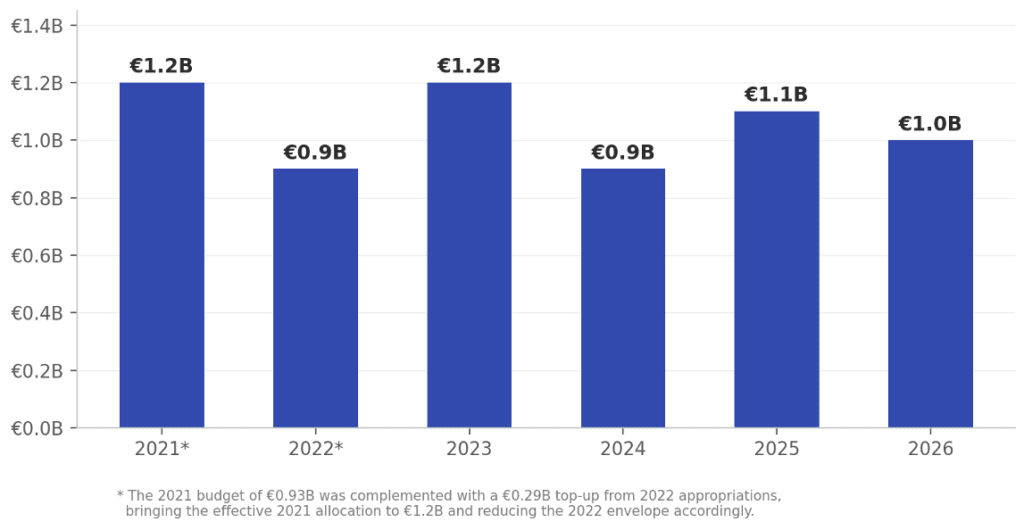
Visual 1: EDF Annual Work Programme Budget, 2021 to 2026
Over a third of the work programme budget supports R&D on major defence capabilities,[3] including an endo-atmospheric interceptor, a main battle tank, a multiple rocket launcher, and a semi-autonomous vessel. A quarter targets critical technologies: quantum-secured networks, electronic warfare, multi-domain cloud, and high-performance energy systems. The remaining quarter funds the EU Defence Innovation Scheme (EUDIS), including roughly €60 million for disruptive technologies and another €60 million in dedicated SME calls.
Most topics close on 29 September 2026. One notable exception is the multi-domain operations cloud, which closes significantly earlier, in April.
Consortium rules remain familiar: at least three independent entities from three different EU Member States or associated countries (currently Norway), though disruptive technology topics require only two. Funding rates vary: up to 100% for research actions, 20 to 80% for development actions depending on the specific activity,[4] with bonuses for SME and mid-cap participation and structured permanent cooperation (PESCO). A notable addition this year is the STEP regulation, which allows high-scoring proposals to earn a Sovereignty Seal, unlocking access to cumulative funding from other EU instruments. Most topics are funded as actual costs grants. A smaller number, including the SME-dedicated and challenge-based actions, use lump sum funding, which simplifies financial reporting.
So far, so standard. The interesting part is what the Commission is actually asking consortia to deliver.
The pattern nobody talks about
Beyond the Horizon (BtH) has reviewed every topic description in the EDF 2026 work programme. A striking pattern emerges: a substantial share of topics, across domains, across budget sizes, across research and development actions alike, explicitly require operational concept work as a mandatory or explicitly expected project activity. Not as background context. Not as a nice-to-have. As part of the scope.
The table below shows EDF 2026 topics where operational framing, end-user requirements, scenarios, CONOPS/CONUSE, threat assessments, or rules of engagement appear in the topic text or mandatory activities.
| Topic Code | Short Title | Topic Budget | Funded | What the Topic Requires Operationally |
| SIMTRAIN-MSAI | AI for military decision-making and training | €16M (max €8M/proposal) | Several | COA development, operational planning process, wargame and combat simulation framework |
| CYBER-QSTN | Quantum secured tactical networks | €14M | 1+ | CONOPS from military end users; operational use cases for tactical environments |
| AISAP | AI situational awareness: swarm challenge (participation) | €23M (max €4.6M/proposal) | Up to 5 | User-friendly operator-swarm interaction; tactical situational awareness evaluation |
| AISAO | AI situational awareness: swarm challenge (organiser) | €7M | 1 | Detailed evaluation plans, scenarios reflecting real military operations, ground truth |
| SMERO-NT | Non-thematic SME/research actions | €35M (max €5M/proposal) | Up to 7 | Defence relevance of civilian-origin solutions; civil-to-military technology adaptation |
| AIR-A4R | Autonomous air-to-air refuelling | €20M | Several | CONOPS for A4R ensuring interoperability in international operations |
| PROTMOB-FMLA | Future multirole light aircraft | €15M | Several | End-user needs analysis; operational scenarios and threat environment for 2030+ |
| MATCOMP-SMT | Smart and multifunctional textiles | €20M | 1+ | Updated CONOPS and CONUSE for soldier systems |
| SENS-CEW | Enhanced cognitive electronic warfare | €24M | 1+ | Challenging and realistic multidomain threat scenarios; operational concept definition |
| ENERENV-AWC | Ammunition waste collection platform | €10M | 1+ | Rules of engagement and concepts of operation for autonomous systems; mandatory threat analysis |
| PROTMOB-DMM | Secure digital military mobility | €9M | 1+ | Digitalisation of military customs formalities; end-user operational requirements; military mobility 2.0 and EU-NATO cooperation |
| DIGIT-MDOC | Multi-domain operations cloud | €40M | 1+ | Review of CONOPS according to new requirements; tactical requirements evaluation |
| NAVAL-EMSAS | Semi-autonomous surface vessel | €90M | 1+ | New CONOPS for autonomous systems aligned with emerging technologies and large USV challenges |
| GROUND-MRL | Multiple rocket launcher | €25M | Several | Threat assessment incl. ISR and counter-battery; HMI for reduced-crew ops; lessons learned from Ukraine |
| MCBRN-DST | CBRN decontamination systems | €15M | 1+ | Scenario-based decision tree; operational constraints for decontamination processes |
| CSBI | Critical seabed infrastructure protection | €30M (max €15M/proposal) | Several | Threat assessment; use cases, scenarios, and rules of engagement |
That is 16 out of 29 topics in the work programme. Nearly all of them explicitly require operational framing or demonstration of alignment with military needs, as part of the mandatory scope, not as background context. Combined, these topics represent approximately €393 million in indicative topic budget.
The message from the Commission is clear: if your consortium cannot articulate how the technology fits into an operational context, your proposal has a structural weakness.
The reason is straightforward. No defence technology operates in isolation. What gets developed will need to integrate into existing command structures, operational procedures, and doctrinal frameworks. It must function in contested, degraded environments, exposed to dust, moisture, extreme temperatures, and the wear of sustained field operations. It must be not only technically feasible but militarily valid. The Commission builds these requirements into the calls because the gap between what industry offers and what the military can actually deploy and sustain in the field remains one of the persistent risks in defence R&D.
What these terms actually mean
For organisations coming from outside the defence sector, the terminology can be opaque. Here is what evaluators are looking for in practice.
CONOPS (Concept of Operations) describes how a capability will be used in an operational setting: who operates it, under what conditions, within which command structures, and against what threats. It is not a technical specification. It is the bridge between what the technology does and why a military end user would adopt it. The quantum secured tactical networks topic (CYBER-QSTN) makes this explicit: it requires solutions “grounded on CONOPS coming from the military end users.” Technical excellence alone is not enough. The consortium must also demonstrate that it can translate military use contexts into credible operational requirements.
CONUSE (Concept for Use) is narrower. It focuses on how a specific system or component is employed in a defined mission context: the procedures, the constraints, the integration points. Think of CONOPS as the “why and where,” CONUSE as the “how, by whom, and under what rules.”
Scenario and threat design means constructing realistic operational environments, informed by current geopolitics, doctrine, and threat assessments, in which the proposed technology can be tested and validated. This is not creative writing. It requires familiarity with military planning processes, threat taxonomies, and operational tempo. The enhanced cognitive electronic warfare topic (SENS-CEW) illustrates this well: it requires “a comprehensive set of challenging and realistic scenarios considering multidomain threats” alongside “an operational concept definition.” Even highly technical electronic warfare projects need credible operational framing to be competitive.
Rules of engagement (ROE) define the circumstances and limitations under which forces may engage. In EDF proposals, ROE work typically applies to autonomous or semi-autonomous systems, where the legal framework and human-machine interaction model must be defined as part of the development activity itself. The ammunition waste collection topic (ENERENV-AWC) is a textbook example: it requires consortia to “propose applicable rules of engagement / concepts of operation for the remote and autonomous operation of the system.”
These are not optional embellishments. They are evaluated as evidence that the consortium understands the operational problem, not just the technical one.
Why consortia fail here, silently
The typical failure mode looks like this: a consortium brings excellent technology partners, strong industrial credentials, and a credible engineering plan. But the CONOPS section lacks the depth that comes from direct operational experience. The scenarios are generic. The validation framework does not map to any recognisable military process. The evaluator marks it down. Not dramatically, but enough. And because EDF is competitive, “enough” means the proposal doesn’t fund.
This is the gap that operational partners exist to fill. Not to replace the engineers or the system integrators, but to ensure that the proposal speaks the language evaluators expect, and that the project, once funded, produces outputs that military end users can actually adopt.
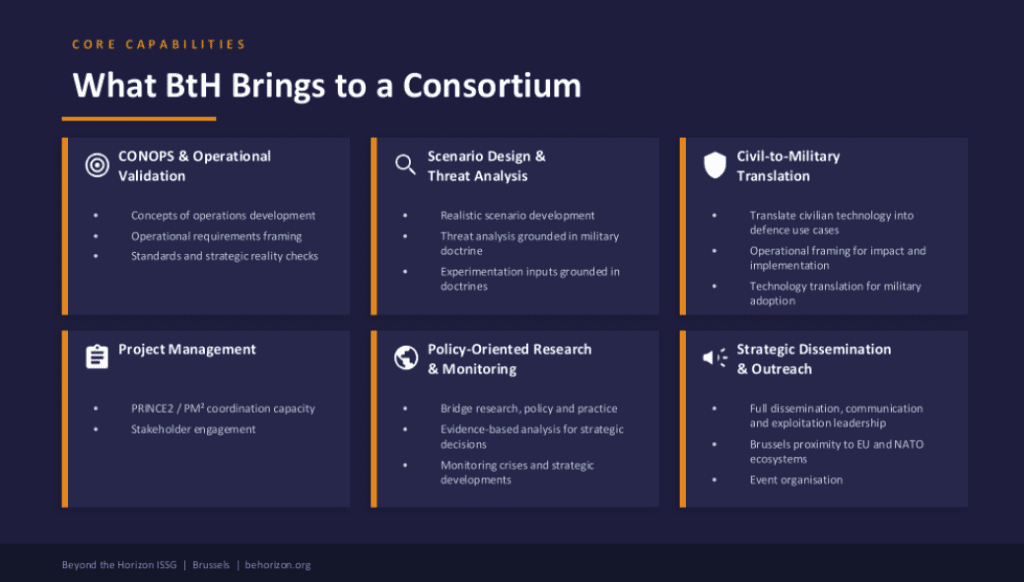
Visual 2: What BtH Brings to a Consortium
BtH works in this space. As a Brussels-based think-and-do tank with a defence-relevant offer built on practitioner networks, cross-programme EU project delivery, and security-oriented research, BtH supports consortia with operational concept development, scenario design, validation support, dissemination and exploitation, and project coordination.
Building a consortium for EDF 2026?
The deadline is 29 September. The operational framing work starts now, not in Month 3 of the project, but in the proposal itself.
Whether you need a partner to lead CONOPS, scenario design, and operational assessment, a dissemination and exploitation lead, or a project coordinator for an ICT-driven topic, BtH would welcome a conversation.
Contact: info@behorizon.org
[1] Full programme: EDF 2026 Call Topic Descriptions (PDF)
[2] The work programme includes 31 topics in total: 29 open calls for proposals plus 2 direct-award actions in support of the EU Alliance for Defence Medical Countermeasures. The EU Funding & Tenders Portal lists the 29 open topics.
[3] These four topics alone account for approximately €340M. The European Commission states that “half of the budget” is earmarked for major defence capabilities when combined with other capability development topics and direct awards outside the open calls.
[4] EDF development-action co-financing is activity-based rather than topic-based. Under the EDF framework, baseline rates differ by activity: studies 90%, design 65%, prototyping 20%, testing 45%, and qualification and certification 70%, with higher rates possible through bonus mechanisms. Most proposals include a mix of these activities, so the effective funding rate per project is significantly higher than the 20% floor.
Related Publications