

By Asha Pieper, Project Assistant at Beyond the Horizon ISSG
In “Why AI Undermines Democracy and What to do About It,” Mark Coeckelbergh calls to rethink tech before it rethinks us.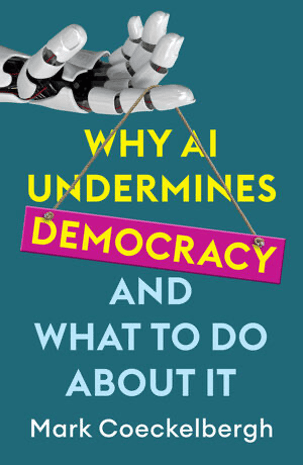
In Why AI Undermines Democracy and What to Do About It (2024), Mark Coeckelbergh, Professor of Philosophy of Media and Technology at the University of Vienna, offers a prompt and critical examination of the growing tensions between artificial intelligence and democratic governance.
Until recently, Coeckelbergh served as Vice Dean of the Faculty of Philosophy and Education, his expertisebolstered through his work on the Editorial Advisory Boards of Ethics and Robotics and other journals focused on the intersection of law, technology, language, and social ethics. This interdisciplinary background informs his analysis of how AI technologies are being leveraged to undermine democratic values, distort public discourse, and reshape policymaking in ways that threaten civic participation and accountability.
Can AI Serve or Only Subvert Democracy?
Coeckelbergh frames AI not just as a technological tool but as a deeply political instrument, drawing on philosophical concepts such as Plato’s kybernetes metaphor for autonomous rule detached from democratic oversight, and historical examples like centralised power in the Roman Empire. He traces how mechanisms of control, once used in imperial governance, re-emerge today in algorithmic systems that facilitate propaganda and surveillance. By situating modern AI within a long-standing philosophical and political tradition, Coeckelbergh offers a distinctive contribution to the field: a conceptual genealogy of how technology has long served to concentrate power and undermine democratic agency.
The book moves from early theories of rule and rationality to the current landscape of AI, examining the shift from binary, or “rule-based” systems to data-driven “machine learning” models, most notably LLMs like ChatGPT. Coeckelbergh highlights how tools like microtargeting, algorithmic profiling, and social media manipulation are leveraged by corporations, politicians, and authoritarian regimes to erode democratic principles, public trust, and epistemic stability.
What distinguishes this work within the broader discourse on AI and politics is its normative ambition. Rather than limiting himself to diagnosing the dangers AI poses to democracy, Coeckelbergh advocates for a constructive reimagining of technology—what he terms a “quiet revolution” rooted in digital humanism. His central assertion is that AI need not be inherently undemocratic; instead, it can be reshaped to foster and strengthen democracy rather than erode it. The book’s greatest strength lies in this forward-looking vision, offering practical, ethically grounded recommendations for both policymakers and citizens to reclaim democratic agency amid rising technological opacity and manipulation.
A notable limitation of the book is its strong philosophical orientation, which, while intellectually rigorous, may leave readers seeking more concrete evidence of how AI functions in real-world democratic erosion. Coeckelbergh’s abstract and conceptual approach provides a valuable theoretical framework, but it lacks detailed case studies, empirical data, or policy analyses that might ground his claims in specific institutional or geopolitical contexts. As a result, readers unfamiliar with philosophical discourse, or those looking for actionable, real-world insights may find the analysis less accessible or practically applicable.