

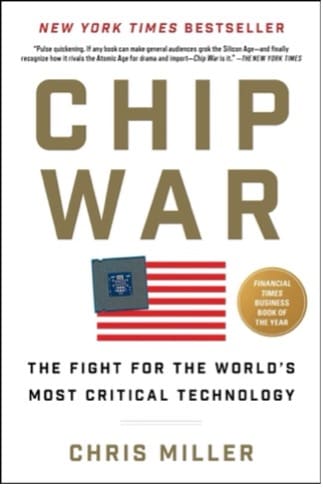
In Chip War: The Fight for the World’s Most Critical Technology, Chris Miller presents a powerful and timely narrative about how the semiconductor industry—once the preserve of niche engineers—has become the epicenter of twenty-first-century geopolitical rivalry. The book is an urgent hybrid: a strategic history, a technological briefing, and a political economy of the silicon age. For scholars and practitioners concerned with the intersection of statecraft, industrial power, and technological infrastructure, Chip War offers both an invaluable empirical chronicle and a strategic warning.
Miller, a historian at Tufts University, argues that control over microchips—integrated circuits carved into slices of ultrapure silicon—now determines not only economic competitiveness but also national security and global influence. At the heart of this argument lies a stark geopolitical reality: while the United States retains dominance in chip design and the software tools that enable it, it has offshored most fabrication capacity to East Asia, especially to Taiwan’s TSMC, the world’s most advanced chipmaker. China, meanwhile, remains heavily reliant on foreign technology, despite multibillion-dollar efforts to build domestic capacity. The resulting configuration has created a global economy wired to a set of fragile chokepoints—and thus acutely exposed to both technological and strategic disruption.
The narrative opens with a compelling scene: the USS Mustin sailing through the Taiwan Strait in August 2020, signaling freedom of navigation while symbolically cruising past TSMC’s Fab 18—the single most advanced semiconductor manufacturing facility in the world. In this juxtaposition, Miller sets the stakes: chips are not only embedded in every smartphone and satellite but are also enablers of military precision and technological sovereignty. Power in the 21st century, the book suggests, will be measured not only in megatons or GDP, but in nanometers—the unit used to describe transistor density on cutting-edge chips.
Chip War excels in making the history of microelectronics both comprehensible and gripping. Miller traces the arc from Cold War-era military R&D and Silicon Valley's entrepreneurial dynamism to the rise of Japan and South Korea as semiconductor powers and China’s contemporary tech nationalism. He gives due credit to pioneering figures such as Jack Kilby, Bob Noyce, Gordon Moore, and Morris Chang—each of whom reshaped the global tech-industrial landscape. But beyond biography, Miller highlights the structural choices that led to today’s vulnerabilities: the offshoring of fabrication, the hollowing out of domestic manufacturing in the U.S., and the hyper-concentration of critical capabilities in geostrategically volatile regions.
Where the book truly distinguishes itself is in linking technological dependence to strategic coercion. Miller provides a lucid account of the U.S. government’s use of export controls to cripple Chinese tech champions such as Huawei. These controls, while short of war, function as tools of geoeconomic containment—what some scholars might call weaponized interdependence. The implication is clear: in a world where technological ecosystems are deeply entangled, power increasingly resides in the ability to deny access.
From an international political economy perspective, Chip War offers a rare and welcome synthesis of micro-level industrial detail with macro-level geopolitical consequence. It illuminates how global value chains—heralded for decades as vehicles of efficiency—have become vectors of insecurity. As the U.S., EU, and others scramble to reshore or “friendshore” production, the book makes it plain that rebuilding capacity is not simply a matter of capital or will, but of mastering deeply specialized expertise and multi-tiered supply chains involving gases, photolithography tools, and intellectual property scattered across jurisdictions. As such, the global semiconductor industry emerges as both a triumph of distributed capitalism and a vulnerability of neoliberal globalization.
The book also complements growing literature on the strategic implications of emerging technologies. Miller treats semiconductors not only as technical inputs but as enablers of military innovation—from precision-guided munitions and AI-enabled surveillance to next-generation telecommunications. The book implicitly echoes the logic of offset strategies: the idea that technological leaps can compensate for conventional asymmetries. In this light, chips are not just commercial products but elements of national deterrence and force projection.
Yet Chip War is not without limitations. It largely eschews explicit theorizing, leaving it to the reader to map its insights onto existing paradigms—be it realism, techno-nationalism, or global production network theory. Similarly, while Miller excels at explaining the U.S. and East Asian trajectories, the political economies of Europe and the Global South receive less attention. Nonetheless, these are tradeoffs of accessibility and narrative momentum rather than oversights.
In conclusion, Chip War is a masterclass in techno-strategic storytelling. It bridges disciplines and speaks urgently to policymakers, scholars, and business leaders alike. As the scramble for semiconductor sovereignty intensifies—from Washington to Beijing, Brussels to Seoul—Miller’s book will be essential reading for those seeking to understand the circuitry of global power. It reminds us that in a digitized, militarized, and data-driven world, the true contest may not be for land or ideology—but for control over the tools that make modernity possible.