

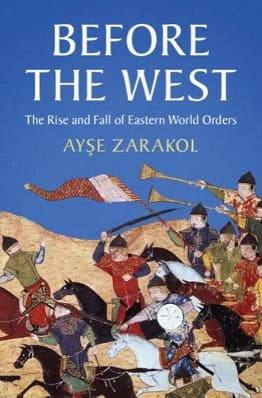
In Before the West, Ayşe Zarakol challenges the very architecture of historical imagination in international relations. Where most accounts trace the genealogy of modern global order through the Westphalian moment, the Enlightenment, or European imperialism, Zarakol instead rewinds the clock to the thirteenth century and centers a radically different story: one in which Eastern polities—not Europe—spearheaded expansive and enduring international orders. Her book is a tour de force in historical reorientation, offering not only a corrective to Eurocentric narratives but a new vocabulary for understanding sovereignty, legitimacy, and international order itself.
Zarakol’s core argument is simple but profound: modern IR has been constrained by a backward-reading of history that treats the rise of the West as both inevitable and exceptional. This retrospective teleology distorts the premodern global order and sidelines the sophisticated world-making practices of non-Western polities. Before the West excavates this alternative lineage through a sweeping examination of Chinggisid, Timurid, Ottoman, Safavid, and Mughal orders—each of which, she argues, aspired not only to regional dominance but to universal sovereignty. These were not passive or isolated systems, but international orders that shaped Eurasian politics for centuries.
Methodologically, Zarakol blends grand historical synthesis with deep conceptual analysis. Drawing from primary sources, comparative political theory, and a wide range of secondary literature, she reconstructs the rise, reproduction, and eventual decline of what she terms “Eastern world orders.” The Chinggisid order, anchored in the Mongol Empire and its successor khanates, serves as the foundation. It was not merely a geopolitical formation, but an epistemic model of rule—transregional, non-confessional, and remarkably stable. Successor empires across Eurasia internalized and adapted these templates in ways that structured diplomacy, legitimacy claims, and patterns of succession long before the West imposed its own order through gunboats and treaties.
Zarakol is not the first scholar to question Eurocentrism in IR, but her intervention is distinct in three ways. First, she refuses to frame Eastern contributions as subordinate or instrumental to Western success—no “East as enabler of the West” argument here. Second, she avoids the pitfall of romanticizing non-Western empires. The book does not mask the violence, hierarchy, and exclusion inherent in Eastern world orders. Rather, Zarakol seeks to understand them on their own terms. Third, and most significantly, she treats these premodern orders as genuinely international—not merely regional systems of rule. In doing so, she reclaims the term “world order” from its post-1945 connotations and restores its precolonial complexity.
Before the West offers a crucial reframing of strategic continuity. Instead of viewing non-Western actors as reactive or peripheral, Zarakol places them at the center of system-shaping dynamics. The notion that sovereignty can be conceptualized and operationalized outside of the Westphalian frame has implications not only for historical understanding but for contemporary geopolitical analysis. In a moment when China, India, Türkiye, and Russia increasingly invoke civilizational narratives and premodern legitimacy, Zarakol’s work provides the intellectual scaffolding to make sense of these claims without defaulting to Orientalist tropes.
Zarakol’s work also destabilizes developmentalist assumptions. Her analysis implicitly critiques teleological models that view economic and political modernization as processes led and defined by the West. By foregrounding long-standing Eurasian governance structures and sovereignty models, she invites a more pluralistic reading of political evolution—one where institutions, norms, and hierarchies circulated globally well before capitalism’s rise or European hegemony.
One of the book’s most compelling features is its theoretical ambition. Zarakol redefines foundational IR concepts: sovereignty is decoupled from territorial fixity; legitimacy is shown to derive from divine mandate, lineage, and universalist aspiration rather than popular consent; order is achieved not through balance-of-power logic but through nested hierarchies of kinship and cosmological alignment. These redefinitions do not merely provincialize Europe—they globalize the very grammar of international relations.
Still, the book does not aim to replace one civilizational frame with another. Zarakol is careful not to trade Eurocentrism for Asiacentrism. She acknowledges the complexity and heterogeneity within Eastern polities, and is reflexive about the limits of her own geographical and temporal scope. Her project is ultimately diagnostic: she seeks to recover lost alternatives in global order-making so that IR can escape the gravitational pull of a singular, Western origin story.
Some readers may find the book’s scope dizzying. Spanning five centuries and dozens of polities, it necessarily abstracts at times. Others might wish for more engagement with African, Southeast Asian, or Indigenous world orders—regions Zarakol brackets explicitly due to the book’s thematic constraints. But these are not so much flaws as invitations for further research. In providing an expansive canvas and a clear methodological precedent, Before the West lays the groundwork for a more polycentric historiography of IR.
In sum, Ayşe Zarakol has written a field-defining book. Before the West is not only a major contribution to historical IR but also a challenge to the discipline’s conceptual foundations. For anyone interested in the global pasts that could have been—and the plural futures that might still be—it is essential reading.