
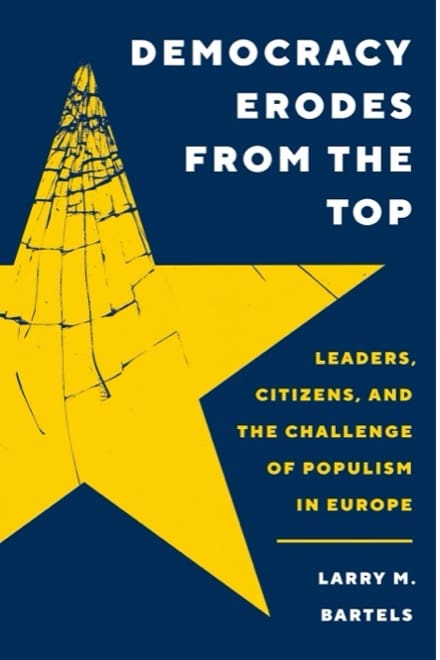
Larry M. Bartels, Democracy Erodes from the Top: Leaders, Citizens, and the Challenge of Populism in Europe. Princeton University Press, 2023. 328 pp. ISBN: 9780691244501.
Conventional narratives about the crisis of democracy in Europe often center on the anxieties and attitudes of voters—casting them as increasingly polarized, intolerant, and hostile to democratic institutions. In Democracy Erodes from the Top, political scientist Larry M. Bartels forcefully reverses this perspective. Drawing on nearly two decades of European Social Survey data and incisive political analysis, Bartels argues that it is not voters who are fueling democratic decline, but political elites themselves. The result is a rigorously documented and sharply argued intervention that invites a fundamental rethinking of the populism-democracy nexus.
Bartels’s central claim is that popular narratives of a widespread democratic crisis are empirically overstated and analytically misguided. Across multiple chapters, he challenges the assumption—widely held in both media and scholarship—that the rise of populist radical right parties reflects a groundswell of authoritarian or anti-democratic sentiment among European publics. Instead, Bartels demonstrates that public attitudes toward immigration, European integration, economic redistribution, and political institutions have remained largely stable—and in some cases, have become more favorable—throughout the 2000s and 2010s.
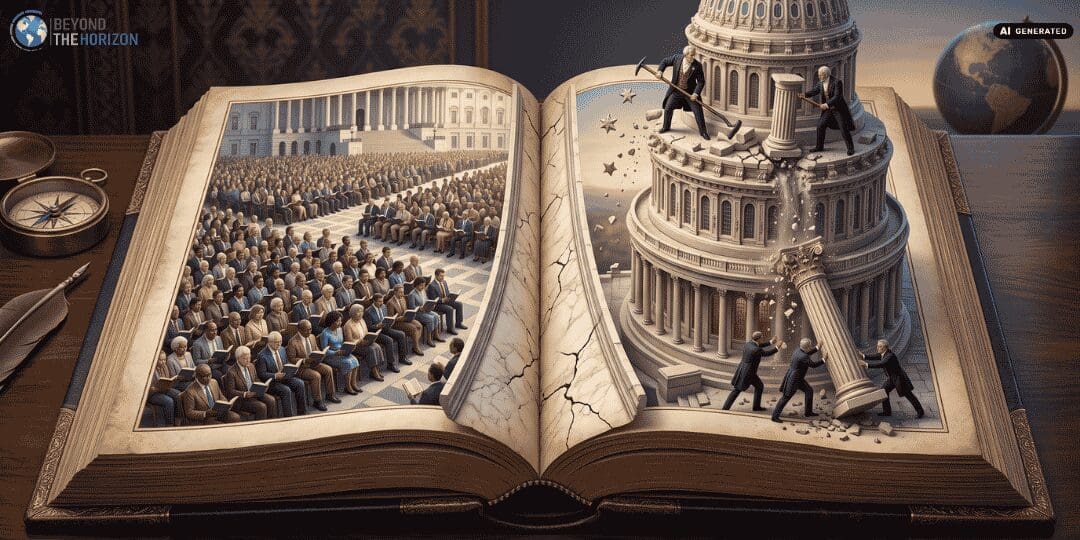
Far from suggesting that democracy is untroubled, Bartels reorients the locus of concern. Democratic erosion, he argues, “comes from the top”—through elite-led manipulation of institutions, erosion of norms, and opportunistic exploitation of public dissatisfaction. Hungary and Poland serve as the book’s cautionary tales: both countries experienced democratic backsliding not as a product of voter radicalization but as a consequence of relatively mainstream parties gradually dismantling institutional safeguards after securing power. In these cases, Bartels finds little evidence of rising populist demand; rather, he points to elite agency and institutional drift as the drivers of democratic decay.
The book’s empirical backbone is its detailed analysis of public opinion across 23 European countries from 2002 to 2019, using over 350,000 survey responses. Bartels divides this period into pre-crisis, crisis (2008–2013), and post-crisis phases, examining how attitudes shifted in response to events such as the eurozone crisis, the refugee influx, and the so-called populist wave. The findings are consistently counterintuitive: support for European integration rebounded after the eurozone crisis; satisfaction with welfare services increased even amid austerity; and in most countries, anti-immigrant sentiment either held steady or softened slightly over time.
This stability presents a paradox: if mass attitudes remained largely unchanged, what explains the electoral rise of right-wing populist parties? Bartels’s answer lies in political supply, not demand. He attributes the success of parties like Lega, Vox, and UKIP to elite entrepreneurship, media amplification, and the failings of mainstream parties, rather than any deep-seated shifts in public ideology. In this sense, Democracy Erodes from the Top implicitly critiques much of the recent literature on populism that overemphasizes voter psychology at the expense of institutional dynamics and elite behavior.
For readers in international relations and security studies, Bartels’s conclusions carry important implications. The book subtly but powerfully challenges the liberal notion that democratic resilience resides chiefly in civic culture. Instead, it suggests that institutional integrity and elite self-restraint are far more consequential for safeguarding liberal democracy. This argument echoes concerns raised in works such as How Democracies Die (Levitsky and Ziblatt), but Bartels is more empirically granular and, arguably, more politically agnostic. His diagnosis is less moralistic than structural: elites matter more than publics, and political systems are only as durable as the people entrusted to manage them.
The book also offers a critical corrective to alarmist accounts linking economic grievances to populist surges. Bartels finds only weak and inconsistent connections between economic discontent and anti-system sentiment, and even weaker links between those sentiments and populist vote shares. Where economic dissatisfaction does appear, it often reflects short-term shocks and quickly rebounds as conditions improve—further undermining narratives of a long-term populist realignment driven by globalization, automation, or austerity.
What makes Democracy Erodes from the Top especially notable is its commitment to evidence over orthodoxy. Bartels resists the temptation to construct a grand theory of democratic failure. Instead, he offers a clarifying lens on what the democratic crisis is not: it is not rooted in a mass rejection of democratic norms, nor in a tidal wave of populist backlash. Rather, it is a more mundane and incremental process—one that unfolds not in the streets but in parliaments, cabinets, and constitutional courts, often under the guise of legality and stability.
This refusal to moralize or overgeneralize may disappoint readers looking for a clear prescriptive agenda. Bartels is measured in his recommendations, preferring conceptual clarity to policy advocacy. If there is a lesson to be drawn, it is that democratization and democratic stability cannot rely solely on an engaged citizenry; they require institutional constraints and accountable leadership. In that sense, Democracy Erodes from the Top is a sober rejoinder to both democratic idealism and populist fearmongering.
In sum, Bartels has produced a book of lasting relevance—empirically rich, methodologically careful, and politically incisive. It will serve as a touchstone for future scholarship on democratic resilience and populist politics in Europe and beyond. Whether one reads it as a political scientist, an IR scholar, or a policy analyst, the core message is both provocative and persuasive: the real threat to democracy is not the people—it is the people in power.