
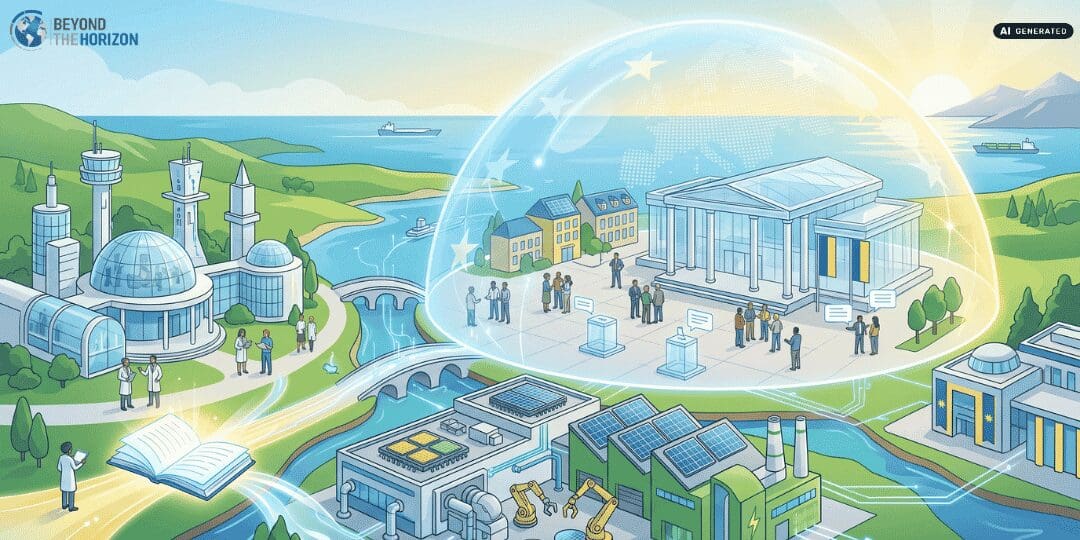
Europe's strategic autonomy will depend not only on defence capabilities, but also on technological leadership, economic resilience, innovation, and democratic strength.
Recent discussions on European strategic autonomy have largely focused on defence capabilities, military spending, and Europe's role within an increasingly unstable international environment. While these issues remain important, they represent only part of the broader challenge the continent is facing.
As the European Youth Think Tank (EYTT), a non-profit organization bringing together young researchers from across Europe to promote independent and interdisciplinary research, we believe the debate should be expanded beyond traditional security considerations. Strategic autonomy in the twenty-first century depends not only on military capabilities, but also on technological sovereignty, economic resilience, innovation, and the strength of democratic institutions. We discuss these issues through the contribution of Luigi Capoani, economist, researcher, lecturer in International Economics at Ca' Foscari University of Venice and President of the European Youth Think Tank, and Linda Rotondo, international affairs analyst at the European Youth Think Tank.
Security Begins Long Before Military Conflict
The war in Ukraine has profoundly reshaped European security perceptions. After decades during which conventional military threats appeared increasingly remote, the possibility of large-scale conflict returned to the centre of political debate. The response was predictable, with much of the discussion surrounding European strategic autonomy focusing on defence budgets, military cooperation, procurement policies, and institutional reforms. While these are all legitimate concerns, they fail to address the problem in its entirety.
Modern security crises rarely begin on the battlefield. The COVID-19 pandemic exposed vulnerabilities in global supply chains. The energy crisis triggered by the war in Ukraine revealed the strategic risks associated with excessive dependence on external suppliers - at the time of the invasion, Russia supplied roughly 45% of the EU's gas imports.Growing tensions between the United States and China have highlighted how technological competition can rapidly evolve into geopolitical confrontation.
These developments suggest a broader definition of strategic autonomy: the ability of a political and economic system to withstand external shocks while preserving its capacity to make independent decisions. That capacity depends not only on military capabilities, but also on energy resilience, technological independence, industrial competitiveness, and institutional stability.
Competitiveness is therefore no longer solely an economic objective. It has become a strategic necessity. A continent that loses technological leadership, experiences declining productivity growth, and becomes dependent on foreign innovation ecosystems will eventually face growing limitations in its ability to pursue independent policies.Strategic autonomy cannot be sustained without economic strength. And economic strength cannot be maintained without continuous innovation.
Technology Is Reshaping the Balance of Power
Throughout history, geopolitical influence has often been linked to the control of strategic resources. In the twenty-first century, technology increasingly plays this role.
Artificial intelligence, advanced semiconductors, quantum technologies, cloud infrastructure, cybersecurity, and digital networks have become critical components of national power.
The competition surrounding semiconductor production illustrates this transformation particularly well. Microchips are no longer merely industrial products. They constitute the technological foundation of modern economies, underpinning telecommunications, transport, defence systems and artificial intelligence alike. The concentration of their production is striking: Taiwan's TSMC alone manufactures the vast majority of the world's most advanced chips, while the US and its allies control an estimated 92% of the semiconductor supply chain's total value.
Europe remains a major scientific actor and retains important industrial capabilities. However, it often struggles to translate scientific excellence into technological leadership and global industrial scale. The challenge is not simply producing more research. It is ensuring that research generates strategic capabilities, industrial competitiveness, and long-term resilience. Technological dependence today may become geopolitical dependence tomorrow.
Universities and Research Are Strategic Infrastructure
Discussions regarding security often focus on military installations, defence industries, and critical infrastructure. Yet some of the most valuable strategic assets of contemporary societies are universities, laboratories, research centres, and innovation ecosystems.
Scientific knowledge has become a source of power. Countries leading technological innovation not only generate economic growth. They shape standards, influence global markets, attract talent, and establish positions of strategic advantage.
Europe possesses a remarkable scientific tradition and some of the world's most respected academic institutions. However, maintaining this position requires sustained investment. Research should not be viewed solely as an educational or scientific priority, but also as a long-term investment in strategic resilience.
Every research programme, every doctoral scholarship, every innovation initiative contributes to strengthening Europe's ability to remain competitive and reduce critical dependencies. The geopolitical competition of the coming decades will increasingly be decided by the capacity to generate knowledge and transform it into practical applications.
Strategic Patience in an Era of Political Uncertainty
Europe also faces a subtler risk: building long-term strategies around short-term political conditions. Current debates are understandably influenced by figures such as Donald Trump and Vladimir Putin. Yet political leaders are temporary. Structural trends are not. Neither the United States nor Russia will remain permanently defined by their current leadership. International politics evolves through generational change, economic transformation, demographic dynamics, and shifting public priorities. Political figures who dominate today's headlines may ultimately represent only one phase in a much longer historical process.
For this reason, Europe should avoid designing its future primarily around present geopolitical tensions. While maintaining credible defence capabilities remains essential, preserving peace should also remain a strategic objective. This is not simply a moral aspiration; it is also an economic and political necessity. History offers reminders that strategic patience can sometimes achieve what confrontation cannot. Avoiding escalation today may create the conditions for more favourable political outcomes tomorrow, sparing societies the immense human, economic, and social costs of prolonged conflict.
Future American and Russian societies may not necessarily share the priorities, perceptions, or political preferences of their current leaderships. New generations, economic realities, and political circumstances may gradually produce environments more open to dialogue, cooperation, and coexistence than those that characterize the present moment.
Europe's challenge, therefore, is not merely to react to today's crises, but to preserve the stability and resilience necessary to navigate tomorrow's transformations.
Democratic Resilience and the Rise of Technocratic Power
Strategic autonomy also depends on the quality and resilience of democratic institutions. Across many democratic societies, public trust in institutions has weakened. Political polarization has increased, while economic and informational power has become increasingly concentrated.
At the same time, large digital platforms and technology corporations have acquired unprecedented influence over information flows, public discourse, and even political processes. This transformation raises important questions about the future relationship between technology, power, and democracy. Some observers have described the growing concentration of technological and informational power as a form of emerging technocratic influence, where decisions affecting large portions of society are increasingly shaped by actors operating outside traditional democratic structures.
The challenge facing Europe is not only competition with authoritarian regimes abroad. It is also ensuring that democratic institutions remain capable of adapting to rapid technological and social change. Representative democracy remains one of Europe's greatest strengths. However, democratic systems must continuously evolve to remain effective and legitimate in the digital age. This likely means integrating new forms of digital participation — not replacing representative institutions, which continue to play an essential role in balancing interests, protecting minorities, and ensuring political stability, but complementing them with more advanced mechanisms of citizen engagement.
One of the paradoxes of the digital age is that while many democratic systems continue to operate through institutional structures designed before the internet revolution, authoritarian regimes are increasingly exploiting digital technologies to strengthen control, influence public opinion, and accelerate decision-making processes.
If democratic societies fail to adapt, they risk creating a growing gap between citizens and institutions. The question is not whether digital technologies should play a larger role in governance, but how they can be incorporated in ways that strengthen transparency, participation, and democratic accountability, rather than weaken them.
Conclusion
The debate on European strategic autonomy is both necessary and timely. However, framing it primarily around defence risks overlooking the deeper foundations of long-term strategic strength.
Military capabilities remain indispensable. Yet they are only one component of a broader ecosystem of resilience. Europe's future autonomy will depend equally on its ability to innovate, remain competitive, develop critical technologies, invest in research, attract talent, and preserve democratic institutions capable of adapting to profound transformation.
The ultimate question is not simply whether Europe can defend itself. It is whether Europe can maintain the economic, technological, and political foundations necessary to shape its own future.
Strategic autonomy does not begin on the battlefield. It begins in universities, laboratories, innovative firms, resilient institutions, and democratic societies capable of preparing for challenges well beyond the next geopolitical crisis.
Authors
Luigi Capoani is an economist, researcher, and lecturer in International Economics at Ca' Foscari University of Venice. He is President and founder of the European Youth Think Tank (EYTT), a non-profit platform connecting young researchers across Europe and promoting interdisciplinary research and international scientific collaboration.
Linda Rotondo is an analyst in international affairs at the European Youth Think Tank (EYTT), where she focuses on European governance, geopolitical transformations, and international security.