

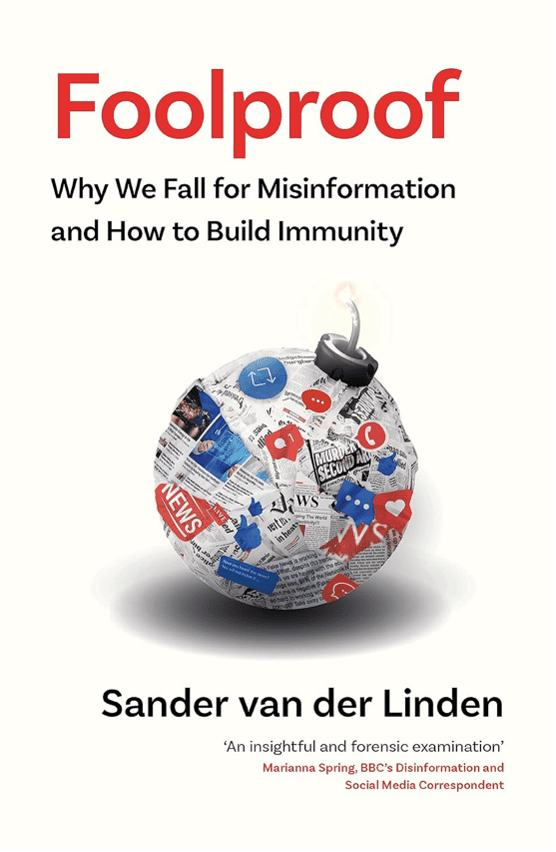
 Foolproof: Why We Fall for Misinformation and How to Build Immunity by Sander van der Linden is an insightful and timely exploration into the pervasive issue of misinformation in the modern world. This book delves into the psychological mechanisms that make people susceptible to false information and offers practical strategies to build resilience against it.
Psychological Mechanisms and Cognitive Biases
Van der Linden, a renowned social psychologist, begins by examining the root causes of our vulnerability to misinformation. He outlines how cognitive biases, such as confirmation bias and the Dunning-Kruger effect, play significant roles in how individuals process information. Confirmation bias, the tendency to favor information that confirms one’s preexisting beliefs, is particularly insidious as it leads people to ignore or dismiss contrary evidence. The Dunning-Kruger effect, on the other hand, highlights how people with limited knowledge in a domain often overestimate their own understanding, making them more likely to believe and spread misinformation.
The Role of Social Media
The book also addresses the role of social media in the spread of false information. Van der Linden points out that platforms like Facebook and Twitter are designed to maximize engagement, often at the expense of truth. The algorithms prioritize sensational and emotionally charged content, which is more likely to be shared, thereby amplifying the reach of misinformation. This creates an environment where false information can spread rapidly and widely, outpacing efforts to correct it. This observation underscores the necessity for a more responsible approach to information dissemination by these platforms.
Prebunking: A Proactive Approach
One of the strengths of "Foolproof" is its focus on solutions. Van der Linden introduces the concept of "prebunking" as a proactive approach to combating misinformation. Prebunking involves inoculating people against false information by exposing them to weakened forms of misinformation and explaining the tactics used to spread it. This method draws on the psychological theory of inoculation, which posits that exposing people to a controlled amount of misinformation can build their cognitive immunity to it.
Van der Linden provides several practical examples of how prebunking can be implemented. One notable example is his collaboration with Google Jigsaw to create interactive games that teach players to recognize common misinformation tactics. These games, such as "Bad News," have been shown to improve players’ ability to identify and resist misinformation in real-world scenarios.
Emphasis on Critical Thinking and Media Literacy
Another significant aspect of the book is its emphasis on critical thinking and media literacy. Van der Linden argues that education systems should incorporate these skills into their curricula to prepare students for the complex information landscape they will encounter. By fostering critical thinking, individuals can become more discerning consumers of information, better equipped to evaluate the credibility of sources and the veracity of claims.
Transparency and Accountability
In addition to educational reforms, Van der Linden advocates for greater transparency and accountability from social media companies. He suggests that platforms should implement clearer policies for flagging and removing false information and improve their algorithms to prioritize accuracy over engagement. This is a call for systemic changes to ensure that the infrastructure of information dissemination supports truth and reliability.
Conclusion
Overall, Foolproof: Why We Fall for Misinformation and How to Build Immunity is an insightful and actionable guide to understanding and combating misinformation. Van der Linden’s expertise in psychology and his practical approach to building resilience make this book an essential read for anyone concerned about the impact of false information in today’s society. By addressing both the psychological underpinnings and systemic issues that contribute to the spread of misinformation, Van der Linden provides a comprehensive roadmap for building a more informed and discerning public.
The book’s thorough examination of cognitive biases and the role of social media offers a deep understanding of why misinformation spreads so effectively. Moreover, the proposed solutions, including prebunking and a strong emphasis on media literacy, offer practical tools for individuals and institutions alike. Van der Linden’s call for greater accountability and transparency from social media platforms adds a crucial dimension to the broader fight against misinformation, highlighting the need for a multifaceted approach to this complex issue.