
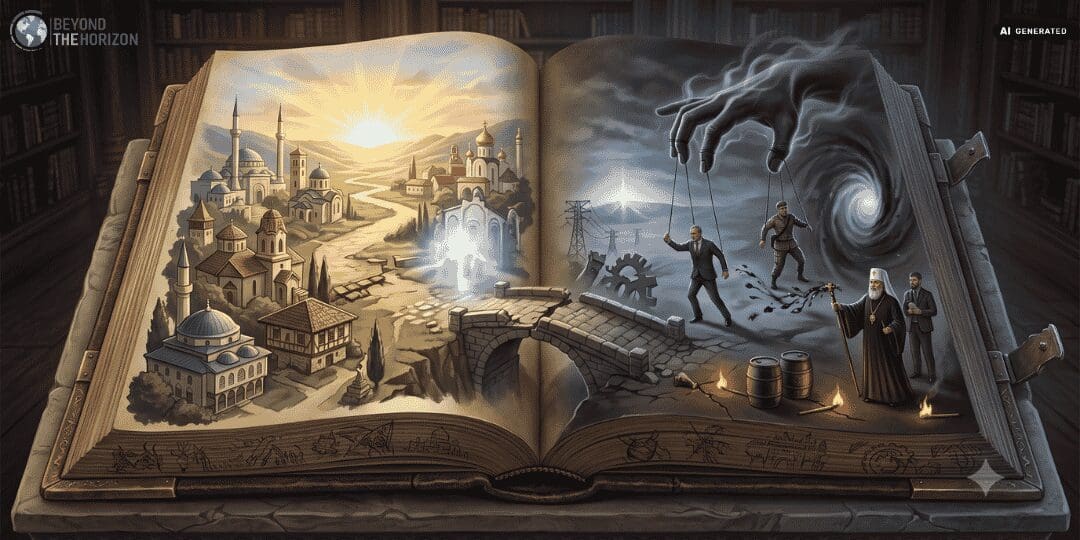
[The Balkans] produce more history than they can consume.
-Winston Churchill-
Abstract
The Western Balkans is a vital European region of different nationalities, religions and cultures. It stands between the West and the East. The overall image of the region is that it has been the prize in incessant battles for competition between different powers and actors for centuries. Since the end of the Cold War, nations of this region have been looking toward integration into Euro-Atlantic structures. Some have succeeded, while others are still struggling to integrate. But, the War in Ukraine has put the spotlight the Western Balkans again. The West has to give new impetus and sustain local ambitions towards the EU membership. Looking at what is happening in the Balkans, the paper at your hand aims to underline the challenges and implications caused by the Russian influence. At the same time, internal actors are using Russia for localized power games.
Keywords: The Western Balkan, the Russian influence, the West and power balance.
Introduction
In the early part of the 20th century, historians metaphorically coined the term "powder keg of Europe" for theBalkan region. This allusion was obvious during tensions among nations at the fall of the Ottoman Empire and the beginning of World War I (1914-19). The region has passed through several stages since then, most prominently WWII, the Cold War and the post-Cold War era. Fukuyama characterizes this last stage, the post-Cold era, as a new era that marks 'the end point of mankind's ideological evolution and the universalization of Western liberal democracy as the final form of human government.'[1]
The Balkans could not benefit from this "final form of human government" as described by Fukuyama. After 1990, the region experienced disintegration and conflicts among former Yugoslavian republics while the rest of Europe enjoyed “peace dividends”. The political and economic atmosphere that immediately changed drastically evidenced the struggle of the regional states to establish themselves as democracies in the Western sense, defying attempts of Serbia to establish hegemony. Against this historical backdrop, the EU and the US policymakers, when referring to the Western Balkans, often identify the region as a geographical entity with this ‘suis generis’ political context.
[1] Francis Fukuyama (1992) ‘The End of History and the Last Man’, The Free Press, A division of Macmillan, Inc, New York.