
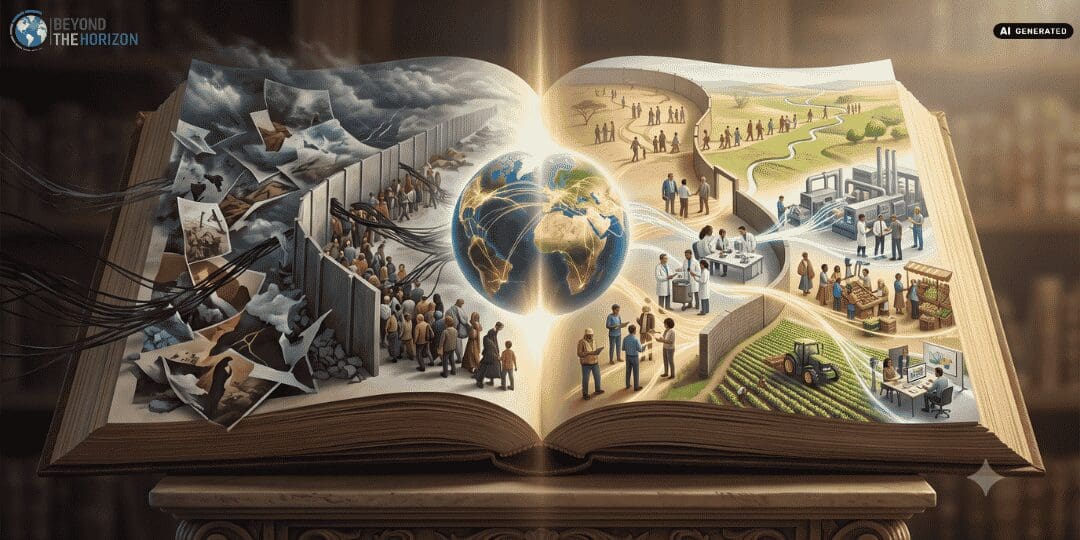
How Migration Really Works by Hein de Haas is a comprehensive and thought-provoking exploration of the realities of global migration. De Haas, a distinguished sociologist and migration expert, delves deeply into the complexities of migration, aiming to dispel common myths and misconceptions that dominate public and political discourse.
The book is a comprehensive analysis of global migration trends, debunking common myths and misconceptions about immigration. The author uses over three decades of research to challenge widely held beliefs from both political spectrums.
He argues that many perceptions about migration are incorrect. In his book, he addresses in total 22 migration myths, providing evidence and data to counteract false narratives, mostly propagated by both political extremes.
For instance, he notes that global migration is not at an all-time high and that climate change will not lead to mass migration. He also points out that immigration mainly benefits the wealthy and that border restrictions often lead to increased migration rather than reducing it. On the other hand, he discusses how the notion that immigrants undermine the welfare state is unfounded, showing that immigrants often contribute positively to the economy through taxes and other means.
This book comes very timely just before this ‘super-elections year’ not only in Europe but also in the world, when we see also an increase of political extremes in many countries. It has a potential to have an impact on public opinion if presented well at their level. Immune 2 Infodemic project uses the main findings of de Haas for immunising people against mis/disinformation about migration topic. It created aha moments for many people during the interactive workshops.
My key takeaways from the book can be summarised as follows:
Global Migration Trends: De Haas argues that contrary to popular belief, global migration is not at an unprecedented high. He provides historical context and statistical evidence to show that the proportion of international migrants relative to the global population has remained relatively stable over the past six decades.
Economic and Social Impacts: The book explores how migration often benefits the wealthy more than the general working population. De Haas critically examines the economic contributions of immigrants, dispelling myths about their alleged drain on welfare systems and highlighting their fiscal contributions through taxes.
Border Restrictions and Migration: One of the more paradoxical findings discussed is that stricter border controls can actually increase migration. De Haas explains how restrictive policies often lead to more permanent settlement of migrants who would otherwise move back and forth between countries.
Climate Change and Migration: De Haas addresses the widely held belief that climate change will lead to mass migration. He argues that the impact of climate change on migration is likely to be less dramatic than often portrayed, with most climate-induced displacement occurring within countries rather than across borders.
Migration Myths: Each chapter tackles a specific myth, such as the idea that immigration undermines the welfare state or that migrants primarily move to exploit social benefits. De Haas supports his arguments with robust empirical research and comparative analysis of migration patterns across different regions.
One of the strengths of the book is its balanced, evidence-based approach for challenging the simplistic and often sensationalist views that dominate public discourse on migration. Despite the complexity of subject matter ‘migration’, De Haas writes in an accessible and engaging style. He breaks down intricate concepts and data into digestible parts, making the book suitable for both academic audiences and general readers interested in understanding migration beyond media headlines.
The book covers a wide range of topics related to migration, including economic impacts, border policies, climate change, and social integration. By addressing such a broad spectrum of issues, De Haas provides a holistic view of migration that helps readers appreciate its multifaceted nature.
The book's commitment to debunking myths and presenting inconvenient truths might be uncomfortable for readers with strong preconceived notions about migration. This, however, is also one of its strengths, as it encourages critical thinking and informed debate and fosters a more informed and less polarized debate about migration.
In conclusion, How Migration Really Works is a significant contribution to the field of migration studies. Hein de Haas’s rigorous and balanced approach provides readers with a detailed, fact-based understanding of one of the most contentious issues in contemporary politics. Its strengths in debunking myths and offering a comprehensive view of migration make it an essential read for anyone interested in the topic. Furthermore, it is a great guide for organisations who aim to depolarise the migration debates which is peaking recently in whole Europe.