
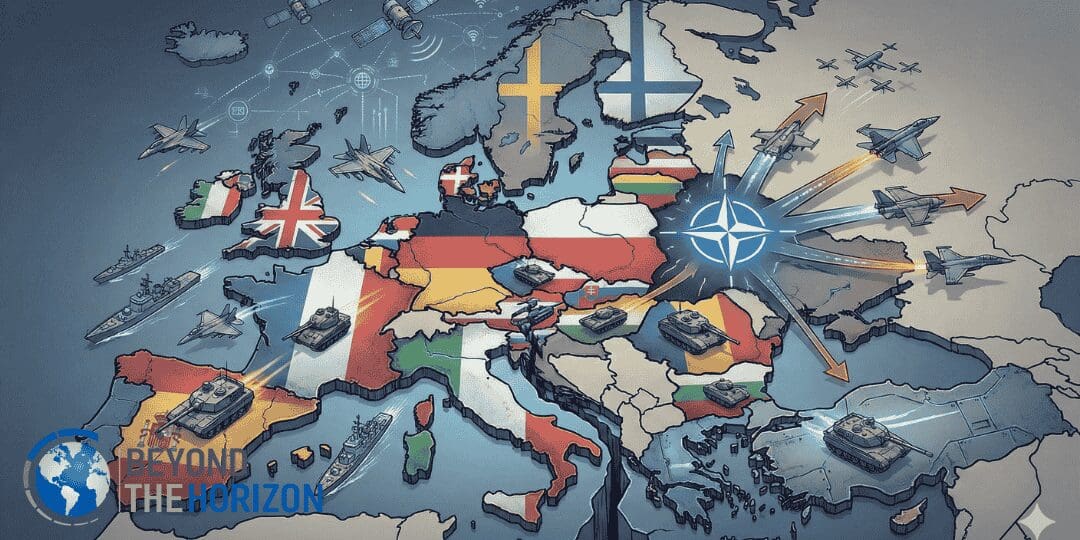
Key Takeaways
- Spending is no longer hypothetical. Fiscal rules have shifted and EU lending tools are active; the rearmament cycle is underway.
- SAFE finances acceleration, not integration. It moves money and incentivises joint procurement but leaves sovereignty, force design, and command untouched.
- Industrial conditionality is significant but limited. The 65% European-origin requirement steers supply chains without severing transatlantic dependencies.
- Germany prioritises immediacy; France prioritises sovereignty. This structural divergence, visible in combat-air choices and FCAS uncertainty, shapes Europe’s defence-industrial trajectory.
- NATO is the main vehicle of Europeanisation. A stronger European pillar is emerging inside the alliance rather than outside it.
- Hybrid and space capabilities are advancing fastest. Drones, counter-drone systems, and resilient satellite networks are becoming core to deterrence.
- Institutional vetoes remain a strategic constraint. Unanimity rules and domestic political blockages can stall EU-level initiatives irrespective of urgency.
- Türkiye embodies the governance gap. Strategically indispensable within NATO yet politically marginal in EU industrial schemes, it exposes the mismatch between geography and institutional design.
- Public support outpaces institutional capacity. Europeans favour deeper defence unity, but current mechanisms incentivise coordination rather than compel integration.
- Europe is becoming stronger, not singular. The decisive question is whether incremental coordination can substitute for unified strategic logic in a prolonged period of geopolitical pressure.
Introduction
Europe’s defence debate has moved from whether to how: how to finance, how to procure, and how to translate higher budgets into usable deterrence. New European Union lending decisions, national fiscal rule changes, and a broadened view of what “defence” includes (drones, critical infrastructure, and space) all point in the same direction: the spending surge is no longer hypothetical.
The harder question is aggregation. Europe is acquiring more capability, but it is still not acquiring it as one system with a single industrial and strategic logic. What is emerging is “Europeanised” defence (more shared money and tighter NATO burden-sharing), not “unified” defence.
SAFE shifts money, not sovereignty
SAFE is genuinely significant—but describing it as a “return of state power” is analytically imprecise. It is not EU command authority or a European defence treasury. It is conditional credit to accelerate national procurement while steering states toward joint purchasing and industrial scaling.
The scale is material. A second tranche of approved national plans totals about €74 billion for eight states, and Poland alone asked for more than €43 billion—an unmistakable indicator that Europe’s security centre of gravity has shifted eastward in both threat perception and political urgency.
SAFE’s industrial preference is also more precise than most suggests. The requirement is that component costs originating in the EU, European Economic Area / European Free Trade Association states, or Ukraine are at least 65% of the end product’s estimated cost. “35% cap on non-European components” is a derivative summary, not the legal rule—and the distinction matters because the regulation also assumes supply chains cannot be re-nationalised at speed.
That design creates a predictable transatlantic friction point. The United States wants Europeans to shoulder more burden, but it also has an interest in keeping Europe inside US-linked platforms and supply chains. A senior U.S. defence official now signals pragmatic acceptance of allies “indigenising” production—yet the baseline asymmetry remains: the same alliance that wants Europeans to spend more also benefits when they spend it on US-anchored ecosystems.
Finally, SAFE’s effectiveness is bounded by European politics. Hungary’s obstruction of an agreed €90 billion EU loan for Ukraine highlights how unanimity rules can convert unrelated bilateral disputes into EU-wide paralysis. And Poland’s internal institutional tug-of-war—illustrated by a presidential veto of a major judicial reform—shows how domestic veto players can complicate the execution of EU-level financial programmes even when the security rationale is strong.
The Franco-German split is about time horizons
The France–Germany divergence is not mainly about personalities; it is structural. Germany has removed major fiscal constraints by exempting defence spending above 1% of GDP from its constitutional “debt brake,” enabling a sustained spending path that many neighbours cannot replicate quickly.
But Berlin’s procurement instincts increasingly prioritise near-term deterrence credibility and NATO interoperability over long-horizon industrial sovereignty. Reporting that Germany is considering a further purchase of U.S.-made F‑35s, amid FCAS deadlock, is the clearest manifestation: it buys time and capability now, at the cost of deepening dependency on a non-European combat-air ecosystem.
FCAS, in turn, exposes the fragility of “strategic autonomy” rhetoric. Public doubts from Germany’s chancellorabout whether FCAS still meets German needs, Airbus floating a “two-fighter” fallback, and repeated signals that a political decision is imminent all indicate that Europe may preserve some shared architecture while abandoning the ambition of a single next-generation aircraft.
Germany’s exploratory talks with France on nuclear deterrence cooperation underline the same theme: urgency is pushing Berlin to consider hard-power options—while still insisting these moves are complementary to, not a substitute for, the U.S. deterrent.
NATO Europeanises through coalitions
If “more Europe” happens, it is most likely via NATO: a stronger European pillar inside a still-transatlantic alliance. NATO’s secretary-general has embraced this framing, explicitly endorsing a “more European-led” NATO so the alliance can remain transatlantic.
The operational signs are increasingly visible. The United Kingdom’s announced deployment of its carrier strike group to the North Atlantic and the High North is intended as a credible signal that deterrence is now multi-theatre and that Europe can still project force at the alliance’s edges.
Europe’s biggest militaries are also forming minilateral procurement and innovation blocs. The launch of a joint programme among Europe’s top defence spenders to develop low-cost air-defence effectors and autonomous platforms reflects a war lesson from Ukraine: mass matters, and expensive interceptors cannot be the only answer.
But the U.S. still shapes European choices in ways that matter for autonomy. A U.S. ambassador publicly urging Portugal to buy F‑35s is a micro-example of how platform ecosystems, interoperability arguments, and political pressure continue to influence European capability paths.
Hybrid and space rearmament outpaces institutional convergence
The EU’s own defence-relevant agenda is expanding beyond classic procurement. The European Commission’s drone and counter-drone action plan treats drones as a hybrid threat to critical infrastructure and borders and links EU preparedness with industrial and training cooperation with Ukraine.
Germany’s military space posture points in the same direction: a major push for secure military communications satellites (reportedly a 100-plus constellation) and non-kinetic counterspace tools implies that deterrence now depends on resilient space-based ISR and communications as much as on conventional stocks.
Yet Europe remains institutionally cautious. Spain has revived arguments for a joint EU army, but key EU leaders warn that a separate force risks duplication and confusing command chains alongside NATO. The practical outcome is coordination without centralisation: shared financing, joint projects, and standard-setting—without a supranational chain of command.
Türkiye shows the gap between geography and governance
Europe’s security geometry is not limited to EU borders. Türkiye implements the Montreux Convention regimegoverning warship passage through the Turkish Straits into the Black Sea, and NATO has highlighted that it has the alliance’s second-largest army—facts that make it strategically hard to ignore in any Black Sea-centric security architecture.
Ankara has therefore pressed for access to EU defence funds, and Reuters has explicitly linked that push to disputes with Greece and to EU restrictions that privilege EU-associated and Ukrainian industry. Reports also suggest procedural barriers have kept Türkiye out of SAFE participation timelines.
Here the EU faces a real dilemma. Exclusion may be geopolitically inefficient; inclusion without political conditionality is institutionally implausible. As long as that tension is unmanaged, Europe will keep relying on Türkiye inside NATO while keeping it at arm’s length in EU-led industrial instruments—an arrangement that forces improvisation when procurement, exports, or regional crises collide.
Public mandate outpaces political conversion
Public opinion is clearly moving toward “more Europe” on security. Eurobarometer polling has shown very high support for a common defence and security policy (81% in Spring 2025), and the European Parliament’s late‑2025 survey reports overwhelming demand for member states to be more united in facing global threats.
But the conversion mechanism is weak. Defence spending is still executed through national budgets, national procurement rules, and national industrial preferences; EU tools mostly “incentivise” rather than direct. Meanwhile, intergovernmental veto structures allow a single capital to weaponize consensus, as the Ukraine loan episode demonstrates.
Conclusion
Europe is not hesitating; it is fragmenting at speed. The fiscal constraints that once limited defence outlays have been loosened, new EU lending instruments are operational, and national procurement plans are accelerating. But aggregation remains political, not structural. The continent is adding capability without yet producing coherence.
SAFE exemplifies the pattern. It meaningfully scales financing and nudges joint procurement, but it does not alter sovereignty over force structure, deployment, or doctrine. Its industrial conditionality tightens European supply chains at the margins, yet leaves intact the gravitational pull of U.S.-anchored ecosystems—especially in high-end platforms such as combat air. The Franco-German divergence underscores the point: urgency pushes Berlin toward immediate NATO interoperability, while Paris prioritises long-term industrial sovereignty. Neither approach is irrational. Together, they entrench a dual-track Europe.
Where convergence is occurring, it is happening through NATO rather than through the EU as a supranational defence authority. Europeanisation inside NATO—carrier deployments, minilateral procurement coalitions, shared air-defence initiatives—signals a more capable European pillar, but not an autonomous strategic centre. Institutional caution persists. Proposals for an EU army remain politically implausible because they would duplicate command structures and destabilise alliance clarity.
The most dynamic expansion is in hybrid and space domains, where resilience, drones, and satellite architectures are advancing faster than institutional integration. Europe is adapting to the character of contemporary conflict. Yet adaptation is occurring through layered coordination, not command centralisation.
Türkiye’s ambiguous position, the persistence of unanimity rules, and domestic veto players illustrate the structural limits. Europe’s security geography extends beyond EU membership, but its defence industrial instruments do not. Public opinion strongly favours more unity, yet the mechanisms to translate that mandate into unified procurement, doctrine, and deployment remain weak.
The result is a continent that is materially stronger but institutionally segmented. Europe is rearming. It is not yet integrating. Whether that distinction becomes strategically costly will depend less on budgets than on whether political leaders accept that deterrence credibility ultimately rests on systemic coherence, not cumulative spending.