
Key Takeaways
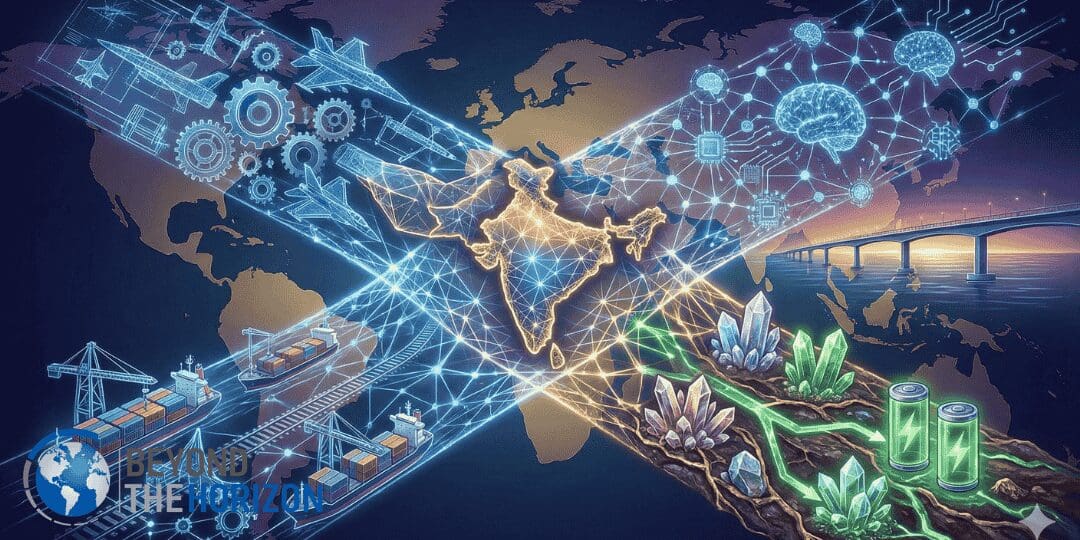
- Autonomy is being pursued through embeddedness, not distance. India’s strategy is to deepen selective interdependence across security, technology, trade, and materials in order to multiply options rather than avoid alignment.
- Defence cooperation is shifting from acquisition to ecosystem building. Industrial nodes—co-design, MRO, engine work, electronics, and supply-chain hedging—are now central.
- AI diplomacy prioritises breadth over binding constraint. By securing endorsement from geopolitical rivals under voluntary, sovereignty-respecting language, India maximises inclusivity but accepts thin enforceability.
- Trade and security are being institutionally fused with Europe. The pairing of a free trade agreement with a security and defence partnership signals that economic integration is intended to reinforce geopolitical resilience, not merely growth.
- Corridor politics is an insurance strategy—but insurance requires capital and stability. IMEC and related port initiatives aim to create redundancy vis-à-vis existing routes, yet financing gaps and regional conflict risk undermine immediate credibility.
- Critical minerals are the material backbone of the strategy. The partnership with Brazil recognises that energy transition and advanced manufacturing autonomy hinge on processing, refining, and environmental governance capacity—not only access to ore.
- Implementation risk is the central vulnerability. Across defence, AI, corridors, and minerals, frameworks are ahead of execution. Without disciplined follow-through, networked autonomy risks diffusing effort instead of consolidating leverage.
Introduction
The most revealing feature of India’s February 2026 diplomacy is not any single bilateral headline, but the way disparate tracks were staged as a single political ecosystem: defence industrialisation with a European partner, AI governance entrepreneurship with a near‑universal signatory list, and critical‑minerals coordination with a major Global South economy. The choreography is clearest in the deliberate coupling of venues and sequencing—high‑level political engagement in Mumbai and the convening power of New Delhi in the same week that produced a dense set of institutional outcomes.
A useful descriptor here is “autonomy through alignment,” not the older myth of autonomy through distance. That framing—strategic autonomy as something constructed via partnerships that build capability and shape the external balance—has become mainstream among serious analysts of India’s grand strategy. The February cluster functions as a case study in networked autonomy: India seeks not to sit “between blocs,” but to sit at the junctions where security supply chains, digital standards, and energy‑transition inputs intersect. The question is whether these junctions generate durable leverage—or merely disperse attention across too many fronts.
Defence‑Industrial Convergence with France
The India–France track is analytically important because it formalises a shift from “platform acquisition” to “platform ecosystem.” The joint statement elevating the relationship to a “Special Global Strategic Partnership” explicitly foregrounds co‑design, co‑development and co‑production, alongside a 2024 defence industrial roadmap, a new joint advanced technology development mechanism, and measures aimed at supply‑chain vulnerability reduction. Those are not decorative phrases: they are the architecture of partial interdependence—deep enough to matter, but calibrated to avoid alliance‑type obligations.
The near‑term anchor is aviation. Emmanuel Macron publicly linked the relationship’s “new era” to joint production of Dassault Aviation Rafales and to India’s stated willingness to order 114 additional aircraft with significant local production (reportedly up to 90). India and France also highlighted the already‑contracted 26 Rafale‑Marine jets and placed fighter aircraft and engine manufacturing under the broader logic of domestic industrial capacity building.
What makes this more than an arms story is the bundling of industrial nodes: the statement references engine MRO ecosystems and multiple co‑production arrangements, including a helicopter final assembly line inaugurated through Tata Advanced Systems and Airbus, plus missile industrial cooperation involving Safran and Bharat Electronics Limited. The logic is obvious: military readiness is increasingly a function of industrial throughput and maintenance loops, not only of orders signed. This is why the joint statement pairs defence with a “Partnership for Security and Sovereignty” and frames advanced technology cooperation as a hedge against supply‑chain shocks.
The hard critique is that “co‑production” is not synonymous with “autonomy.” Local assembly and partial localisation can still preserve choke‑point dependencies in engines, sensors, and mission software—exactly the layers that define modern combat credibility. The industrial bargain will be tested when localisation targets collide with vendor incentives, export controls, and the political economy of Indian defence procurement. The joint statement itself implicitly acknowledges this by treating technology cooperation as a problem of “competitive edge” and supply‑chain exposure rather than as a solved issue.
Norm‑Setting at Scale in AI
India’s AI diplomacy in 2026 is best understood as an attempt to turn scale into legitimacy. The AI Impact Summit ran from 16–20 February and was explicitly anchored in three “Sutras”—People, Planet, Progress—positioning India as a convenor focused on development outcomes rather than frontier competition. The more consequential outcome, however, is the AI Impact Summit Declaration: a document that is simultaneously expansive in membership and minimalist in legal bite.
The Declaration’s structure matters. It builds global cooperation around seven “Chakras” (pillars) and repeatedly emphasises voluntary, non‑binding frameworks, while overlaying a sovereignty clause—cooperation “while respecting national sovereignty” and “national laws.” In practical terms, India is advertising a governance model designed to attract broad buy‑in from countries that will not accept a treaty‑like regime in AI—especially when AI is now entangled with national security, industrial competitiveness, and data control.
The scale of endorsement supports this reading. The signatory list includes major geopolitical rivals and system competitors—among them the United States, China, and Russia—as well as the European Union and International Fund for Agricultural Development, reaching 88 endorsers in total. This is not a trivial diplomatic signal: India is demonstrating that it can still convene across fracture lines, at least at the level of principles.
Substantively, the Declaration tries to reframe the AI governance debate around distribution, not merely safety. It “takes note” of a Charter for the Democratic Diffusion of AI (access to foundational resources), a Global AI Impact Commons (replicable use cases), and a Trusted AI Commons (tools, benchmarks, best practices), alongside skilling and energy‑efficiency commitments. The recurring, almost programmatic emphasis on affordability and access is an explicit Global South play, and it gives India rhetorical and institutional symmetry with its own domestic narrative of “digital public infrastructure” as a development multiplier.
But this is also the vulnerability of India’s normative ambition: consensus at this breadth is likely to be consensus at the lowest common denominator. The Declaration’s reliance on “take note” language and its repeated insistence on voluntary approaches make it more a platform for coordination than a mechanism for constraint. Credible observers also underline that, even with broad endorsement, gaps in infrastructure, funding, and governance remain binding constraints on turning a declaration into capacity—particularly for large‑scale deployment beyond pilot projects. In short: India has built a big tent; whether it can build a working system inside it remains unresolved.
Corridors and the European Union: Resilience Without Bloc Discipline
A striking feature of this month’s diplomacy is how trade, security, and infrastructure were narratively fused. The India–EU summit in late January formally concluded negotiations on a landmark free trade agreement and launched a first‑of‑its‑kind India–EU Security and Defence Partnership, explicitly covering defence industry and technology, maritime security, cyber and hybrid threats, space, and counter‑terrorism.
India’s February engagement with France then treated that EU framework as a force multiplier. The India–France joint statement directly welcomed the EU–India FTA conclusion and argued that the new security and defence partnership would contribute to the strategic autonomy of both India and the EU—language that is unusually explicit about the intended geopolitical effect of trade and defence institutionalisation.
The corridor politics sit inside that logic. India and France reaffirmed their commitment to the India–Middle East–Europe Economic Corridor and urged concrete steps via an IMEC ministerial process in 2026. Outside government‑to‑government language, commercial and sub‑national infrastructure tie‑ups are also being mobilised: reporting on an MoU between Adani Ports and Special Economic Zone Ltd and Port of Marseille Fos describes an effort to institutionalise an “IMEC Ports Club” and develop a “green maritime corridor,”explicitly framed as strengthening India–Europe connectivity.
It is tempting to read all this as “counter‑BRI without confrontation,” and the temptation is not baseless: outlets covering the port agreement describe IMEC as an alternative to the Belt and Road Initiative and the corridor is regularly discussed as a diversification tool rather than as an ideological project. But the fragility is structural. Analyses of IMEC’s implementation constraints emphasise that regional conflict dynamics (including the Gaza war’s wider diplomatic effects), as well as a lack of a clear funding structure and formal commitment architecture, have repeatedly delayed “vision to reality.” Even sympathetic observers note that IMEC’s strategic story is ahead of its financing and its on‑the‑ground sequencing—and that fundable, bankable projects are the real test of credibility.
The deeper point is that India is trying to create redundancy rather than dependence: corridors, port clubs, and regulatory alignment as insurance policies. But insurance only pays out if it exists when the shock arrives; corridors that remain hostage to regional security crises do not eliminate vulnerability—they rearrange it.
Brazil and the Politics of Critical Minerals
India’s Global South diplomacy this month did not run parallel to its Western technology and trade engagement; it was braided into the same week and, crucially, into the AI summit itself. President Luiz Inácio Lula da Silva visited India from 18–22 February and participated in the AI Impact Summit before holding bilateral talks with Narendra Modi. The choreography matters: India is linking development‑framed technology governance to the supply‑chain politics that will define the green and digital transition.
The India–Brazil joint statement places critical minerals at the heart of this linkage. It records the signing of an MoU on rare earth elements and critical minerals, explicitly aimed at strengthening “supply value chains” across exploration, mining, processing, recycling, and refining. This is a material‑security agenda, not merely a trade agenda, and it is explicitly framed as an energy‑transition and advanced‑manufacturing issue.
Two additional layers make the Brazil vector strategically useful to India. First, the economic target‑setting is ambitious but concrete: the leaders referenced strong trade growth and set a target of USD 30 billion by 2030, alongside efforts to reduce non‑tariff barriers and deepen investment facilitation. Second, the governance rhetoric is direct: both sides called for comprehensive UN reform and reaffirmed mutual support for permanent membership in an expanded United Nations Security Council.
There is, however, a built‑in tension that analysis should not evade. Critical‑minerals partnerships are politically and environmentally expensive. The joint statement itself notes concern about environmental crimes and illegal mining—an implicit acknowledgement that minerals diplomacy is inseparable from domestic regulatory capacity and enforcement credibility. Moreover, MoUs do not automatically translate into de‑risked supply; they create frameworks whose success depends on project pipelines, permitting, community buy‑in, processing capacity, and price cycles. That implementation burden is precisely where “networked autonomy” can turn into “networked obligation.”
Conclusion
February 2026 illustrates a coherent strategic wager rather than a collection of diplomatic set pieces. India is attempting to convert density into leverage: dense industrial linkages with France, dense norm-setting coalitions in AI, dense trade and security institutionalisation with the European Union, corridor connectivity through IMEC, and dense material-security coordination with Brazil. The operative logic is that autonomy in a fragmented order is not achieved by insulation, but by occupying junctions—where supply chains, standards regimes, and infrastructure routes intersect.
This is a more sophisticated proposition than non-alignment redux. It recognises that power now travels through maintenance ecosystems, software layers, mineral processing capacity, regulatory templates, and port governance. By tying defence industrialisation to technology collaboration, AI governance to development access, trade liberalisation to security partnership, and corridor politics to critical-minerals diplomacy, India is constructing interlocking forms of partial interdependence designed to reduce single-point vulnerability.
Yet the strategy’s credibility will be measured not by the number of communiqués issued or declarations endorsed, but by implementation under friction. Co-production that leaves engine cores and mission software abroad does not eliminate dependence; AI declarations that rely on voluntary language may institutionalise dialogue without constraining behaviour; corridors without finance and security guarantees remain exposed to regional shocks; minerals MoUs without processing capacity and environmental enforcement create obligation without insulation. Networked autonomy is therefore not a status but a condition that must be continuously reproduced through industrial policy discipline, regulatory coherence, and political stamina.
The February cluster demonstrates that India can choreograph scale. The harder test is whether it can convert scale into sustained structural advantage—turning junctions into leverage rather than liabilities.