
Key Takeaways
- The alliance is intact but no longer implicit. The United States reaffirmed commitment to Europe, yet tied it to burden-sharing and ideological clarity, challenging Europe to demonstrate strategic seriousness.
- Narrative power matters. Competing framings—civilizational decline versus structural recalibration—revealed that control over the meaning of “the West” is itself a strategic battleground.
- Europe faces a legitimacy gap in Ukraine diplomacy. Despite bearing substantial costs, European governments remain peripheral to peace negotiations, undermining both leverage and domestic political sustainability.
- Strategic autonomy is moving from slogan to policy. Nuclear deterrence debates, activation of EU defense clauses, and greater coordination in regions like the Arctic signal a gradual normalization of hard-power thinking in Europe.
- Geography has returned to center stage. The Arctic controversy illustrated how alliance politics, sovereignty, and resource competition intersect in newly strategic spaces.
- China positions itself as systemic alternative. Beijing’s emphasis on multilateralism and UN authority highlights the broader contest over the norms and institutions of global governance.
- The post-Cold War order is over. Munich did not announce a new system, but it confirmed that the era of assumed Western primacy and effortless cohesion has ended. What follows will hinge on Europe’s willingness to convert unity into responsibility.
Introduction
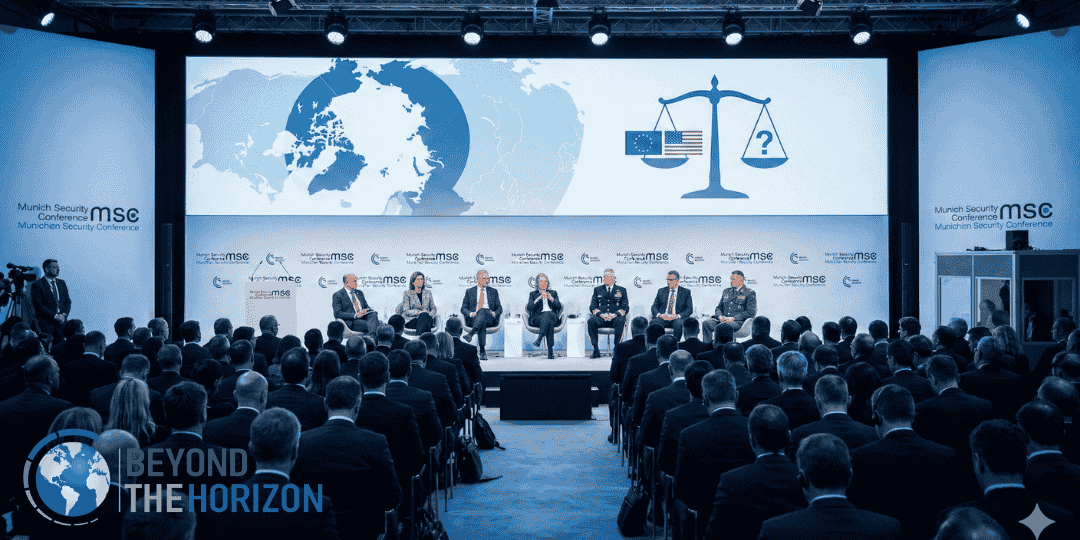
The Munich Security Conference of 2026 did not yield a grand diplomatic breakthrough – but it did deliver much-needed clarity. Over three days, leaders from the United States, Europe, Ukraine and China laid bare competing visions of order and alliance. The US message framed the transatlantic alliance in civilizationalterms, urging Europeans to “help save the West” and beware “managed decline,” whereas European officialsbristled at being cast as vassals in need of rescue. At the same time, Ukrainian President Volodymyr Zelenskyy highlighted a glaring imbalance: Europe underwrites Ukraine’s defense and reconstruction, yet remains “practically not present” in the peace talks shaping that future. Underlying all of this was a recognition – echoed by German Chancellor Friedrich Merz – that the old post‑Cold War order “no longer exists”. In short, Munich 2026 was not about reassuring commitments but about recalibrating who defines the West and its responsibilities.
Transatlantic Tensions: Civilization vs. Structure
US Secretary of State Marco Rubio set the tone by casting the alliance in civilizational terms, rather than merely strategic ones. Rubio stressed that Americans and Europeans “belong together” – the US is “always a child of Europe” – but warned that Americans will no longer passively tend to a Western “managed decline” while Europe rationalizes the broken status quo. In other words, partnership is welcome but only on terms of ideological alignment and burden-sharing. The underlying US demand was clear: Europe must step up its own defense and policy choices, even as Washington pledges to stay engaged.
European officials listened warily. EU High Representative Kaja Kallas flatly rejected the narrative of a Europe in decline. Evoking controversy over a recent US strategy report, she quipped that “a woke, decadent Europe is not facing civilizational erasure,” and insisted the EU does not need rescuing. Kallas’ point was not to sever ties – she vigorously supports NATO – but to argue that framing matters. Europe resents being seen as waiting for an American savior. As one German official put it, Europe “must stand on our own two feet” even as it remains in alliance. In practice, values between Europe and America remain broadly aligned, but the battle over the alliance’s narrative is sharpening: who sets the agenda? The US wants allies who share its vision; Europeans insist they already share it and can act on their own. In effect, Munich revealed that the transatlantic partnership is intact – but uneven. Washington affirms the alliance, while quietly demanding Europe carry more of the strategic weight.
Ukraine’s European Dilemma
Just when Europe is most heavily invested in Ukraine’s defense and future, Kyiv’s leader pointedly highlighted Europe’s sidelining in diplomatic strategy. President Zelenskyy bluntly warned that it is “a big mistake” Europe is “practically not present at the table” of peace negotiations. Europe now provides the bulk of Ukraine’s arms, loans, and promises of postwar support, yet Washington brokers most high-level talks with Russia. Zelenskyy’s plea underscores a stark imbalance: Europe bears the costs of war more than any other, but wields little direct influence over how it ends. This cuts to legitimacy and leverage. Why should European publics underwrite security guarantees or reconstruction if their governments have no seat in setting the peace terms?
Munich brought this paradox to light. On one hand, Zelenskyy told listeners that Ukraine’s destiny is inevitably European and his country is racing toward EU and NATO membership. He even urged a “date” so Ukraine is “technically ready” to join the EU by 2027, tying membership to security assurances. On the other hand, Kaja Kallas admitted privately that most EU capitals hesitate to promise a fixed accession date. Moscow, meanwhile, is content letting Europe’s divisions fester. In Munich there was a recognition that Europe could play a bigger role in shaping Ukraine’s peace – and that excluding it would ultimately hurt both Ukraine and the EU. Europe is indispensable in practice, but peripheral in process. Ukrainian leaders used Munich to signal that Europe’s strategic agency must catch up with its obligations.
Return of Big-Power Politics
Perhaps the sharpest message from Munich was that the era of assumed Western primacy is over. German Chancellor Merz was explicit: the post-1945, rules-based order “no longer exists in that form”. Every session echoed this. Delegations spoke of a “dangerous new era” of great-power rivalry. Even within NATO, the refrain was not whether to deter aggression, but how.
In this context Europe is quietly reconsidering hard power. A week before Munich, Merz revealed he has begun confidential talks with France on a joint European nuclear deterrent, while emphasizing any such capability would be strictly “embedded within our nuclear sharing in NATO”. Munich itself saw high-profile follow-up: French President Macron affirmed that EU leaders are in dialogue on how to “articulate our national doctrine” on nuclear deterrence, and signaled that Europe must learn to be a “geopolitical power”. This debate – long taboo after the Cold War – is significant. It signals that Europeans no longer assume Washington’s nuclear umbrella will cover them unchallenged forever. (As a German official put it after Munich, any future European nukes would “supplement and strengthen” the US shield, not replace it.)
Similarly, Europe’s conventional defense posture is shifting. Commission President Ursula von der Leyenurged that the EU “bring our mutual defence clause to life” – activating Article 42.7 of the EU treaty so that “one for all and all for one” becomes a political reality. She called for faster decision-making on EU defense integration and more partnerships (notably with the UK). Behind this language lies a simple fact: European states will have to build real military capability, not just trust in alliances. Munich did not announce a new European army, but it did show that previously reluctant capitals are starting to confront the reality that they cannot simply outsource deterrence. France, Germany and others all spoke of lowering the political threshold for joint defense. In short, Munich signaled the end of complacency – Europe is inching toward genuine strategic autonomy while still scrambling to keep Washington on board.
Arctic Stakes and Strategic Geography
Amid these discussions, geography re-emerged as geopolitics. The row over Greenland – where President Trump openly mulled seizing territory from ally Denmark – underscored how old alliances intersect with new resource contests and Arctic security. NATO has responded by launching Arctic Sentry, an “enhanced vigilance” mission to coordinate allied forces in the High North. As NATO Secretary-General Mark Rutteexplained, Arctic Sentry will “bring efforts by various members under a single command” so gaps can be identified and filled. Its purpose is “to safeguard [allied] members and maintain stability in one of the world’s most strategically significant … areas,” said NATO’s Supreme Allied Commander Europe.
For Denmark and Greenland, the messages were mixed. Danish PM Mette Frederiksen publicly refused to compromise Greenland’s sovereignty, calling it a “red line,” but she also suggested Washington, Denmark and Greenland could cooperate on security (for example, by expanding the US military footprint on the island). Greenland’s own leaders signaled willingness: the Greenlandic PM thanked NATO for the Arctic Sentry plan, calling the current trilateral process “the first right step” and pledging his territory “is committed to be part of the alliance”. All in all, Munich made clear that the Arctic – with its thawing sea lanes and untapped resources – is now a recognized theater of competition. Europe is no longer just debating whether to defend its interests, but how and on whose terms.
Beijing’s Global Counterpoint
Parallel to Western debates, China’s delegation offered a contrasting vision. Foreign Minister Wang Yiemphasized multilateralism and UN authority. He warned against a return to “law of the jungle and unilateralism,” and urged renewal of the UN system as “the most universal and authoritative” foundation of world order. On Ukraine, Wang Yi noted that “the door to dialogue is finally open,” calling on all parties to seize the chance for a comprehensive, durable peace agreement. In effect, Beijing offered a narrative: the current turmoil reflects Western failure, and the solution lies in a more “just and equitable” global governance (as proposed in President Xi’s Global Governance Initiative). China’s presence at Munich underlined that any rethinking of the world order must account for the largest non-Western power’s stake in shaping norms and institutions.
Conclusion: From Unity to Responsibility
Munich 2026 did not fracture the transatlantic alliance; it stripped it of comforting illusions. The conference made unmistakable that unity can no longer rest on habit, sentiment, or inherited narratives of Western primacy. The United States signaled that its commitment endures, but only alongside demonstrable European capacity and ideological alignment. European leaders, for their part, rejected civilizational tutelage yet conceded—implicitly if not always explicitly—that structural dependence on Washington is no longer sustainable.
On Ukraine, the contradiction was especially stark: Europe finances and arms the war effort, yet remains marginal in shaping the diplomatic endgame. This imbalance is not merely procedural; it is strategic. If Europe aspires to geopolitical agency, it must translate material investment into political leverage. Otherwise, it risks underwriting outcomes it did not meaningfully negotiate.
The return of great-power rivalry has accelerated this reckoning. From discussions of a European nuclear dimension to renewed emphasis on the EU’s mutual defense clause and Arctic vigilance, the conference revealed a continent inching toward strategic maturity. Yet these moves remain tentative, framed as supplements to NATO rather than alternatives. Europe seeks autonomy without rupture, responsibility without abandonment. Whether that balancing act is viable in an era of sharpened geopolitical competition remains uncertain.
Munich 2026 thus marked the end of strategic ambiguity. The post-Cold War assumption that the liberal order would self-sustain under US guardianship has dissolved. What replaces it will depend less on rhetorical unity and more on whether Europe is willing—and able—to assume the burdens commensurate with its ambitions.