
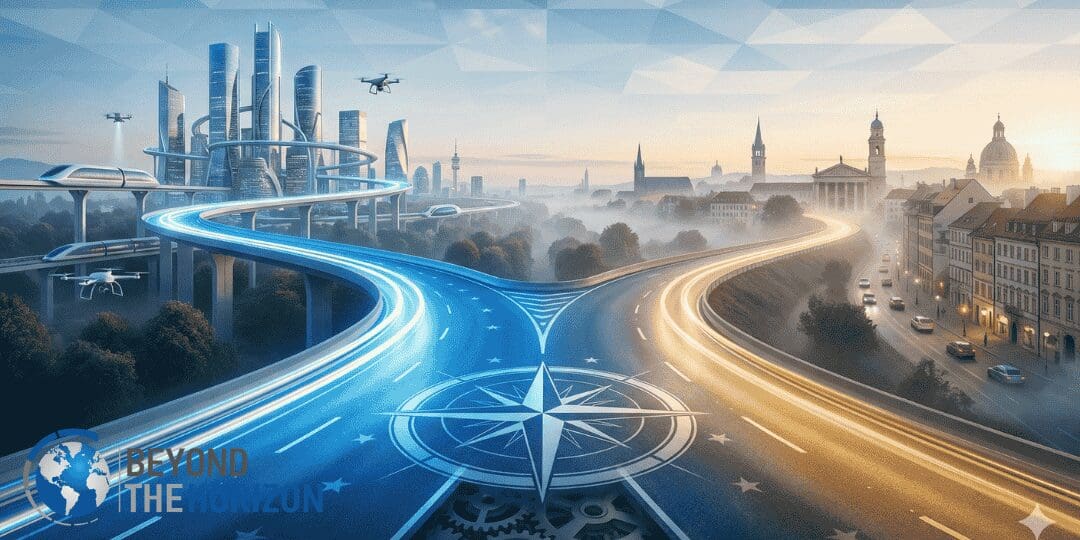
Key Takeaways
- The “two-speed Europe” debate is no longer theoretical. Senior EU leaders are openly conceding that unanimity has become a liability in security and competitiveness, marking a shift from rhetorical commitment to consensus toward acceptance of permanent differentiation.
- Differentiated integration is old; its political bluntness is new. The euro, Schengen, PESCO, and enhanced cooperation show that multi-speed Europe has long existed. What is novel is the readiness of top officials to frame it explicitly as a solution to paralysis rather than as a temporary exception.
- Security, not ideology, is the primary driver. Russia’s war, NATO pressure, and doubts about long-term U.S. focus have exposed Europe’s inability to act quickly at 27. Two-speed integration is being advanced as damage control, not as a federalist leap.
- Economic competitiveness is the secondary but reinforcing motive. Fragmented regulation, underpowered capital markets, and industrial decline have pushed leaders to conclude that effectiveness may now outweigh procedural inclusiveness.
- Speed and scale are real advantages—but not guaranteed. Smaller coalitions can procure faster, spend bigger, and signal credibility. Yet this assumes sustained political alignment among core states that historically disagree on threat perception and strategy.
- The fragmentation risk is structural, not rhetorical. A visible inner circle risks entrenching hierarchies, hardening opt-outs into semi-detachment, and provoking obstruction by excluded states—undermining solidarity rather than compensating for its absence.
- The central gamble is political, not technical.Europe is betting that it can institutionalise differentiation without hollowing out the Union itself—a wager that history suggests is far from safe.
Introduction
Europe’s leaders have quietly opened a long-avoided debate: what if some EU members press ahead on vital policy areas while others lag? Commission President Ursula von der Leyen has suggested that if consensus stalls, a core of “willing” states should use enhanced cooperation to push an agenda – a significant shift from the EU’s norm of unanimity. Germany’s finance minister echoed this in January, declaring “now is the time for a Europe of two speeds” to break the bloc’s decision-making inertia. The proposal is not a grand new vision but a blunt admission of Europe’s constraints. Faced with wars on its borders, growing U.S.-China rivalry, and domestic economic drags, the EU’s traditional consensus model is being challenged by leaders who fear that unanimity risks paralysis. This analysis examines the appeal and the perils of a two-speed Europe, drawing on recent developments and historical experience.
A Legacy of “Multi-Speed” Europe
This idea is not unprecedented. From the start, the EU has accommodated different levels of ambition. As one EU commentary notes, differentiated integration has been “integral” since the Treaty of Rome – from the eurozone and Schengen to the recent Permanent Structured Cooperation (PESCO) in defence. The Lisbon Treaty even provides for enhanced cooperation: if at least nine states agree, they can pursue deeper integration without all 27. Brussels has used this mechanism (under Article 20) to create the European Public Prosecutor’s Office, a unitary patent, harmonised divorce rules, and, most recently, a €90 billion joint aid package for Ukraine. These examples show that letting “those who want to do more” is legally possible. In practice, the euro and Schengen areas have always been “two-speed” constructs: the eurozone group-sharing a currency while others opt out, Schengen starting with five states before expanding. What is new in 2026 is the bluntness of the pitch: top officials are openly saying that core states may have to move ahead on economy and security issues without waiting for everyone
Drivers of Differentiation: Strategy and Competitiveness
Why now? The catalysts are clear. First, Europe’s security environment has deteriorated sharply. Russia’s invasion of Ukraine forced many EU states to boost defence spending, yet chronic fragmentation remains. Most EU members committed to spend 2% of GDP on defence by 2025, but many still only “barely exceed” that threshold. A recent EU study notes that virtually all member states raised defence budgets in 2022–23 in response to the war, but gaps endure. With NATO pushing a 3.5% target by 2035, Europe still trails the U.S. in collective firepower. At the same time, America’s relative focus is shifting, and Asian superpowers loom large. European leaders fear that if they cannot coordinate quickly, frontline countries (especially in the east) will be left vulnerable or will have to lean even harder on NATO.
Economically, too, Europe is under strain. Leaders warn of falling behind the U.S. and China in technology and industry. Regulatory barriers and “gold‐plating” inflate costs, and the single market’s benefits are hampered by national rules. EU summit host Mario Draghi and others have argued that Europe must become a “genuine federation” to avoid deindustrialisation. In a letter to capitals, von der Leyen bluntly stated that if political differences block an “ambitious” agenda for competitiveness, the EU should use enhanced cooperation to move forward with a subset of countries. In other words, preserving effectiveness may trump formal unanimity.
Berlin has taken the lead on this. In late January, German Finance Minister Lars Klingbeil proposed a new “bloc of six” (including France, Italy, Spain, Poland, the Netherlands) to coordinate on the euro, capital markets, raw materials and defence. He explicitly couched this as a two-speed format to overcome “decision-making inertia”. Defence was on the agenda: Klingbeil urged member states to “turn defence into an engine for growth” by embedding it in the EU budget and harmonising procurement. In short, core states are saying: we need to align means with commitments or risk strategic failure.
Mechanisms for Going Faster
How would this work in practice? The EU’s legal toolbox already includes paths. Enhanced cooperation (min 9 states) would be the treaty-based route. For example, the Ukraine aid package was approved under this mechanism – notably, Hungary, Slovakia and the Czech Republic opted out of that deal even as 24 states went ahead. Enhanced cooperation keeps action within EU law and institutions, which pleases Brussels officials: it prevents ad-hoc clubbings that “escape [EU] oversight and complicate internal coordination”. In contrast, the new E6 initiative is more informal; it convenes ministers to set a common agenda and invites others to join. Its open-ended nature (as Klingbeil put it, “other countries are welcome to join us”) reflects the balance between inclusivity and pragmatism. Neither model is bulletproof: too much informality can undermine the Commission’s role, but rigid unanimity has clearly failed on urgent projects.
In defence specifically, the EU already encourages coalitions of the willing. The 2025 Defence Readiness Roadmap calls for “capability coalitions” in nine key areas (air defence, drones, mobility, etc.) to close gaps through joint procurement. Some groups like PESCO allow committed states to pool resources for common projects. The commission’s latest proposals even envision an EU-wide military mobility network by 2027. A core EU could simply accelerate these plans among itself. Smaller groups could standardise equipment, share ammunition production or joint-logistic hubs. On the monetary side, the eurozone already runs its own budgets and debt facilities. A multispeed security framework would similarly rely on sub-unions: a front-line defence pact paralleling the Schengen or Eurozone models.
Benefits: Speed, Scale and Credibility
Advocates argue the upside is strategic pragmatism. A coalition of high-capability states can move projects from planning to reality far faster than 27 states can agree. With economies of scale, they could launch large multibillion‐euro procurement programmes (tanks, missiles, ships) to replenish stocks and deter aggression. Shared resources would unlock joint R&D in critical areas (air defence, munitions, cyber) that Europe struggles to fund. As Fabian Zuleeg of the European Policy Centre observes, insisting on unanimous consent often means “you can no longer reach the speed, scale and scope of the policy response that is needed”. In practice, a smaller core has already driven big steps: the recent €90 billion Ukraine loan was approved only because non-participating states were excused and the rest used enhanced cooperation. The implication is that targeted two-track action can deliver vital aid or defence projects that a 27-way veto might block.
Furthermore, a credible “European pillar” of defence could strengthen both the EU and NATO. By jointly purchasing from EU industries, core members would spur a domestic defence market and lessen reliance on U.S. suppliers. The German economic ministry recently floated a “Buy European” requirement for critical sectors; a self-selected group could implement such rules more swiftly. In aggregate, a militarily integrated core could deter adversaries by showing readiness and autonomy. Commission planning even promises €800 billion of increased spending if budgets are freed and a new €150 billion loan facility (SAFE) is set up. These steps would be easier to enforce among a small core. In short, a two-speed framework might finally align Europe’s talk of strategic sovereignty with concrete action.
Risks: Fragmentation and Double Standards
Yet the concept carries heavy risks. The EU was founded on solidarity and “ever-closer union.” A formal division into faster and slower lanes flies in the face of that ethos. If some capitals visibly surge ahead in defence or industry while others hang back, it could deepen resentment. Countries left out of a “core club” might retreat further into passivity or even obstruct future EU initiatives. We already saw Hungary, Slovakia and the Czech Republic opt out of the Ukraine funding scheme – a hint that excluding nations can stiffen opposition. Critics fear this would create a permanent hierarchy: a security “inner circle” vs second-class members. As one analyst warned, the gap between “those advancing and those left behind” could grow so wide that the Union’s foundational objective – integrating all under common rules – is “rendered obsolete”.
Institutionally, multiple speeds can breed confusion. Ad hoc coalitions (E6, Frugals, Visegrád, MED9, etc.) already litter EU politics. While useful to push issues, they also run separate foreign and security policies at times, undermining a single European voice. Two-speed defence could magnify this cacophony: imagine some EU countries negotiating arms deals under a core agreement while others strike separate deals. The Commission’s Nicolai von Ondarza notes the fear that by moving in smaller groups, member states might simply “go for flexible coalitions outside of the EU framework”, eroding the Commission’s role and Europe’s unity in foreign affairs. Political dynamics could suffer too. Faster integration in one area might spark backlash in others. For example, if some states push for a military tax to fund Euro‐navies or drones, debtor states might resist on fiscal grounds and use that to extract concessions elsewhere. Paradoxically, a faster core could make unanimous decisions in remaining domains even harder, if sidelined members feel cheated of influence.
There are also strategic considerations. A two-speed EU assumes that core members agree on priorities and can implement projects effectively. In reality, even France and Germany have different threat perceptions: Paris favours strategic autonomy and often champions intervention, while Berlin is cautious about overextending. Italy and Spain care about southern threats (North Africa) more than eastern ones. Aligning all these behind one core project could prove difficult. And externally, Russia and China might exploit divisions. They have an interest in an EU at odds with itself – disunity makes European deterrence less credible. Finally, allies like the U.S. will watch closely: NATO wants Europe rearming, but it also relies on a united European front. A fragmented EU could complicate transatlantic coordination, even if overall spending rises.
Conclusion: Pragmatism or Premature Surrender?
The re-emergence of a two-speed Europe is best seen as a hard-nosed admission of reality rather than a grand vision. It reflects frustration that conventional EU decision-making “moves too slowly” to meet today’s crises. As ex-ECB chief Mario Draghi put it, “pragmatic federalism” allows willing states to act without “subordinating” or “sacrific[ing] our values to achieve power”. In the coming weeks, EU leaders must decide whether that justification suffices. If the core group formalises, it must do so cautiously: it should enshrine its actions in treaties (to stay credible to outsiders) and clearly keep doors open for others. Above all, it needs a coherent strategy so that “two speeds” does not simply become a pretext for elite-driven deals.
Yet even as the core progresses, the EU should beware complacency. Ultimately, letting some members “opt out” of collective security risks undermining the solidarity that holds the EU together. The two-speed approach may speed up procurement or budget decisions, but it’s still a gamble: Europe gains flexibility at the cost of political unity. The real test will be whether Brussels can manage this dual-track without losing the plot. For now, von der Leyen and others have signalled that old certainties have been shaken. The question is whether Europe can afford the fiction that consensus alone will keep it secure, or whether a calculated split is the only way forward – even if it means rewriting the rules of the union.