
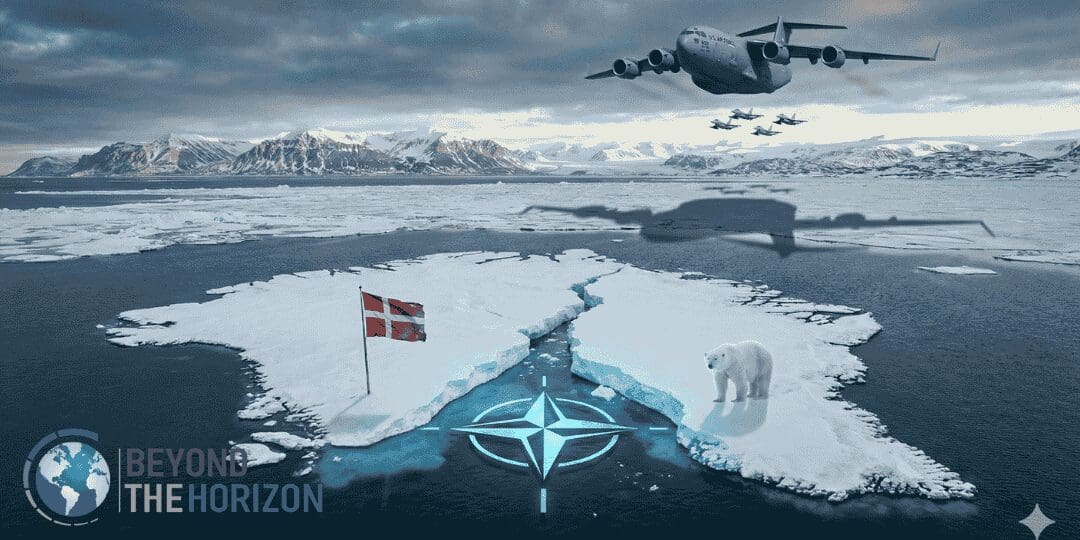
Key Takeaways
- Greenland’s value to NATO is strategic, not discretionary. Its location, infrastructure, and resources are integral to Arctic and transatlantic security—but strategic importance does not confer ownership rights.
- The greatest threat revealed is internal, not external. A NATO member openly threatening another member’s territory exposes a gap in alliance design that Article 5 was never meant to address.
- Alliance credibility depends on restraint by the powerful. NATO cannot function if its strongest member claims exceptional rights over weaker allies under the guise of security necessity.
- European solidarity is politically meaningful but institutionally insufficient. Statements of support for Denmark highlight unity in principle, yet NATO lacks mechanisms to resolve internal coercion.
- Greenlandic self-determination is not a side issue. Ignoring local agency would destabilize Arctic governance and weaken NATO’s normative legitimacy.
- Adversaries benefit most from NATO’s internal discord. Any erosion of trust or paralysis within the alliance directly advances Russian and Chinese strategic interests.
- How NATO handles Greenland will set a precedent. The outcome will signal whether NATO remains a rules-based collective defense alliance or drifts toward power-based internal bargaining.
Introduction
Greenland’s geography makes it a critical linchpin in NATO’s collective security posture. The vast island sits between North America and Europe in the Arctic, astride the Greenland-Iceland-UK (GIUK) gap – a key maritime corridor. This position is central to monitoring Russian submarines (and even potential Chinese subs) entering the Atlantic. During the Cold War, NATO deployed sensors and patrols across the GIUK gap to track Soviet naval movements, and that strategic relevance has resurfaced with renewed great-power competition in the Arctic. Today, U.S. and Danish defense cooperation in Greenland remains robust, exemplified by the American-operated Thule/Pituffik base in northwestern Greenland. That installation hosts early-warning radar systems that provide missile launch detection for North America and NATO. In addition, Greenland’s high latitude makes it ideal for satellite ground stations and space surveillance infrastructure, now seen as vital for communications and missile-defense as rivals develop advanced capabilities.
Beyond pure defense logistics, Greenland is rich in strategic natural resources. The ice-capped island harbors extensive deposits of rare earth elements and critical minerals – resources indispensable for high-tech and military industries. These assets heighten Greenland’s geopolitical value at a time when Arctic sea lanes are opening and global powers are vying for influence in the far north. In short, Greenland’s unique location and assets grant NATO a forward Arctic presence that is crucial for early threat detection, power projection, and resource security. Any change in Greenland’s status could thus reverberate through NATO’s defense architecture, affecting everything from North Atlantic shipping lanes to ballistic missile warning systems.
Sovereignty Debates and Impact on NATO Cohesion
Recent developments surrounding Greenland’s sovereignty have triggered urgent diplomatic discussions about NATO’s future cohesion. In early 2025, U.S. President Donald Trump revived his controversial interest in Greenland, again floating the idea of the United States acquiring the island – an idea he had first suggested in 2019. By January 2026 this rhetoric escalated into formal White House statements, with officials openly confirming that “all options” – including military force – were being considered to take control of Greenland. Trump insisted that the U.S. “needs” Greenland for security reasons, even claiming this would preempt Russia or China from gaining a foothold there. This unprecedented stance – essentially a NATO leader threatening to seize territory of a fellow NATO member (Denmark) – poses a grave and unprecedented challenge to the alliance’s cohesion. NATO was created to defend against external aggression, and its mutual defense clause (Article 5) never contemplated a scenario of one member attacking another. An internal confrontation involving NATO’s most powerful member would be perhaps even an existential crisis for the alliance. Simply put, Article 5’s collective-defense pledge cannot function if the very aggressor is within NATO’s own ranks.
European Responses: Solidarity Without Institutional Resolution
European allies have responded to the Greenland sovereignty dispute with statements of solidarity for Denmark, but also visible anxiety. On January 6, 2026, the leaders of Denmark and several major NATO countries (including France, Germany, Britain, Italy, Poland, and Spain) issued a joint declaration reaffirming that Greenland’s status can only be decided by Greenland’s people and the Kingdom of Denmark – underscoring the principles of national sovereignty and territorial integrity under the UN Charter. The statement also emphasized that Arctic security should be handled collectively by NATO allies. Canada, Greenland’s close Arctic neighbor, likewise voiced support for Danish sovereignty over the island. Despite this, NATO as an institution has been cautious: officials avoided commenting on “hypotheticals” but quietly acknowledged the Arctic’s strategic importance and the alliance’s interest in maintaining stability in the High North. In the face of Washington’s pressure, some European members have even discussed boosting their military presence in Greenland as a signal of commitment to the island’s defense and to dissuade any unilateral action. France began coordinating contingency plans with Germany and Poland on how to respond if the U.S. attempted to take Greenland by force. These measures indicate that while Europe stands with Denmark diplomatically, there is deep concern about NATO’s ability to withstand an internal schism over Greenland.
Article 5, Credibility, and the Risk of Alliance Paralysis
The Greenland sovereignty saga has indeed exposed rifts that threaten NATO’s unity. Danish Prime Minister Mette Frederiksen warned that a U.S. attack on Greenland would mark “the end of NATO” – effectively shattering the post-World War II security order. Her alarm is not theoretical: Denmark’s defense officials reminded everyone of a standing directive to resist any invasion of Danish territory (including Greenland) immediately and without waiting for orders. If an ally as central as the United States were to act as an aggressor, it’s widely feared that other NATO members would be paralyzed. Observers note that no one truly expects the rest of NATO to invoke Article 5 against the U.S. itself in defense of Greenland. Such an unthinkable fracture in collective defense would destroy the core trust holding the alliance together. It also carries real strategic consequence: Russia – and other adversaries – would be the obvious beneficiaries of a divided or weakened NATO. Kremlin officials have every reason to “gloat” as this crisis unfolds, seeing an opportunity to exploit NATO’s distraction and discord. Security analysts caution that NATO’s credibility is on the line – if one leading member undermines another’s sovereignty, it erodes the alliance’s credibility and serves only the interests of rivals like Moscow or Beijing.
Greenlandic Agency and the Independence Dimension
The controversy has also energized Greenland’s own independence movement. Trump’s aggressive posture – paradoxically – has fueled Greenlandic aspirations for greater autonomy from Denmark. Greenland’s majority Inuit population has long harbored dreams of full independence, and they have made it clear they do not wish to become a bargaining chip or territory of the United States. Any push by Washington to claim Greenland against local will would only heighten calls in Nuuk for self-determination. This adds another layer of diplomatic complexity for NATO: the alliance must respect the right of Greenland’s people to decide their future, while also preventing a breach in alliance integrity. In sum, the question of Greenland’s sovereignty – whether through an independence referendum or external coercion – has become a pivotal test of NATO’s cohesion and principles. Preserving alliance unity will require careful diplomacy, respect for the territorial rights of Denmark and Greenland, and a reaffirmation that security in the Arctic must be achieved collectively rather than through zero-sum claims. How NATO navigates this Greenland challenge could set a precedent for its ability to withstand internal strains, ultimately shaping the future of the alliance in a new era of great-power rivalry.
Conclusion
Greenland’s strategic importance to NATO is undeniable; what is deeply troubling is how casually that reality has been weaponized to justify rhetoric that undermines the very alliance it purports to protect. The Greenland episode exposes a structural vulnerability in NATO that has long been ignored: the alliance is built on the assumption that its most powerful member will remain a guarantor of order rather than a source of revisionist pressure. Once that assumption collapses, NATO’s legal framework, political cohesion, and deterrence logic all begin to unravel simultaneously.
The central danger here is not hypothetical military action against Greenland, but the normalization of coercive discourse within the alliance. When sovereignty becomes negotiable based on “security needs,” NATO ceases to be a defensive pact and begins to resemble a hierarchy enforced by power asymmetry. That shift would fatally erode trust among allies and hand strategic advantage to adversaries without a single shot being fired. Russia and China do not need to challenge NATO militarily if NATO proves willing to hollow itself out from within.
At the same time, the crisis underscores that Greenland is not merely a strategic asset but a political community with agency. Any NATO response that treats Greenland as infrastructure rather than as a people will not only be morally indefensible but strategically counterproductive, accelerating independence dynamics and complicating Arctic governance. Ultimately, the Greenland sovereignty debate is a stress test for NATO’s foundational principles. If the alliance cannot uphold territorial integrity and collective restraint among its own members, its credibility as a security institution in an era of great-power rivalry will be irreparably damaged.