
25 MARCH 2026
This week’s edition is defined not by a single escalation, but by the cumulative effect of multiple crises beginning to reinforce one another. The widening Iran war is no longer a parallel distraction to Ukraine, but a force that is actively reshaping the strategic environment in which that war is being fought. From the diversion of air-defence assets to the Gulf to the growing competition for political attention in Washington and European capitals, the interaction between theatres is now structural rather than incidental. At the same time, Ukraine is not simply absorbing these pressures; it is adapting to them—exporting battlefield expertise, embedding itself in new defence partnerships, and leveraging its wartime innovation in ways that complicate the traditional distinction between security consumer and provider.
Across Europe, this convergence is exposing a deeper and more uncomfortable reality: the continent is operating under simultaneous strategic strain without a corresponding increase in coherence. Disputes over defence financing, fractures in EU decision-making, tensions over transatlantic burden-sharing, and diverging national positions on the Iran war all point in the same direction. Even where there is broad agreement on threat perception—Russia as the central danger, escalation in the Middle East as destabilising, defence capacity as insufficient—Europe continues to struggle to translate shared diagnosis into unified action. The result is a pattern of reactive alignment rather than deliberate strategy.
At the operational level, the picture is becoming sharper and less forgiving. European military assets are now directly engaged in protecting Gulf infrastructure, NATO territory is brushing against the edges of the Iran conflict, and defence-industrial debates are shifting from ambition to constraint. Programmes meant to symbolise strategic autonomy are faltering under industrial rivalry, while efforts to scale production and financing remain entangled in political disagreement. What emerges is not a lack of awareness, but a gap between recognition and execution—between understanding the scale of the challenge and organising effectively to meet it.
Taken together, this is a week that underscores a simple but uncomfortable point: Europe is no longer dealing with separate crises that can be prioritised or sequenced. It is confronting an increasingly interconnected security environment in which decisions in one theatre carry immediate consequences in another. The question is no longer whether Europe can respond to individual shocks, but whether it can operate as a coherent strategic actor when those shocks arrive simultaneously.
- Key Developments
- Statistics of the Week
- Map of the Week
- Photo of the Week
- Infographic of the Week
- Analysis
Sweden Warns Iran War Is Raising Domestic Security Risks
Sweden’s Security Service (SAPO) said the war involving Iran has increased the threat to Sweden, especially against American, Israeli and Jewish targets, as it published its 2025–2026 national security assessment on 18 March. SAPO chief Charlotte von Essen said the conflict had sharpened already serious risks, while operations chief Fredrik Hallstrom warned that a pressured Iranian regime could become more dangerous. The agency also reiterated that Iran has previously used criminal networks in Sweden to carry out hostile acts, even as Russia remains the principal long-term driver of the country’s deteriorating security environment.
For European security, the significance is twofold. First, it shows how the widening Iran war is no longer a distant Middle Eastern crisis but a direct internal-security concern for European states, particularly where Jewish communities, U.S. assets and diaspora networks may be exposed. Second, SAPO’s warning underlines a broader pattern: Europe is facing simultaneous pressure from Russia, Iran and China, with state threats increasingly expressed through hybrid methods, proxies and sabotage rather than conventional force alone.
FCAS Crisis Forces Paris and Berlin Into a Strategic Reckoning
French President Emmanuel Macron and German Chancellor Friedrich Merz were due to discuss the troubled Future Combat Air System (FCAS) on the sidelines of the 19–20 March EU summit, as the €100 billion Franco-German-Spanish programme edged closer to breakdown. Reuters reports the immediate dispute centres on control of the next development phase: Dassault wants clearer authority over the fighter jet element and supplier choices, while Airbus insists existing equal-partnership arrangements should remain. The project, launched by France and Germany in 2017 and later joined by Spain, is meant to deliver a networked system of crewed fighters and combat drones to replace Rafale and Eurofighter fleets from around 2040.
For European security, the significance goes beyond one procurement quarrel. FCAS was supposed to embody Europe’s ambition for strategic autonomy in high-end air power; if it stalls or collapses, that would expose again how national industrial rivalries can cripple flagship defence projects. Reuters also notes that failure could trigger a broader reshuffling of European aerospace alignments, including renewed German links to Britain’s rival GCAP programme or new partnerships involving Sweden. In other words, this is not just an industrial dispute but a test of whether Europe can actually build the systems its rhetoric demands.
Paris Floats Single-Market Return as Britain Limits Its EU Reset
French Foreign Minister Jean-Noel Barrot said on 17 March that Britain would be welcomed with “open arms” if it chose to return to the EU single market, framing the offer as a response to London’s increasingly explicit search for a post-Brexit reset with the bloc. His remarks followed comments by British finance minister Rachel Reeves that the UK was ready to align with many EU business rules to support growth. But Reuters notes the Starmer government still rules out both rejoining the single market and entering a customs union, meaning the political signal from Paris currently runs well ahead of any realistic British policy shift.
For European security, the significance is indirect but real. A closer UK-EU economic relationship would not itself solve Europe’s strategic problems, but it could strengthen the political basis for deeper cooperation at a time of mounting pressure on defence, sanctions, industrial policy and support for Ukraine. At the same time, the episode exposes the limits of the current reset: both sides are testing softer forms of alignment, but the core institutional break created by Brexit remains intact. Europe still wants Britain close; Britain still wants the benefits of closeness without restoring the full obligations that made it possible.
Ukraine Turns Battlefield Drone Expertise into Strategic Leverage
Euractiv reports that the widening Iran war is recasting Ukraine from a security consumer into a security provider, as Kyiv offers combat-tested counter-drone expertise to partners facing Iranian attacks. That shift is no longer rhetorical. Reuters has since reported that Ukraine deployed 228 specialists to five Middle Eastern countries — the UAE, Saudi Arabia, Qatar, Kuwait and Jordan — to help protect critical and civilian infrastructure against drones, building on experience gained against thousands of Shahed-type attacks during Russia’s war.
For European security, the significance is sharper than the headline suggests. Ukraine is demonstrating that its wartime innovation base now has export value in one of the most urgent defence fields: cheap, scalable air defence against mass drone attack. That strengthens Kyiv’s diplomatic hand and supports deeper industrial ties with partners, but it also exposes Europe’s weakness. As Reuters notes, the same crisis is consuming air-defence resources that Ukraine still needs at home, meaning Kyiv is simultaneously a provider of expertise and a victim of Western missile scarcity.
Britain and Ukraine Move Drone Cooperation into Industrial Partnership
Britain and Ukraine agreed on 17 March to deepen drone cooperation through a new military-industrial partnership announced during President Volodymyr Zelenskiy’s visit to London. Reuters reports the deal is meant to combine Ukraine’s battlefield expertise in drones and counter-drone systems with Britain’s manufacturing base to increase drone supply and explore sales to third countries. Prime Minister Keir Starmer and Zelenskiy also agreed to support the battlefield use of artificial intelligence, while London pledged £500,000 for a new AI centre in Ukraine. NATO Secretary General Mark Rutte joined the talks, which also touched on broader Euro-Atlantic security and support for Ukraine.
For European security, the significance is concrete. This is not another symbolic pledge of support but an effort to turn Ukraine’s wartime innovation into scalable industrial output with a major European partner. Reuters also notes that more than 200 Ukrainians are already deployed across the Gulf and Middle East to help partners counter Iranian drone threats, underscoring how Kyiv is becoming a provider of security expertise rather than only a recipient of aid. The harder point for Europe is that Ukraine’s combat innovation is advancing faster than Europe’s own defence-industrial adaptation.
Türkiye Reasserts Itself as a Diplomatic Hub for Ukraine Talks
Turkish Foreign Minister Hakan Fidan told his Russian counterpart Sergei Lavrov on 17 March that Türkiye is ready to host the next round of negotiations between Russia and Ukraine, according to Reuters. The offer comes as talks have faced repeated delays and venue uncertainty amid the widening Iran war, which has diverted U.S. attention and disrupted earlier plans to hold meetings in locations such as Abu Dhabi. Ankara has previously hosted direct talks between Kyiv and Moscow and continues to position itself as an acceptable intermediary to all parties.
For European security, the significance is practical rather than symbolic. Türkiye is attempting to keep a fragile diplomatic channel alive at a moment when geopolitical distraction risks freezing the negotiation process altogether. But the offer also highlights the limits of current diplomacy: talks remain procedurally active yet strategically stalled, with deep disagreements over territory and war aims unresolved. In that context, Ankara’s role is less about driving a breakthrough than about preventing total diplomatic collapse—and ensuring that any future process does not shift entirely under U.S. control.
Starmer Warns Iran War Must Not Eclipse Ukraine
British Prime Minister Keir Starmer used President Volodymyr Zelenskyy’s 17 March visit to London to argue that the widening Iran war must not be allowed to weaken Western support for Ukraine. Standing alongside Zelenskyy and NATO Secretary General Mark Rutte, Starmer said “we can’t lose focus” on Ukraine and warned that Vladimir Putin must not benefit from higher oil prices or any easing of sanctions caused by the Middle East conflict. Euronews reported that the talks also covered energy security and the battlefield situation, as concern grows that the Iran war is both reviving Russian oil revenues and diverting scarce Western air-defence resources away from Kyiv.
For European security, the significance is strategic rather than ceremonial. London is trying to keep Ukraine politically central at a moment when another war is competing for attention, munitions and diplomatic bandwidth. That is harder than the rhetoric suggests: Euronews noted that the Middle East conflict is already draining U.S. interceptor stocks and stalling diplomacy on Ukraine, while Reuters reported that Britain and Ukraine used the visit to deepen drone and AI cooperation as part of a broader effort to turn support into industrial capacity.
Rutte’s London Visit Ties NATO More Closely to Britain’s Ukraine Push
NATO Secretary General Mark Rutte visited London on 17 March for talks with British Prime Minister Keir Starmer and Ukrainian President Volodymyr Zelenskyy, with official NATO material showing meetings between all three leaders as well as events at the House of Commons. NATO’s own coverage presents the visit less as a ceremonial stop than as a high-level political alignment around Britain’s support for Ukraine at a moment when the widening Iran war is competing for Western attention. Reuters reported the same day that Rutte joined Starmer and Zelenskyy as Britain and Ukraine launched a deeper drone and AI partnership during Zelenskyy’s visit.
For European security, the significance lies in the choreography as much as in any formal announcement. Rutte’s presence alongside Starmer and Zelenskyy signals NATO’s backing for keeping Ukraine at the centre of the Euro-Atlantic agenda even as the Middle East crisis strains allied focus and resources. It also reinforces Britain’s role as a key political convenor on Ukraine outside the EU framework. That matters because alliance cohesion is now being tested not only by Russia, but by competing crises that risk diluting strategic attention.
Polish Power Struggle Hits Europe’s Defence-Financing Push
Poland’s fight over nearly €43.7 billion in EU defence loans has become a test case for how domestic politics can disrupt Europe’s rearmament plans. President Karol Nawrocki vetoed the law needed to unlock Poland’s access to the EU’s €150 billion Security Action for Europe (SAFE) programme, arguing the scheme would burden future generations with debt and weaken sovereignty. Prime Minister Donald Tusk rejected that logic and vowed to find a way to use the funds anyway, insisting the cheap financing is essential for Poland’s security as Russia remains the central threat on Europe’s eastern flank.
For European security, the significance is larger than Poland’s internal feud. Poland is the biggest potential SAFE beneficiary, so a blockage in Warsaw hits at the credibility of the EU’s attempt to turn defence urgency into actual procurement capacity. The dispute also exposes a broader fault line inside Europe: even among the states most serious about rearmament, there is still no settled consensus on whether defence should be financed through common EU instruments or strictly national means. That is not a procedural problem. It is a strategic one.
Stubb Floats a Hormuz-for-Ukraine Bargain
Finnish President Alexander Stubb has suggested Europe could offer Donald Trump limited help in dealing with the Iran crisis — notably around securing shipping through the Strait of Hormuz — if Washington, in return, gives firmer backing to Ukraine. Politico reported the idea after remarks Stubb made in London, presenting it less as enthusiasm for a Middle East mission than as transactional leverage aimed at keeping U.S. attention and resources focused on Kyiv. The proposal comes as Trump has pressed allies to help reopen Hormuz, but several European governments have already balked at direct military involvement.
For European security, the idea is strategically interesting but politically awkward. It reflects growing fear that the Iran war is competing directly with Ukraine for diplomatic bandwidth, munitions and U.S. presidential attention. But it also exposes Europe’s limits: EU foreign ministers have shown “no appetite” to expand the bloc’s naval mission into Hormuz, and major allies still do not want to be pulled into a U.S.-Israeli war they did not start. So Stubb’s proposal is best read as a bargaining concept, not an emerging European policy.
Trump’s Hormuz Demand Exposes the Limits of Allied Solidarity
President Donald Trump on 17 March publicly attacked NATO allies for refusing to support U.S. efforts linked to the Iran war, calling their stance a “very foolish mistake” after several governments declined to send ships to help secure the Strait of Hormuz. Reuters reported that Trump had warned NATO faced a “very bad” future if allies did not assist, but key partners quickly pushed back: Germany said the conflict was “not NATO’s war,” Britain ruled out any alliance role, and other U.S. partners including Japan and Australia also resisted joining a military mission.
For European security, the significance is stark. Europe wants Gulf shipping lanes reopened and energy disruption contained, but major allies do not want to be dragged into a U.S.-Israeli war they neither authorised nor control. That is not simple free-riding; it reflects escalation fears, legal caution and a hierarchy of threats in which Russia and Ukraine remain the central European priority. The result is strategically awkward: Europe remains exposed to Hormuz disruption, yet still lacks both the unity and the appetite to shoulder the military consequences itself.
EU Moves to Break Hungary’s Ukraine Loan Blockade
EU leaders escalated their clash with Viktor Orbán after Hungary continued to block a promised €90 billion loan for Ukraine, a package Brussels says is vital to keep the Ukrainian state functioning as the war grinds on. Reuters reports Orbán is tying his veto to a dispute over disrupted Russian oil supplies through the Druzhba pipeline, while other leaders have rejected that justification and accused Budapest of bad faith. German Chancellor Friedrich Merz called the move an unprecedented act of “serious disloyalty,” and European Council President António Costa said no member state should be allowed to “blackmail” the European Council.
For European security, the significance is institutional as much as financial. Kaja Kallas said the EU has alternatives to bypass Hungary if leaders show enough political courage, and Ursula von der Leyen later vowed that the bloc would deliver the money “one way or the other.” That matters because the dispute is no longer just about one loan: it is becoming a test of whether the EU can sustain strategic support for Ukraine when unanimity rules collide with obstruction by a single member state.
Europe and Japan Edge Toward a Hormuz Security Role
Britain, France, Germany, Italy, the Netherlands and Japan said on 19 March that they were ready to join “appropriate efforts” to ensure safe passage through the Strait of Hormuz, while also working with energy producers to stabilise oil markets. In a joint statement reported by Reuters, the group condemned Iran’s attacks, welcomed the release of strategic petroleum reserves, and said they would take further steps to calm markets as the Gulf crisis continued to threaten shipping and energy flows.
For European security, the significance is carefully calibrated rather than dramatic. This is not a commitment to join a U.S.-led war mission, but it does mark a shift from outright reluctance toward conditional involvement in protecting a chokepoint vital to Europe’s energy security. That matters because it suggests some leading European states are trying to reduce market disruption without formally endorsing a broader military escalation against Iran. At the same time, the wording remains deliberately vague, which shows that Europe still wants the benefits of maritime stabilisation without taking on the full political and military burden of the crisis.
Greek Patriot Battery in Saudi Brings Europe Directly Into Gulf Air Defence
A Greek-operated Patriot battery deployed in Saudi Arabia intercepted two Iranian ballistic missiles on 19 March, according to Greek Defence Minister Nikos Dendias. Reuters reports the missiles were aimed at Saudi oil facilities, and a Greek defence official said this was the first time Greek personnel had actually used the system since Athens sent the U.S.-made battery to the kingdom in 2021 under a bilateral agreement to help protect critical energy infrastructure. Saudi authorities separately said a missile targeting the Red Sea port city of Yanbu, home to a refinery, had been intercepted, though it was not clear if that was one of the same missiles.
For European security, the significance is operational, not rhetorical. Greece is no longer merely signalling solidarity with Gulf partners; it is now directly engaged in live ballistic-missile defence outside Europe. That matters because it shows how the Iran war is pulling European military assets into the protection of global energy infrastructure, while also exposing the continent’s dependence on a small pool of high-end air-defence systems. In practice, Europe is discovering that crises on its southern flank can absorb the very capabilities it also needs for deterrence closer to home.
FCAS Troubles Are Reshaping Europe’s Next-Generation Fighter Map
Poland is in talks about joining the UK-Italy-Japan Global Combat Air Programme (GCAP), Euractiv reported, as frustration grows with the rival Franco-German-Spanish Future Combat Air System (FCAS). At the same time, India is weighing whether to join either FCAS or GCAP, according to Euractiv and other reporting on an Indian parliamentary defence committee recommendation. That comes as FCAS remains mired in disputes between Dassault and Airbus over control of the next phase, prompting Berlin to set a mid-April deadline to try to rescue the programme. GCAP, by contrast, already has approved funding in Italy and has openly discussed future expansion.
For European security, the significance is larger than fighter procurement alone. Europe’s two sixth-generation projects are no longer just competing on technology; they are competing for political credibility, industrial partners and strategic influence. If Poland gravitates toward GCAP while India explores both camps, FCAS risks looking less like the core of European air-power integration and more like a stalled continental bloc. That would deepen the fragmentation Europe claims it wants to overcome in high-end defence capability.
Mid-April Mediation Becomes a Last-Chance Test for FCAS
France and Germany have agreed to a final mediation effort to rescue the troubled Future Combat Air System (FCAS), with experts tasked to produce a result by mid-April. The deadline, first reported by Euractiv and confirmed by Reuters, reflects mounting urgency in Berlin ahead of federal budget decisions and follows a worsening dispute between Dassault Aviation and Airbus over control of the fighter jet element. The €100 billion FCAS programme, which also includes Spain, is meant to deliver a next-generation combat aircraft and connected drone system from around 2040, but has been pushed toward breakdown by industrial rivalry over leadership, workshare and supplier authority.
For European security, the significance is straightforward. This is no longer just another procurement quarrel but a test of whether Europe can sustain a flagship high-end defence programme when national industrial interests collide. If mediation fails, the consequences could reach beyond FCAS itself: Reuters notes that a collapse could trigger a wider reshuffling of Europe’s aerospace landscape, while recent reporting points to growing interest in rival arrangements such as GCAP. In practice, Europe’s claim to strategic autonomy in advanced air power is being tested by its own inability to organise it.
Greenland Contingency Report Exposes a Deep Arctic Trust Rupture
Euractiv, citing Danish broadcaster DR, reported that Denmark in January quietly prepared contingency plans to destroy key runways in Greenland if the United States attempted to seize the island by force. The reported measures included sending explosives and blood supplies to Greenland and accelerating military deployments under the cover of an exercise, as Copenhagen took Donald Trump’s threats over the Arctic territory seriously. Reuters had already reported in January that Trump’s push to acquire Greenland triggered what officials described as Denmark’s worst foreign-policy crisis since World War Two, before he later ruled out using force and three-way talks with the United States and Greenland began.
For European security, the significance is severe. This is not just another Trump provocation story; it suggests that, at least in Danish planning, a U.S. military threat to allied territory had become credible enough to justify denial measures against NATO’s leading power. That exposes how badly trust inside the alliance has been damaged in the Arctic and why European states are now treating Greenland not only as a sovereignty issue, but as a test of whether NATO can survive open coercion from within.
France Tightens the Squeeze on Russia’s Shadow Fleet
France boarded and seized the Mozambique-flagged tanker Deyna in the western Mediterranean on 20 March after suspecting it was falsely flagged and linked to Russia’s shadow fleet, Reuters reported. The vessel had sailed from Murmansk and was believed by a Western military source to be carrying Russian crude. Paris said the operation, conducted with British support, targeted a network of opaque, poorly regulated tankers that helps Moscow keep oil exports flowing despite Western sanctions. President Emmanuel Macron said such ships were “war profiteers” financing Russia’s war effort, and the vessel was escorted to anchorage for further inspection of its registration and insurance documents.
For European security, the significance is broader than one interdiction. France is adopting a more assertive posture against the shadow fleet at a moment when pressure on Russia’s energy revenues is being complicated by Middle East turmoil and temporary U.S. sanctions relief on some Russian oil sales. This was France’s second such interception in recent months, following the Grinch case in January. The message is clear: Paris is trying to show that the Iran war will not distract Europe from enforcing pressure on Russia, especially in the maritime space where sanctions evasion remains one of Moscow’s most resilient financial lifelines.
Broader Hormuz Coalition Signals a Carefully Limited Shift
A wider group of countries joined Britain, France, Germany, Italy, the Netherlands, Japan and Canada on 19 March in a joint statement on the Strait of Hormuz, saying they were ready to contribute to “appropriate efforts” to ensure safe passage and to help stabilise energy markets. Reuters reports the additional signatories included South Korea, New Zealand, Denmark, Latvia, Slovenia, Estonia, Norway, Sweden, Finland, Czechia, Romania, Bahrain and Lithuania. The statement condemned Iranian attacks on commercial shipping and civilian energy infrastructure, backed the IEA’s coordinated strategic petroleum release, and called for immediate steps to end threats to maritime traffic.
For European security, the significance lies in the wording. This is a broader coalition than before, but still not a commitment to a U.S.-led combat mission. The signatories deliberately framed their role around “appropriate efforts,” preparatory planning and market stabilisation, which reflects a familiar European instinct: protect shipping and energy flows without openly embracing a wider war with Iran. That matters because it shows some convergence after earlier hesitation, but also the limits of allied solidarity when maritime security, escalation risk and legal caution collide.
Recruitment Uptick Gives Berlin Some Relief — Not a Solution
Germany’s armed forces have seen a rise in applications following the launch of a new recruitment drive, with Euractiv reporting a 20% increase in applicants since the start of the year. The biggest gains came from volunteers signing up for short-term military service, while the Bundeswehr’s total strength has also edged up modestly. That offers Berlin some badly needed political encouragement as it tries to expand the force well beyond its current size in response to Russia and NATO capability targets. But Reuters had already warned earlier this month that recruitment remains the Bundeswehr’s main structural problem, with demographic decline, labour-market competition and high dropout rates still limiting growth.
For European security, the significance is limited but real. The increase suggests Germany’s attempt to rebuild military mass is not failing outright, which matters because Berlin’s rearmament plans are central to any credible European defence posture. But this is not yet a breakthrough. A rise in applications is easier to achieve than sustained retention, trained readiness and long-term force expansion. The underlying question remains unchanged: whether voluntary service can generate the numbers Germany says it needs, or whether Berlin will eventually be pushed back toward some form of compulsion.
Orbán Escalates Energy Pressure on Ukraine
Hungarian Prime Minister Viktor Orbán threatened new measures against Ukraine after again blocking a €90 billion EU loan for Kyiv at the Brussels summit. Euronews reported that Orbán said Hungary had “a lot of cards in our hands,” explicitly warning that Budapest could use its leverage over electricity transit — he claimed 40% of Ukraine’s electricity supply passes through Hungary — and would continue to withhold support for new EU sanctions on Russia. He is tying the dispute to halted Russian oil deliveries through the Druzhba pipeline, which Ukraine says were disrupted by a Russian drone strike, not by deliberate Ukrainian action.
For European security, the significance is corrosive rather than dramatic. Orbán is no longer merely blocking one aid package; he is signalling a readiness to weaponise Hungary’s position inside the EU and its role in regional energy flows to extract concessions from Kyiv. EU leaders have responded with unusually open fury, with European Council President António Costa condemning what he called attempted “blackmail” and Brussels vowing to find a way to deliver the loan anyway. The episode exposes, again, how easily a single member state can obstruct Europe’s Ukraine strategy at a critical moment.
Orbán Turns Hungary’s Election Into a Far-Right Rallying Point
Viktor Orbán is using Hungary’s 12 April election campaign to stage a broader show of European nationalist solidarity. Euronews reports that Marine Le Pen, Matteo Salvini, Andrej Babiš and Geert Wilders are due to join him in Budapest for what organisers call the first “Patriotic Grand Assembly,” underlining Orbán’s role as a focal point for the Patriots for Europe camp in the European Parliament. The rally comes at an awkward moment for the Hungarian prime minister: Fidesz is trailing Péter Magyar’s Tisza party in most polls, turning the event into both a campaign mobilisation effort and a demonstration that Orbán still has heavyweight allies across the European far right.
For European security, the significance is political rather than operational. Orbán is not just fighting for re-election; he is trying to frame Hungary as the organising hub of a sovereigntist bloc sceptical of deeper EU integration and hostile to Ukraine’s centrality in European strategy. That matters even more because U.S. Vice President JD Vance is also planning a visit to Hungary, according to Reuters, although the timing remains uncertain amid the Iran war. The combination points to a widening transatlantic far-right alignment around Budapest at a moment when EU cohesion is already under strain.
Cyprus Pushes to Reframe the Status of Britain’s Island Bases
Cyprus is seeking tighter coordination with the United Kingdom over the sovereign British bases at Akrotiri and Dhekelia after the Iran war turned them into direct targets. Euractiv reported that Nicosia wants a more structured relationship with London over the bases, which President Nikos Christodoulides has called a “colonial consequence.” The immediate trigger was the 2 March drone strike on RAF Akrotiri, which Reuters said was believed by security officials to have been carried out by Hezbollah using an Iranian-made drone. The attack caused limited damage but pushed the island into high alert and revived scrutiny of the 1960 arrangements that left the two bases under full British jurisdiction.
For European security, the significance is political as much as military. Cyprus is not yet demanding that the bases close, but it is clearly signalling that the old formula is no longer acceptable if British facilities can expose an EU member state to retaliation without prior coordination. EU leaders have already backed Nicosia’s intention to open talks with London and said the bloc stands ready to assist. That makes the issue larger than a bilateral dispute: it is now a test of how Europe handles allied military infrastructure that creates direct security risks on EU territory.
Rutte Urges Europe to Help Contain the Hormuz Crisis
NATO Secretary General Mark Rutte said on 22 March that European allies were beginning to rally behind efforts to secure the Strait of Hormuz after Donald Trump publicly berated them for hesitating over the Iran crisis. Reuters reported that Rutte said 22 countries — including NATO members and partners such as Japan and South Korea — were coordinating on steps to reopen navigation through the strait. In interviews carried by other outlets, Rutte argued that European governments had needed time to calibrate their response because they were not warned in advance of the original U.S.-Israeli operation against Iran.
For European security, the significance lies in the politics of alignment rather than in any formal NATO mission. Rutte is effectively trying to reconcile two uncomfortable facts: Europe does not want to be dragged into a U.S.-Israeli war with Iran, but it also cannot ignore a chokepoint critical to global energy flows. That balancing act is strategically awkward. It shows how the Iran war is forcing Europe to support crisis management around Hormuz while still resisting full military ownership of the conflict that created the problem.
Germany Pushes Japan Pact to Extend Defence Cooperation Beyond Europe
Germany is seeking a new military access agreement with Japan that would make it easier for troops from both countries to train and operate on each other’s territory. During a 22 March visit to Yokosuka, German Defence Minister Boris Pistorius proposed a reciprocal access arrangement in talks with Japanese Defence Minister Shinjiro Koizumi, while both sides also agreed to deepen defence-industrial cooperation and increase military exchanges. Reuters had already reported before the trip that Pistorius would travel with representatives from major German arms firms, underlining that Berlin’s Indo-Pacific push is about industrial as well as strategic ties.
For European security, the significance is not regional window-dressing. Berlin is signalling that Euro-Atlantic and Indo-Pacific security are increasingly linked, and that Germany wants practical partnerships with Asian democracies rather than relying solely on NATO geography. That matters because it broadens Germany’s defence diplomacy at a time when Europe is under pressure from Russia, supply-chain vulnerability and uncertainty over long-term U.S. reliability. But it also reflects a harder truth: Europe’s leading powers are now looking beyond the continent because the security environment no longer fits neatly inside Europe’s old boundaries.
Iran’s Diego Garcia Strike Extends the War’s Geographic Reach
Britain has confirmed that Iran unsuccessfully targeted the joint U.S.-UK base at Diego Garcia in the Indian Ocean, marking a sharp expansion in the geographic scope of the war. Reuters reported on 21 March that Iran fired two ballistic missiles at the base, according to Iran’s semi-official Mehr agency, while subsequent reporting and UK official confirmation indicated the attack failed to hit its target. The admission matters because Diego Garcia is one of the West’s most important long-range military hubs, used for bomber operations and regional force projection, and sits far beyond the Gulf itself.
For European security, the significance is not merely symbolic. An attempted strike on Diego Garcia shows that Iran is willing to threaten core Anglo-American military infrastructure well outside the immediate theatre, raising the stakes for Britain even as London tries to limit its role to defensive support. It also underlines a broader point: the war is no longer geographically containable in any serious sense. Once facilities in Cyprus, the Gulf and now the Indian Ocean are drawn into the conflict, Europe and its closest allies are dealing not with spillover, but with a widening battlespace.
EU and Australia Seal a Trade Deal with Strategic Weight
The EU and Australia finalised a long-delayed free trade agreement on 24 March, ending eight years of negotiations and resolving the farm-access disputes that sank talks in 2023. Reuters reports the deal will eliminate tariffs on almost 100% of EU goods exports, save European exporters about €1 billion annually in Australian duties, and is expected to lift EU exports to Australia by roughly a third over the next decade. Sensitive agricultural issues were handled through quotas rather than full liberalisation: Australian beef imports into the EU will rise gradually to 30,600 tonnes a year, while a safeguard mechanism will allow Brussels to act against damaging import surges.
For European security, the significance is geoeconomic rather than military. Euronews notes the agreement opens access to Australian critical raw materials including lithium, manganese and aluminium, while also accompanying a new EU-Australia security and defence partnership. That matters because Brussels is trying to diversify supply chains, deepen Indo-Pacific ties and reduce strategic dependence in an environment shaped by Chinese influence and wider geopolitical instability. The deal is therefore not just commercial; it is part of the EU’s broader effort to build resilience through trade with politically aligned partners.
EU and Australia Add a Security Pillar to Their Indo-Pacific Turn
The EU and Australia signed a new Security and Defence Partnership on 24 March alongside the conclusion of their free trade deal, giving the relationship a more explicitly strategic shape. According to the EU’s diplomatic service, the partnership covers crisis management, maritime and cyber security, countering hybrid threats and foreign information manipulation, emerging technologies, space security, arms control, counter-terrorism and defence-industrial cooperation. It is also meant to facilitate Australian participation in EU security and defence missions, exercises, training and information exchange, while stopping short of creating mutual-defence obligations.
For European security, the significance is geopolitical rather than symbolic. Brussels is using the Australia deal to push further into the Indo-Pacific with a like-minded partner that already backs Ukraine and is central to critical-minerals supply chains. Reuters noted the EU is also seeking to reduce dependence on China for minerals and strategic inputs, while the new partnership broadens that economic logic into defence and resilience cooperation. In practice, the EU is signalling that Europe’s security can no longer be treated as confined to its own neighbourhood.
Hungary Leak Allegations Deepen Europe’s Trust Crisis
Reports that Hungarian officials may have passed sensitive information from EU meetings to Moscow have triggered little surprise inside NATO, according to Euractiv, underscoring how long-standing suspicions about Budapest’s Russia ties have become normalised rather than resolved. The immediate controversy followed a Washington Post report alleging that Foreign Minister Péter Szijjártó regularly briefed Sergei Lavrov on closed-door EU discussions. Reuters reported on 24 March that Polish Prime Minister Donald Tusk said Lithuania had warned as early as 2019 that Hungary posed a leak risk within NATO, although a former Lithuanian ambassador said he did not recall any formal request to exclude Hungary from a meeting. Szijjártó denies the allegations, and Viktor Orbán has instead ordered a probe into alleged wiretapping.
For European security, the significance is severe. The problem is no longer simply that Hungary maintains warmer ties with Moscow than most EU and NATO members; it is that key allies increasingly appear to treat Budapest as a potential security vulnerability inside Western institutions. That corrodes trust where intelligence-sharing, sanctions coordination and Ukraine policy all depend on discretion. Even if the specific allegations remain contested, the broader damage is already done: suspicion itself is becoming an operational fact.
Steinmeier’s Iran-War Rebuke Sharpens Germany’s Transatlantic Unease
German President Frank-Walter Steinmeier has delivered one of Europe’s sharpest criticisms yet of Donald Trump’s Iran war, calling it a “disastrous mistake” and a violation of international law. Reuters reports that Steinmeier said the U.S. justification — an imminent threat to American targets — was unconvincing, marking a notably tougher line than Chancellor Friedrich Merz’s more cautious position. He also linked the episode to a broader rupture in transatlantic relations, warning that Germany must reduce strategic dependencies on the United States in defence and technology just as it had to rethink its earlier dependence on Russia.
For European security, the significance is political as much as legal. Steinmeier is not just criticising one war; he is giving voice to a deeper European fear that Washington has become a less predictable strategic anchor under Trump. That matters because Germany sits at the centre of Europe’s defence-industrial and political balance. If Berlin’s establishment is openly questioning U.S. judgment and legality, the pressure for greater European strategic autonomy will intensify — not as rhetoric, but as a response to perceived American unreliability.
European Security Impact Dashboard
|
Development |
Significance level |
Why it matters for European security |
|
Denmark’s Greenland contingency planning revealed |
Severe |
Suggests trust erosion inside NATO became serious enough for contingency planning against the United States itself. |
|
Iran war raises threat inside Sweden |
High |
Shows Middle East escalation now has direct internal-security consequences inside Europe through proxies, criminal networks and vulnerable domestic targets. |
|
FCAS crisis deepens |
High |
Undermines Europe’s claim to strategic autonomy by exposing its inability to coordinate a flagship high-end defence project. |
|
Ukraine exports drone expertise |
High |
Confirms Ukraine is becoming a provider of security know-how, while exposing Europe’s shortage of scalable air-defence solutions. |
|
UK–Ukraine drone partnership |
High |
Moves support from aid into production and gives Europe access to Ukraine’s battlefield innovation. |
|
Starmer warns not to lose focus on Ukraine |
High |
Makes explicit that Iran and Ukraine are now competing for the same political attention and military resources. |
|
Poland blocks SAFE loans |
High |
Reveals that even frontline states are divided over how Europe should finance rearmament. |
|
Trump pressures allies over Hormuz |
High |
Exposes the limits of allied solidarity and Europe’s reluctance to support a war it did not choose. |
|
Hungary blocks Ukraine loan |
High |
Tests whether the EU can sustain support for Ukraine when unanimity rules are weaponised. |
|
Greek Patriot intercepts missiles in Saudi Arabia |
High |
Demonstrates that European military assets are already being pulled directly into Gulf air defence. |
|
FCAS vs GCAP competition expands |
High |
Deepens fragmentation in Europe’s future air-power architecture. |
|
FCAS mediation deadline set |
High |
A real test of whether Europe can organise strategic defence industry rather than just talk about it. |
|
Orbán escalates pressure on Ukraine |
High |
Shows how one EU member can obstruct Europe’s wider Ukraine strategy through energy and institutional leverage. |
|
Iran targets Diego Garcia |
High |
Confirms that the war’s battlespace is expanding to core Western military infrastructure. |
|
Hungary leak allegations intensify |
High |
Damages trust inside NATO and the EU, with possible operational consequences for intelligence-sharing. |
|
Steinmeier rebukes Trump’s Iran war |
High |
Sharpens doubts about U.S. reliability and strengthens the case for greater European autonomy. |
|
UK–EU reset rhetoric resurfaces |
Medium |
Politically relevant, but still mostly rhetorical; Brexit constraints continue to block serious reintegration. |
|
Türkiye offers to host talks |
Medium |
Keeps diplomacy alive, but does not alter the strategic deadlock. |
|
Rutte joins London talks |
Medium |
Useful alliance signalling, though more political choreography than substantive change. |
|
Stubb proposes Hormuz–Ukraine bargain |
Medium |
Interesting as a bargaining concept, but not an actual European policy. |
|
Europe signals limited Hormuz role |
Medium |
Shows cautious movement toward maritime stabilisation, but without willingness to own the wider conflict. |
|
France seizes shadow-fleet tanker |
Medium |
Important enforcement signal against Russia, but not strategically transformative on its own. |
|
Broader Hormuz coalition forms |
Medium |
Shows wider alignment, but still with deliberately vague and limited commitments. |
|
German recruitment rises |
Medium |
Positive for rearmament, but still far from solving Germany’s structural manpower problem. |
|
Orbán rallies Europe’s far right |
Medium |
Politically corrosive, though still indirect in its immediate security effects. |
|
Cyprus challenges status of UK bases |
Medium |
Highlights how allied military infrastructure can create political and security liabilities on EU territory. |
|
Rutte pushes Hormuz coordination |
Medium |
Reflects Europe’s balancing act between energy security and war avoidance. |
|
Germany deepens defence ties with Japan |
Medium |
Strategically relevant as Europe broadens its security outlook into the Indo-Pacific. |
|
EU–Australia trade deal concluded |
Medium |
Important for resilience and diversification, but mainly geoeconomic rather than immediate hard security. |
|
EU–Australia defence partnership launched |
Medium |
Strategically relevant signal that Europe is linking Indo-Pacific partnerships to its own security. |
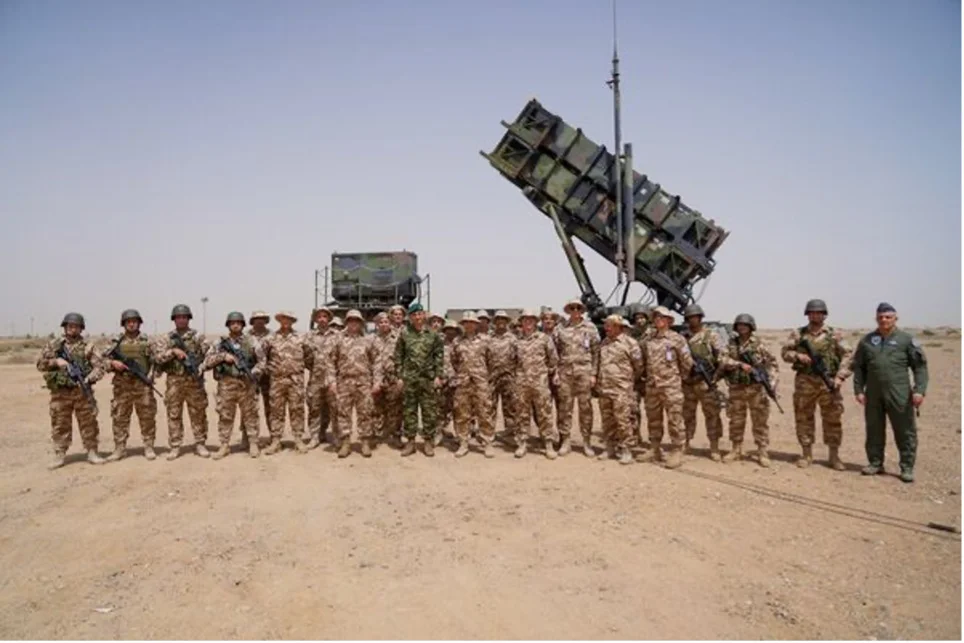
EU–Australia Deal
The EU–Australia free trade agreement, finalised on 24 March, is not just commercially significant—it is structurally tied to Europe’s security posture.
- €1 billion in annual savings for EU exporters, reinforcing industrial competitiveness
- ~99% of EU goods entering Australia duty-free, marking near-total market liberalisation
- €37 billion in EU exports to Australia (2025 baseline), highlighting the scale of the relationship
- +33% projected export growth over the next decade, indicating long-term expansion
- Duty-free access to critical minerals (lithium, cobalt, manganese), reducing dependence on China
- Access to public procurement across 27 EU states, deepening industrial integration
These figures underline that the agreement is less about trade volume than about resilience and strategic positioning. By securing access to critical raw materials and embedding itself more deeply in the Indo-Pacific economy, the EU is using trade policy to reduce structural dependencies and strengthen its long-term strategic autonomy.
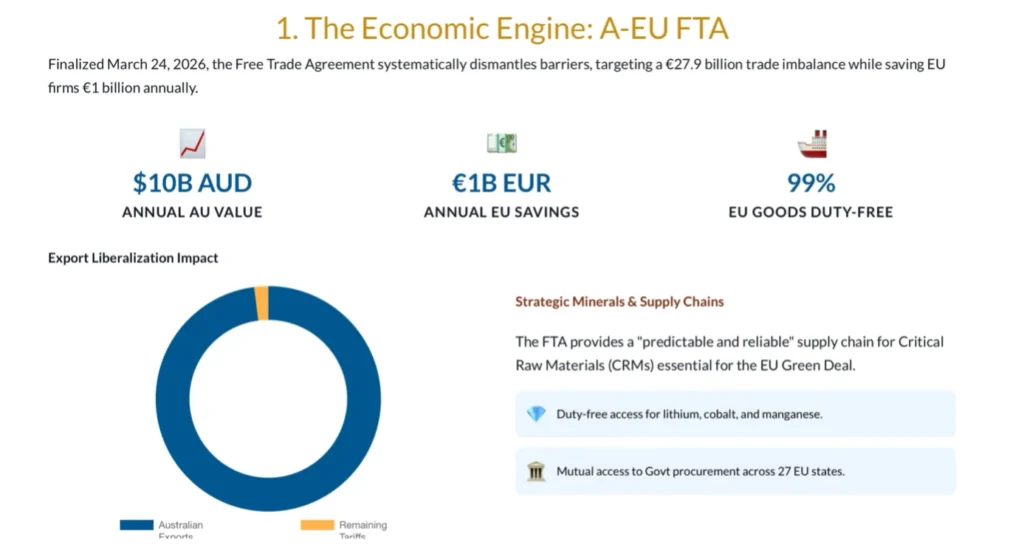
Iran’s Strike on Diego Garcia
This week’s map captures a sharp escalation in the geographic scope of the Iran war: Tehran’s attempted strike on the joint U.S.-UK base at Diego Garcia on 21 March. According to Reuters, Iran fired two ballistic missiles at the base in the Indian Ocean; one failed in flight and the other was intercepted, while ISW assessed the attack as the furthest attempted Iranian missile strike to date. The map’s central point is straightforward and uncomfortable: a conflict that many European governments still treat as regionally bounded has already extended into the wider Indian Ocean battlespace.
For European security, the significance lies less in physical damage than in demonstrated reach. Diego Garcia is not peripheral infrastructure; it is a core Anglo-American power-projection hub. An attempted strike there suggests Iran is willing to target Western military architecture well beyond the Gulf and Levant, raising the stakes for Britain even as London tries to limit its role to defensive support. More broadly, the map reinforces a harder point: once Iranian missile reach is shown at roughly 4,000 km, the war can no longer be analysed as a contained Middle Eastern crisis with only indirect consequences for Europe.
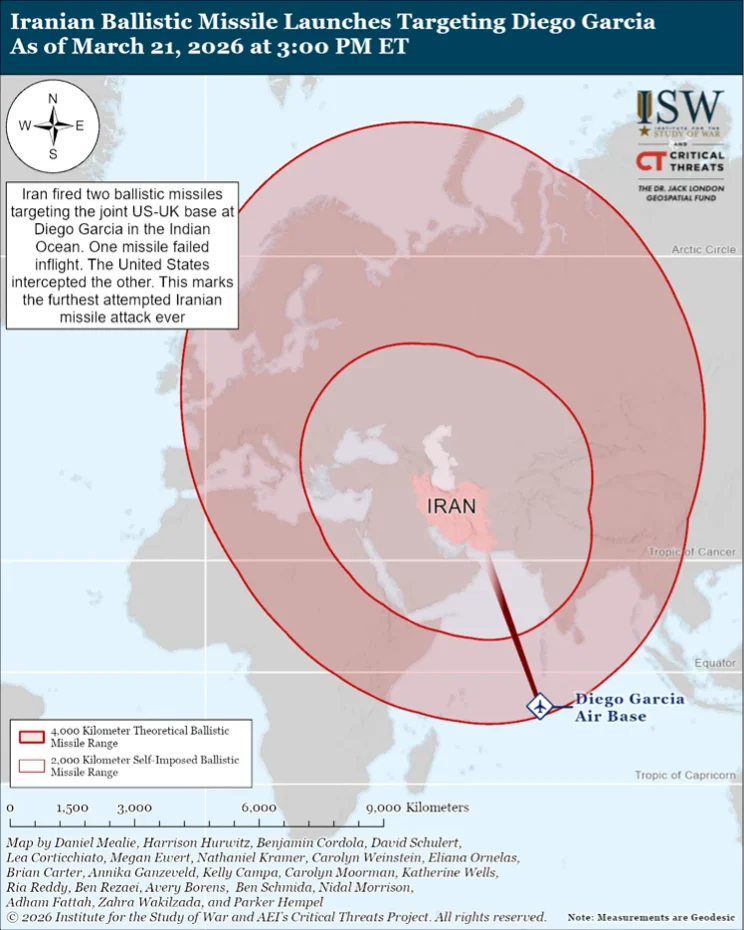
Greece’s Patriot Battery in Saudi Arabia
This week’s photo shows the Greek Patriot battery and personnel deployed in Saudi Arabia — an image Janes notes was originally released in May 2024, but one that acquired fresh relevance after the unit intercepted two Iranian ballistic missiles on 19 March 2026. Reuters and Janes both reported that the Greek-operated, U.S.-made Patriot system shot down missiles targeting Saudi oil infrastructure, marking the first known combat use of the Greek deployment since Athens sent it to the kingdom in 2021 under a bilateral agreement to help protect critical energy sites.
For European security, the significance is operational rather than symbolic. This is not a photo of abstract solidarity; it is a photo of a European air-defence asset already engaged in live combat outside Europe. That matters because it shows how the Iran war is drawing scarce European high-end capabilities into the protection of Gulf energy infrastructure, while the same class of systems remains urgently needed for deterrence on Europe’s own periphery. Greece can call the mission strictly defensive, and politically that is true, but strategically the point is harsher: Europe is already absorbing the military consequences of a widening southern crisis.
EU–Australia Trade Deal
This week’s infographic presents the EU–Australia free trade agreement as both an economic and strategic milestone, explicitly framed by leaders on both sides as a response to growing global uncertainty. As shown in the visual (pages 2–3), European Commission President Ursula von der Leyen emphasises the deal as “economically beneficial and strategically necessary,” while Australian Prime Minister Anthony Albanese describes it as “comprehensive, balanced and commercially meaningful.” The infographic (page 4) also highlights a critical point often lost in headline reporting: the agreement is not frictionless, but the result of political compromise—particularly in sensitive sectors like agriculture.
For European security, the significance lies in how explicitly the infographic links trade policy to strategic intent. This is not presented as a conventional market-opening agreement, but as part of a broader effort to align economic policy with security priorities—especially diversification and supply-chain resilience. The emphasis on “trusted partners” and “global uncertainty” reflects a shift in EU thinking: trade is no longer treated as separate from geopolitics. Instead, it is being used as a tool to reduce dependency risks and anchor Europe more firmly in the Indo-Pacific. The infographic therefore captures a broader transformation: Europe is operationalising geoeconomics as a component of its security strategy.
🇪🇺🤝🇦🇺 EU–Australia Trade Deal: Economic Breakthrough or Strategic Realignment?
After eight years of negotiations, the European Union and Australia have finalised a sweeping free trade agreement—eliminating tariffs on most goods and reshaping bilateral economic ties.
Leaders… pic.twitter.com/d8se8XuoyC
— Beyond the Horizon (@BehorizonOrg) March 24, 2026
Europe’s Indo-Pacific Hedge Under Pressure
Introduction
Europe’s response to the Iran war and its simultaneous push into the Indo-Pacific are not separate developments—they are two sides of the same strategic adjustment. Faced with a widening Middle Eastern conflict, uncertainty over U.S. leadership, and structural vulnerabilities in supply chains, the EU and key European states are pursuing a hedging strategy: maintaining alignment with Washington where necessary, while expanding partnerships in the Indo-Pacific to reduce long-term dependency. The result is a dual-track approach—reactive in the Gulf, but increasingly proactive beyond Europe’s traditional security perimeter.
A Calibrated Response to U.S. Pressure
Donald Trump’s request for allied support in securing the Strait of Hormuz exposed a familiar fault line in transatlantic politics. European states broadly agree on the importance of keeping the maritime chokepoint open, given its centrality to global energy flows. However, their response—expressed through carefully worded commitments to “appropriate efforts”—reveals a deliberate attempt to avoid full alignment with a U.S.-led military operation.
This is not simple reluctance or free-riding. Rather, it reflects a layered calculation. European governments are balancing three competing concerns: the need to stabilise energy markets, the risk of escalation in a conflict they did not initiate, and the political and legal constraints of joining a war lacking clear multilateral backing. The broader coalition that emerged—including partners such as Japan and South Korea—reinforces this pattern. It signals convergence around limited objectives (maritime security and market stabilisation) while stopping short of endorsing military escalation. In effect, Europe is engaging in selective alignment: supporting outcomes that protect its interests, without fully committing to the strategic logic driving U.S. policy. This approach preserves flexibility, but it also underscores the limits of allied cohesion under pressure.
Alliance Politics and the Limits of Cohesion
The Hormuz episode illustrates a deeper shift in alliance politics. NATO remains central to European security, but it is no longer the sole framework through which European states interpret threats or organise responses. The absence of a NATO mandate—and the explicit rejection by some European governments of framing the Iran conflict as “NATO’s war”—points to a fragmentation of strategic priorities.
At the same time, the inclusion of Indo-Pacific partners in the Hormuz statements suggests an emerging pattern: ad hoc coalitions built around specific functions rather than formal alliances. This is a more flexible, but also more ambiguous, model of cooperation. It allows Europe to engage with a broader set of partners, but it also dilutes the clarity and predictability traditionally associated with alliance commitments. Trump’s pressure therefore has a paradoxical effect. While intended to reinforce burden-sharing, it instead accelerates Europe’s search for strategic alternatives—both in terms of partnerships and in how it defines its own role in crisis management.
The Indo-Pacific Turn as Strategic Hedging
Against this backdrop, Europe’s intensified engagement with the Indo-Pacific appears less as expansion and more as hedging. Germany’s push for a defence access agreement with Japan and the EU’s trade and security agreements with Australia illustrate a deliberate effort to diversify both economic and security relationships.
The EU–Australia deal is particularly instructive. On the surface, it is a trade agreement. In practice, it serves multiple strategic functions: securing access to critical raw materials, embedding Europe in Indo-Pacific supply chains, and aligning with a politically reliable partner. The parallel security and defence partnership reinforces this logic, extending cooperation into areas such as maritime security, cyber defence and emerging technologies.
Germany’s outreach to Japan operates on a similar principle, but with a stronger military dimension. By enabling joint training, industrial cooperation and operational access, Berlin is signalling that European security interests are no longer geographically confined. Instead, they are increasingly linked to developments in the Indo-Pacific, particularly in areas such as maritime security and technological competition.
Conclusion: A Strategy of Managed Exposure
Europe’s current approach can best be understood as a strategy of managed exposure. In the Middle East, it seeks to limit its involvement while mitigating the risks of instability. In the Indo-Pacific, it is expanding its presence to reduce long-term vulnerabilities and diversify partnerships.
This hedging strategy is rational, but not without tension. It depends on maintaining a delicate balance: staying aligned enough with the United States to preserve transatlantic security, while building sufficient autonomy to navigate an increasingly unpredictable geopolitical landscape. The events of this week suggest that Europe is moving in that direction—but also that the space for such balancing is narrowing.
The underlying question is no longer whether Europe should engage beyond its neighbourhood, but whether it can do so without overstretching its political cohesion and limited military capabilities.