Germany & South Korea:
Economic Integration Meets Security Policy
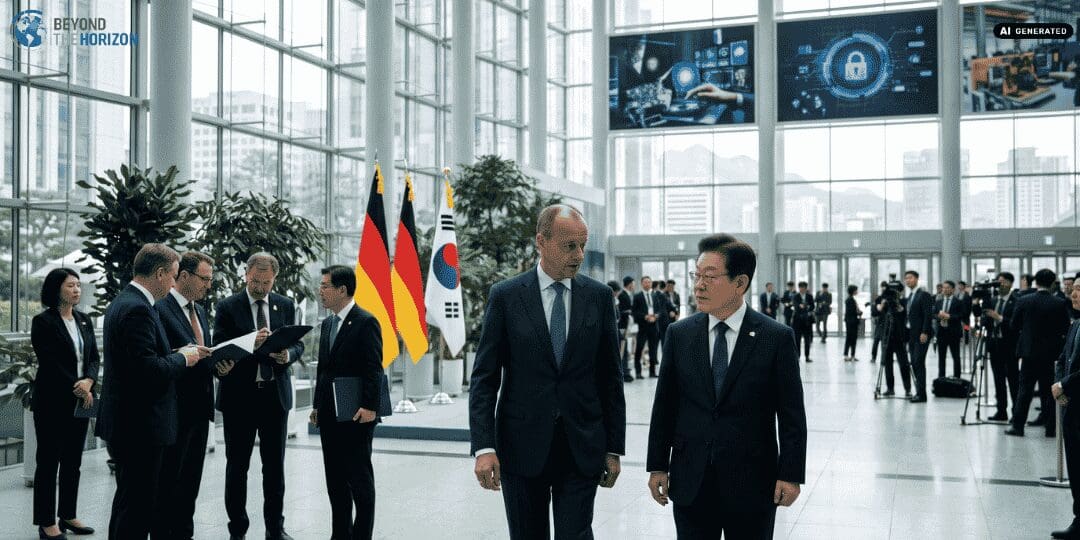
Chancellor Friedrich Merz and President Lee Jae-myung elevated bilateral ties to synchronize supply-chain resilience, defence industrial cooperation, and deterrent strategies against interconnected Eurasian and Indo-Pacific challenges.
Moving beyond conventional trade into the structural fusion of economic security with defence policy, tested by practical program delivery.
1. Foundational Economic & Societal Baseline
Auswärtiges Amt & YonhapGermany is South Korea’s largest trading partner in the entire European Union.
South Korea stands as Germany’s 3rd largest trade partner across all Asian nations.
German corporations operating facilities and subsidiaries across South Korea.
Korean workers employed directly by German enterprise investments.
2. The Geopolitical Imperative & Security Interdependence
Indivisible SecurityRussia–North Korea Military Collaboration as European-Korean Nexus
Chancellor Merz linked North Korean combat deployment in Ukraine and Russian advanced military technology transfers to Pyongyang as undeniable proof that European and Korean security theaters are now structurally interconnected.
North Korean troops and artillery sustain Russia's war in Ukraine; in return, Russian missile, satellite, and naval technology flows back to Pyongyang.
War-fighting capabilities refined on European battlefields directly upgrade threats aimed at the DMZ and Seoul, mandating close intelligence integration.
Institutionalized defence-ministry talks, military training exchanges, and pending pact on protecting classified military information.
3. High-Tech & Industrial Framework
Critical Supply ChainsCombining Korean advanced fabrication and memory chips with German optics, chemicals, and industrial precision machinery.
Diversifying critical raw material supply chains (lithium, nickel, rare earths) away from monopolistic processing hubs.
Joint technological research programs, quantum cryptography applications, and trusted standards for frontier artificial intelligence.
Renewed bilateral energy partnership in clean hydrogen and offshore wind; signed protocol amending the double-taxation agreement.
Strategic Priority Allocation
Summit Agenda FocusRelative weighting of bilateral initiatives across technology, defence, and commercial diplomacy.
US Tariffs & Chinese Industrial Expansion
The summit occurred against the twin headwinds of potential US protectionist tariff policies and China’s state-subsidized manufacturing surge. Both Germany and South Korea view closer bilateral coordination as a vehicle to:
- Diversify Markets: Reduce disproportionate export vulnerability to both superpower rivals.
- Defend Multilateral Rules: Preserve collective influence over international high-tech standards.
President Lee’s Request: EU Parity Under IAA
President Lee requested German endorsement for South Korea to receive treatment equivalent to EU member states under the emerging Industrial Accelerator Act (IAA) initiative.
Convert strategic rhetoric into unhindered market access and subsidy qualification within the EU.
Germany cannot unilaterally alter EU Single Market directives or displace domestic European manufacturers.
4. Implementation Scorecard: Observable Delivery Metrics
Future Assessment BenchmarksMust be finalized to establish the essential legal prerequisite for sharing classified defence intelligence and sensitive operational data.
Requires shifting high-level declarations in quantum, AI, and semiconductors into dedicated, appropriated co-funding budgets.
Moving beyond non-binding expressions of interest to establish actual defense consortia, co-production, or procurement contracts.
Whether political elevation secures genuine commercial parity under European industrial and green transition subsidy frameworks.