
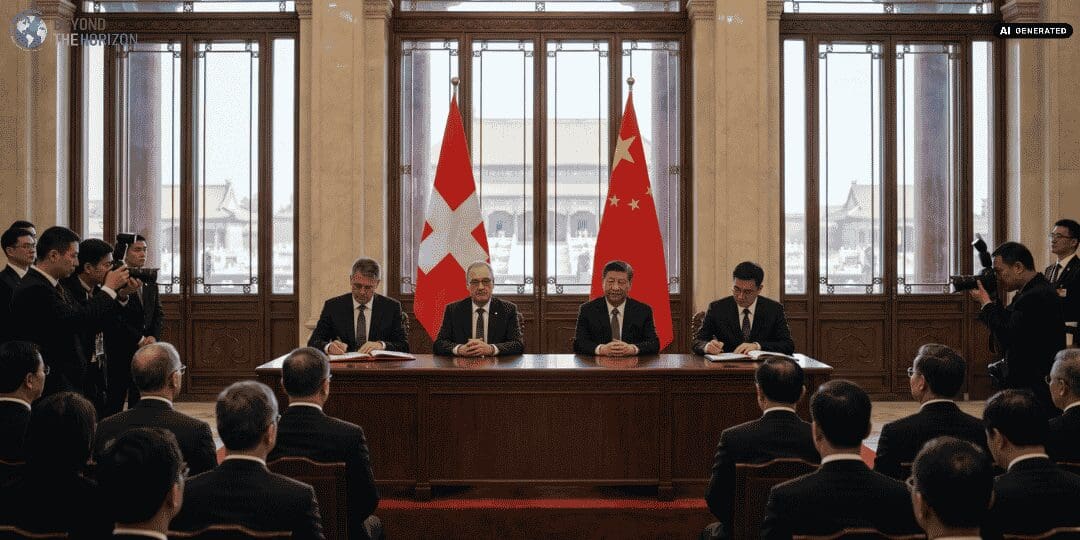
Implications of Swiss President Guy Parmelin’s October 2026 visit to Xi Jinping in Beijing
Coinciding with the 10th anniversary of the 2016 Innovative Strategic Partnership, the Beijing summit yielded an upgraded Free Trade Agreement alongside pacts on scientific data and labour. It underscores a shared willingness to deepen regulated commerce despite enduring political and security friction.
“China–Switzerland relations are becoming commercially deeper and more formally regulated while political and security differences continue to constrain trust.”
Prospective coverage under the upgraded FTA, pending Swiss domestic approval.
Provides Bern a strong commercial incentive to preserve market access.
Anniversary of the Innovative Strategic Partnership (diplomatic ties since 1950).
New scientific-data rules clarify export sensitivity so bilateral calls can restart.
Three Agreements Signed in Beijing (30 October 2026)
Interactive comparison of pre-2026 and post-2026 bilateral frameworks.
Upgraded Free Trade Agreement
Expands duty-free access for current Swiss exports to China from roughly half to 99.8%. Broadens rules on investment access, services, digital trade, and trade facilitation.
Scientific Data Agreement
Resolves the uncertainty that forced the Swiss National Science Foundation (SNSF) to suspend bilateral calls in 2021. Mandates upfront clarity on sensitive Chinese data classifications.
Labour & Sustainability
Accompanies the FTA with a standalone agreement on labour and employment, plus a legally binding chapter on trade and sustainable development inside the upgraded FTA.
FTA Evolution: 2014 Original vs. 2026 Upgrade
Analytical Caveat: Diversification vs. Exposure
While Bern’s stated objective is to diversify export markets across Asia, broader Chinese tariff relief could still lead individual Swiss firms to increase their commercial exposure to China. Furthermore, benefits remain prospective until Swiss domestic approval and implementation are complete.
How the Scientific-Data Pact Works
Leaves Chinese data restrictions intact, but introduces mandatory transparency so Swiss researchers are not trapped mid-project.
76 Years of Bilateral Ties (1950–2026)
Select a milestone below to inspect its significance in the bilateral trajectory.
Strategic Meaning & Political Limits: Beijing vs. Bern
Beijing’s Strategic Calculus
Beijing assigns the Swiss relationship wider European significance, presenting the FTA upgrade as a model of openness against protectionism.
Xi encouraged Switzerland to contribute positively to broader China–Europe economic relations and champion free trade.
Emphasised expanding cooperation in artificial intelligence (AI), digital cooperation, and energy storage.
These reflect Chinese priorities expressed in the meeting, rather than evidence that Switzerland has accepted a broader Chinese geopolitical agenda.
Bern’s Strategic Calculus
Bern’s Asia G20 Strategy (2025–28) situates China within a wider effort to diversify partnerships across Asia and preserve economic options.
Securing tariff parity and investment access in Switzerland’s third-largest market after the EU and United States.
Parmelin stressed the link between European and East Asian security, recognising that commerce remains exposed to geopolitical disruption.
The visit functions as a pragmatic exercise in preserving economic options while maintaining explicit security and political boundaries.
19th Bilateral Human Rights Dialogue
Held immediately prior to the summit (19–20 October), Switzerland raised concerns regarding Tibetan and Uyghur populations, Hong Kong, and minority rights. Continued dialogue preserves a formal channel for criticism, though its existence alone establishes no improvement in on-the-ground conditions.
Espionage & Knowledge-Security Risks
Switzerland’s official strategy identifies espionage risks to the country’s scientific and economic assets. As bilateral research cooperation resumes and expands under the new data agreement, institutional safeguards remain critical.
Outlook: The Next Three Implementation Tests
Signature strengthens institutional foundations, but practical delivery depends on three post-summit tests.
Domestic Approval & FTA Implementation
The 99.8% duty-free coverage and expanded services/investment rules are prospective until Switzerland completes domestic parliamentary approval and bilateral implementation.
Effective Research-Data Access
Whether upfront sensitivity disclosures work smoothly in practice as the SNSF resumes bilateral project calls, while safeguarding Swiss scientific assets against espionage risks.
Credible Labour & Environment Application
Practical operation and verification of the legally binding chapter on trade and sustainable development alongside the bilateral labour and employment agreement.