
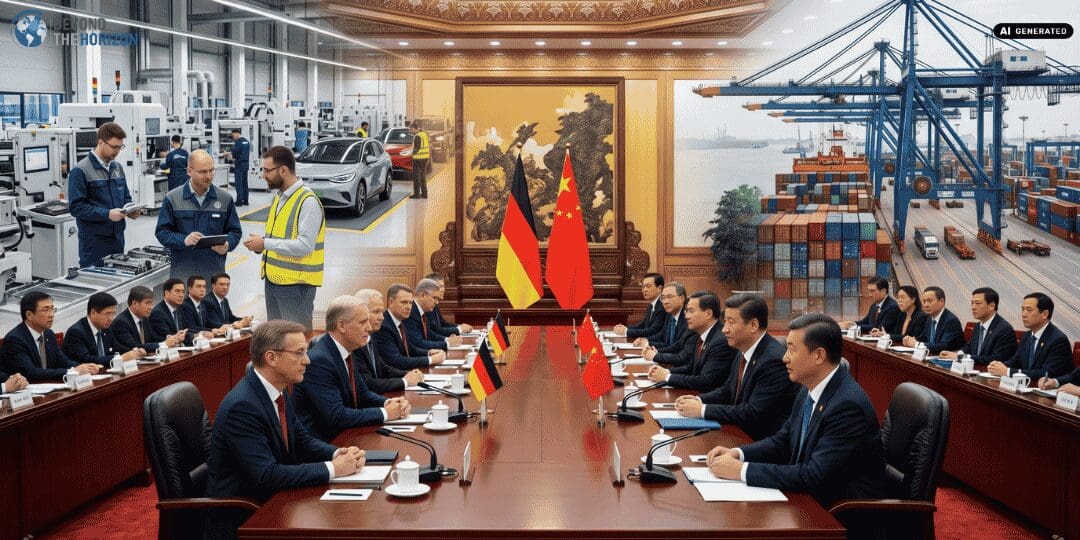
The Balancing Act of Engagement & De-Risking
Germany is seeking to preserve vital economic cooperation with China while reducing exposure to unequal market access and strategic dependencies. Federal President Frank-Walter Steinmeier’s October 2026 state visit illustrates the structural difficulty of pursuing both objectives simultaneously.
“Both governments favour cooperation while disagreeing over the economic and political conditions needed to sustain it.”
Why Complete Withdrawal Is Not an Option — Yet Exposure Carries Risk
Preserve Industrial & Tech Cooperation
At Volkswagen’s development centre in Hefei (27 Oct), Steinmeier encouraged technological cooperation and noted that innovations developed in China could benefit Germany and Europe.
Reduce Strategic Vulnerabilities
At Peking University (29 Oct), Steinmeier challenged restrictions on European market access, warned against self-sufficiency policies that heighten others’ vulnerability, and criticised raw-material export constraints.
An Increasingly Uneven Economic Relationship
Destatis bilateral goods trade figures for January–May 2026 (Year-on-Year % change)
Bilateral Goods Trade Shift (Jan–May 2026 YoY)
Source: Destatis [3]Why the €42.8B Deficit Is Only the Surface Signal
While the 14.5% export drop and €42.8 billion deficit explain Berlin’s concern, a bilateral deficit alone does not demonstrate unfair competition.
Discriminatory Access: Are European firms facing structural barriers inside China’s market?
Industrial Subsidies: Do state subsidies distort competition across strategic sectors?
Irreplaceable Inputs: How vulnerable is industry to raw-material export constraints?
Steinmeier in China & Merz in the Indo-Pacific
Select a date below to inspect the venue, message, and analytical takeaway.
Track A: President Frank-Walter Steinmeier’s State Visit to China
Chancellor Friedrich Merz’s Parallel Asian Tour
Steinmeier’s visit coincides directly with Chancellor Merz’s travel to Singapore, Japan, and South Korea. Read together, these journeys show Germany pursuing broader Asian partnerships while preserving access to Beijing.
Southeast Asian trade, finance & supply-chain diversification hub.
G7 economic security partner & high-tech industrial alignment.
Critical semiconductors, batteries & resilient industrial networks.
The Russia–Ukraine Factor in Germany’s China Policy
European security directly shapes the bilateral relationship. On 29 October, Steinmeier urged Beijing to use its close ties with Moscow to help end Russia’s attacks and advance serious negotiations.
Same Word (“Cooperation”), Different Conditions
Both capitals favour cooperation, yet disagree over the economic and political conditions required to sustain it.
- Enduring trade on more reciprocal terms
- Removal of market access restrictions
- Predictable critical raw-material supplies
- Constructive pressure on Moscow
- Strengthening mutual political trust
- Expanding technological innovation ties
- Advancing wider China–Europe relations
- Pursuing domestic self-sufficiency goals
Federal President Steinmeier can communicate political expectations, but executive policy rests with the federal government. Sustained policy and commercial decisions must extend well beyond a presidential visit.
Why Diplomatic Warmth Alone Is Insufficient
The visit’s significance should be judged cautiously. Diplomatic warmth will matter only if followed by concrete movement across three observable benchmarks:
Improved Market Access
Reductions in discriminatory barriers facing German and European companies inside China.
Predictable Critical Inputs
Reliable supplies of raw materials paired with German investment in alternative suppliers and domestic capabilities.
European Security Movement
Observable Chinese actions affecting Russia’s ability or incentives to continue the war against Ukraine.