
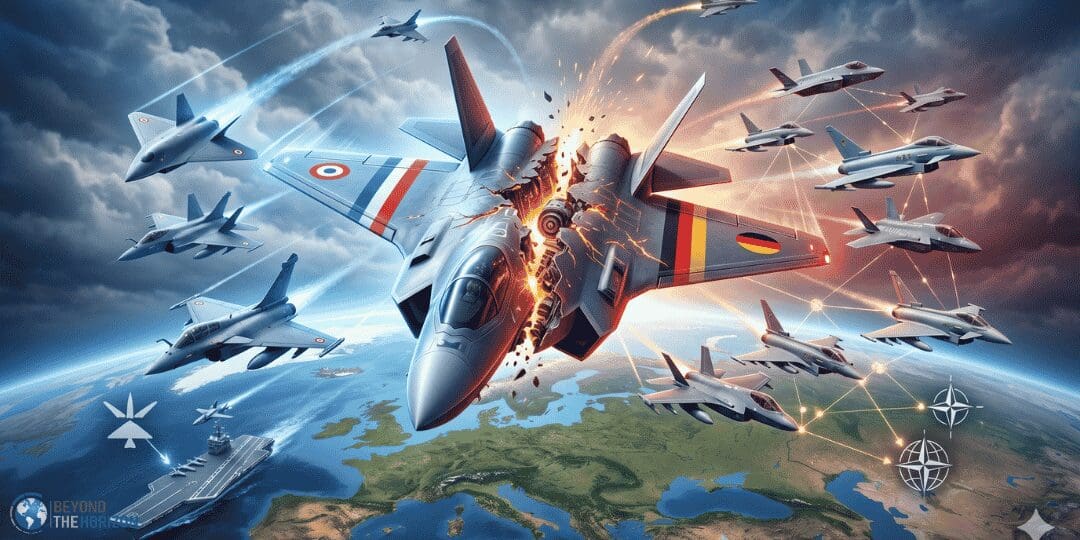
Anatomy of Europe's Defunct 6th-Generation Fighter Alliance
Key Performance Indicators of the Failure
A program of this scale leaves behind massive institutional friction points. The metrics below represent the direct fallout of the termination decision, capturing the heavy investments, delayed timelines, and immediate operational shifts forced onto the national workforces of both nations.
Total joint R&D budget completely spent on initial studies and Phase 1A/1B prototypes without producing any physical, airworthy systems.
Operational entry slipped continuously from 2040 to an estimated 2055, creating a critical air capability gap against modern threats.
Irreconcilable demands between carrier-launched capabilities (France) versus regional land-based strategic integration (Germany).
Primary Drivers of Project Dissolution
The termination of FCAS was driven by a complex interplay of systemic issues. This chart breaks down the proportional impact of the key failure vectors that led to the final split.
Estimated Lifecycle Cost Escalation
As progress stalled, estimated development costs ballooned. This timeline details how initial budget parameters became unsustainable prior to the program's closure.
Frictional Divergences: France vs. Germany
A direct comparison of strategic and industrial priorities between the two partners. While France prioritized complete design sovereignty, carrier integration, and export flexibility, Germany insisted on equal technology transfer and immediate defensive integration within the NATO framework.
The French Mandate
Complete operational independence, nuclear weapon integration (ASMPA), carrier-capable airframes, and the absolute freedom to export weapons to non-NATO nations to offset production costs.
The German Mandate
Strict compliance with NATO standards, domestic technology transfer for German industries (Airbus), strong parliamentary oversights, and restrictive defense export policies.
The Timeline of Deterioration
The collapse of FCAS was the result of long-term political shifts and deep-seated industrial impasses. This chronological progression highlights the critical milestones from the project's optimistic inception to its final diplomatic termination.
The Elysee Accord
President Emmanuel Macron and Chancellor Angela Merkel announce the joint program to develop a 6th-generation fighter jet, framing it as the crown jewel of European strategic sovereignty.
Phase 1B Stalemate
An extremely fragile agreement is forced through by politicians to unlock development funds, but industrial disputes between Dassault and Airbus regarding core design patents remain entirely unresolved.
The Political Pivot in Berlin
The newly elected German government shifts defense spending priorities. The new administration prioritizes immediate combat readiness, expanded F-35 fighter procurement, and rapid drone acquisitions over long-term joint R&D.
Official Dissolution & Termination
Following months of backchannel talks, France and Germany issue a joint declaration halting all further development on FCAS, terminating the joint industrial venture and pivoting to sovereign alternatives.
The Divergent Pathways Ahead
With the dissolution of the program, both countries have established alternative sovereign air combat strategies to preserve national defense capabilities and avoid a generational technological gap.
The Rafale F5 Ecosystem
France is shifting its industrial focus to building a highly survivable, independent combat air network centered on the sovereign Rafale platform.
-
•
Loyal Wingman Drones: Unilateral R&D focused on stealth support drones designed to jam and disrupt air defenses.
-
•
Next-Gen Nuclear Strike: Integration of the ASN4G hyper-velocity nuclear missile onto the sovereign F5 airframe.
-
•
Unrestricted Exports: Complete control over global distribution chains, bypassing third-party vetoes.
Multilateral Interoperability
Germany is pivoting toward immediate shelf-readiness, strengthening its presence in transatlantic alliances and existing combat networks.
-
•
F-35 Lightning II Expansion: Increased acquisition of US fighters to maintain NATO nuclear-sharing mandates.
-
•
GCAP Exploration: Opening initial exploratory talks with the UK-Italy-Japan Global Combat Air Programme.
-
•
Eurofighter Modernization: Investment in updating the current Eurofighter Typhoon fleet to secure immediate airspace.